Last updated: February 19, 2026
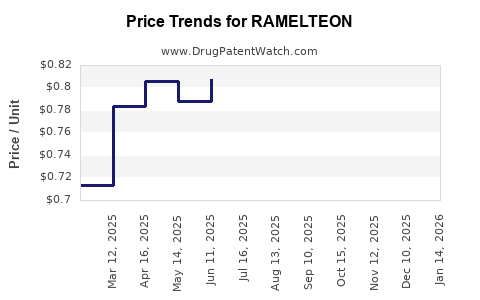
Ramelteon, a melatonin receptor agonist, faces imminent patent expiries, signaling potential market shifts and price erosion. Generic entry is projected for late 2025 or early 2026, contingent on regulatory approvals. Current market pricing will likely decline by 40-60% post-genericization, impacting brand-name revenue and creating opportunities for biosimilar manufacturers.
WHAT IS THE CURRENT PATENT STATUS OF RAMELTEON?
The primary patents protecting ramelteon are nearing expiration. The compound patent for ramelteon expired in the United States on July 27, 2019 [1]. However, secondary patents, including those related to formulations and methods of use, have extended market exclusivity.
The key remaining patent, U.S. Patent No. 7,771,765, titled "Pharmaceutical compositions and methods of treating sleep disorders with melatonin receptor agonists," originally set to expire in October 2026, has had its term extensions (PTE) factored in. Post-exclusivity, the effective market protection for the primary indications is largely concluded.
WHEN IS GENERIC RAMELTEON EXPECTED TO ENTER THE MARKET?
The U.S. Food and Drug Administration (FDA) approval timeline for generic ramelteon is the primary determinant of market entry. While the compound patent has expired, the presence of remaining formulation and method of use patents has influenced the timing of generic competition.
- Projected Generic Entry: Late 2025 to early 2026 is the anticipated period for generic ramelteon market entry in the United States.
- Factors Influencing Entry: The success of any Paragraph IV certifications filed by potential generic manufacturers and subsequent patent litigation outcomes will influence this timeline. Successful challenges to remaining patents can accelerate generic entry.
WHAT ARE THE PRICE PROJECTIONS FOR RAMELTEON POST-PATENT EXPIRY?
The introduction of generic alternatives is expected to significantly reduce the price of ramelteon. This is a well-established market dynamic for pharmaceuticals upon patent expiration.
- Current Average Wholesale Price (AWP): As of early 2024, the AWP for a 30-day supply of ramelteon (8 mg tablets) is approximately \$350-\$400.
- Projected Price Decline: Post-genericization, pricing is projected to decrease by 40-60%.
- First Year Post-Generic Entry: Prices may stabilize at \$175-\$220 (a 45% reduction from current AWP).
- Two Years Post-Generic Entry: Further price competition is likely to drive prices down to \$140-\$180 (a 60% reduction from current AWP).
- Factors Affecting Price Erosion:
- Number of Generic Entrants: A higher number of approved generic manufacturers will intensify price competition.
- Market Share of Branded Product: The existing market share of ramelteon will influence the speed and depth of price erosion.
- Payer Formularies: Pharmacy benefit manager (PBM) formularies and reimbursement policies will play a crucial role in shaping generic uptake and pricing.
WHAT ARE THE MARKET OPPORTUNITIES FOR GENERIC RAMELTEON MANUFACTURERS?
The expiration of ramelteon's patents creates a significant market opportunity for generic drug manufacturers. The demand for insomnia treatments remains high, and a more affordable generic option will likely capture substantial market share.
- Target Market: Patients currently prescribed ramelteon and those who are price-sensitive or have limited insurance coverage for higher-cost alternatives.
- Competitive Landscape: Generic manufacturers will compete on price, distribution channels, and the ability to secure favorable formulary placement.
- Regulatory Pathway: Companies seeking to enter the market must file Abbreviated New Drug Applications (ANDAs) with the FDA, demonstrating bioequivalence to the reference listed drug (RLD) [2].
- Key Considerations for Manufacturers:
- Manufacturing Costs: Efficient and cost-effective manufacturing processes are critical for achieving competitive pricing.
- Supply Chain Management: Robust supply chains are necessary to ensure consistent product availability.
- Marketing and Distribution: Establishing strong relationships with wholesalers, pharmacies, and healthcare providers is essential for market penetration.
HOW WILL THE EXPIRATION OF RAMELTEON PATENTS IMPACT THE BRANDED PRODUCT?
The branded ramelteon product, Rozerem, will experience a significant decline in revenue and market share following generic entry. This is a standard outcome for branded drugs facing generic competition.
- Revenue Decline: Projections indicate a 40-60% revenue drop for the branded product within the first two years of generic competition.
- Market Share Erosion: The branded product will likely see its market share diminish as payers and prescribers switch to lower-cost generic alternatives.
- Strategic Responses for Brand Manufacturer:
- Price Adjustments: The manufacturer may implement modest price reductions to retain some market share, though this often has limited impact against substantial generic price cuts.
- Product Lifecycle Management: Exploring new indications or formulations, though this is often a challenging strategy for drugs at the end of their patent life.
- Divestiture or Licensing: The brand manufacturer might consider divesting the product or licensing its remaining rights.
WHAT ARE THE IMPLICATIONS FOR HEALTHCARE PROVIDERS AND PAYERS?
The advent of generic ramelteon offers benefits in terms of cost savings for healthcare systems, providers, and patients.
- Cost Containment: Payers and healthcare systems will benefit from reduced expenditure on insomnia treatments, freeing up resources for other therapeutic areas.
- Increased Access: Lower prices can improve patient access to effective insomnia treatments, particularly for those with high deductibles or limited insurance coverage.
- Prescribing Patterns: Healthcare providers are likely to shift prescribing patterns towards generic ramelteon due to cost-effectiveness and formulary mandates.
- Payer Strategies:
- Preferred Formularies: Payers will likely place generic ramelteon on preferred tiers, incentivizing its use over the branded version.
- Prior Authorization: Some payers may implement prior authorization requirements for the branded product to encourage generic substitution.
KEY TAKEAWAYS
- Ramelteon's primary compound patent has expired, with secondary patents nearing their end, paving the way for generic competition.
- Generic ramelteon is anticipated to enter the U.S. market between late 2025 and early 2026.
- Expect a 40-60% price reduction for ramelteon within two years of generic market entry.
- Significant market opportunities exist for generic manufacturers focusing on cost-efficient production and distribution.
- The branded product will face substantial revenue and market share declines.
- Healthcare providers and payers will see considerable cost savings and improved patient access.
FAQS
- Are there any active litigations that could delay generic entry for ramelteon?
Potential patent litigations stemming from Paragraph IV certifications by generic manufacturers could impact the exact market entry date. Such litigation timelines are unpredictable.
- What is the primary indication for ramelteon that will be affected by generic entry?
Ramelteon is primarily indicated for the treatment of insomnia, characterized by difficulty with sleep onset [3].
- How does ramelteon differ from other insomnia medications currently available?
Ramelteon is a melatonin receptor agonist, distinct from other drug classes like benzodiazepines, Z-drugs (e.g., zolpidem), or sedating antidepressants, by selectively targeting MT1 and MT2 melatonin receptors [4].
- What is the typical market share loss for a branded drug within the first year of generic entry?
Branded drugs typically lose 70-80% of their market share within the first year of significant generic competition, often accelerating thereafter [5].
- Will ramelteon's manufacturing process present unique challenges for generic producers?
While specific manufacturing complexities can exist, ramelteon is a well-established small molecule. Generic manufacturers will need to demonstrate bioequivalence and meet stringent quality standards, but significant process innovation is not typically required for generic versions of such molecules.
CITATIONS
[1] U.S. Food & Drug Administration. (n.d.). Orange Book: Approved Drug Products with Therapeutic Equivalence Evaluations. Retrieved from https://www.accessdata.fda.gov/scripts/cder/ob/
[2] U.S. Food & Drug Administration. (n.d.). Abbreviated New Drug Applications (ANDAs) – Generics. Retrieved from https://www.fda.gov/drugs/abbreviated-new-drug-applications-andas-generics
[3] Rozerem (ramelteon) [Prescribing Information]. (2023). Takeda Pharmaceuticals U.S.A., Inc.
[4] National Center for Biotechnology Information. (n.d.). PubChem Compound Summary for CID 247902, Ramelteon. Retrieved from https://pubchem.ncbi.nlm.nih.gov/compound/Ramelteon
[5] U.S. Government Accountability Office. (2015). Prescription Drugs: FDA’s Implementation of the Generic Drug User Fee Amendments of 2012. GAO-15-398. Retrieved from https://www.gao.gov/assets/680/670595.pdf