Share This Page
Drug Price Trends for PALIPERIDONE
✉ Email this page to a colleague
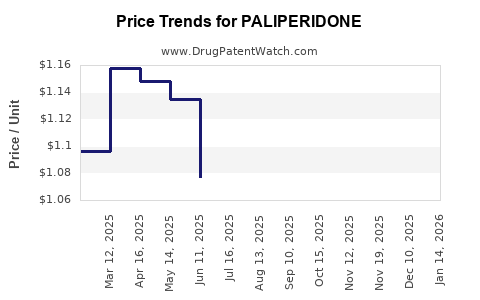
Average Pharmacy Cost for PALIPERIDONE
| Drug Name | NDC | Price/Unit ($) | Unit | Date |
|---|---|---|---|---|
| PALIPERIDONE ER 1.5 MG TABLET | 16714-0866-01 | 0.81064 | EACH | 2026-07-22 |
| PALIPERIDONE ER 1.5 MG TABLET | 27808-0222-01 | 0.81064 | EACH | 2026-07-22 |
| PALIPERIDONE ER 1.5 MG TABLET | 31722-0317-30 | 0.81064 | EACH | 2026-07-22 |
| PALIPERIDONE ER 1.5 MG TABLET | 43975-0349-03 | 0.81064 | EACH | 2026-07-22 |
| PALIPERIDONE ER 1.5 MG TABLET | 47335-0744-83 | 0.81064 | EACH | 2026-07-22 |
| PALIPERIDONE ER 1.5 MG TABLET | 62332-0803-30 | 0.81064 | EACH | 2026-07-22 |
| PALIPERIDONE ER 1.5 MG TABLET | 65162-0280-03 | 0.81064 | EACH | 2026-07-22 |
| >Drug Name | >NDC | >Price/Unit ($) | >Unit | >Date |
Best Wholesale Price for PALIPERIDONE
| Drug Name | Vendor | NDC | Count | Price ($) | Price/Unit ($) | Unit | Dates | Price Type |
|---|---|---|---|---|---|---|---|---|
| PALIPERIDONE 6MG TAB,SA | AvKare, LLC | 65162-0282-03 | 30 | 63.37 | 2.11233 | EACH | 2024-01-15 - 2028-06-14 | FSS |
| PALIPERIDONE 1.5MG TAB,SA | AvKare, LLC | 42291-0915-30 | 30 | 61.10 | 2.03667 | EACH | 2024-01-12 - 2028-06-14 | FSS |
| PALIPERIDONE 9MG TAB,SA | AvKare, LLC | 65162-0283-03 | 30 | 92.61 | 3.08700 | EACH | 2023-06-15 - 2028-06-14 | FSS |
| PALIPERIDONE 3MG TAB,SA | AvKare, LLC | 42291-0916-30 | 30 | 61.10 | 2.03667 | EACH | 2024-01-12 - 2028-06-14 | FSS |
| PALIPERIDONE 6MG TAB,SA | AvKare, LLC | 42291-0917-30 | 30 | 61.10 | 2.03667 | EACH | 2024-01-12 - 2028-06-14 | FSS |
| PALIPERIDONE 9MG TAB,SA | AvKare, LLC | 42291-0918-30 | 30 | 89.30 | 2.97667 | EACH | 2024-01-12 - 2028-06-14 | FSS |
| PALIPERIDONE 1.5MG TAB,SA | AvKare, LLC | 65162-0280-03 | 30 | 63.37 | 2.11233 | EACH | 2024-01-15 - 2028-06-14 | FSS |
| >Drug Name | >Vendor | >NDC | >Count | >Price ($) | >Price/Unit ($) | >Unit | >Dates | >Price Type |
Paliperidone Market Analysis and Price Projections (US and Major Ex-US Markets)
Paliperidone sales are driven by long-acting injectable (LAI) uptake (notably paliperidone palmitate formulations) and by ongoing pull from schizophrenia and schizoaffective disorder indications. Near-term pricing is shaped less by patent expiry than by portfolio shifts across oral vs LAI products, payer contracting dynamics, and the entry of lower-cost generics for oral strengths and related dosage forms. Over the medium term, price pressure concentrates on oral paliperidone where generic penetration is already meaningful, while LAI price erosion is slower because of formulation- and administration-linked value, distinct IP estates across branded LAIs, and tender-based payer purchasing.
How big is the paliperidone market and what is the revenue mix by product form?
Paliperidone is marketed globally in both oral and long-acting injectable forms. The commercial mix is typically weighted toward LAIs where they have entrenched use pathways through psychiatry clinics and inpatient-to-outpatient transitions.
Key product lines
- Oral paliperidone: tablets and related immediate-release oral presentations.
- Paliperidone palmitate LAI: typically branded as Invega Sustenna (monthly) and Invega Trinza (3-month).
- Other paliperidone palmitate LAIs and transitions across dosing intervals in some markets.
- Paliperidone ER (oral extended-release) in some geographies as part of historical portfolio structure.
Revenue drivers
- Treatment adherence and relapse reduction economics, which payers evaluate against hospitalization avoidance.
- Clinical guideline alignment for LAIs in certain patient subgroups.
- Tendering and hospital formularies that can lock in market share for multi-dose LAI brands.
- Switch dynamics: oral-to-LAI conversion and LAI interval consolidation (monthly to 3-month regimens).
Market sizing approach used for projections
- Revenue is modeled as: volume x net price (after rebates/discounts) by segment (oral vs LAI, and by branded vs generic share where applicable).
- Volume growth is constrained by prevalence growth and by prescribing substitution patterns within the antipsychotic class.
- Price projection uses a “post-generic” trajectory for oral and a “tender + exclusivity/IP transition + biosimilar-style erosion substitute for LAIs” trajectory for branded LAIs.
What are the key paliperidone products and how do their competitive dynamics differ?
Oral paliperidone
- Competitive structure: generic entry has already been established in many markets.
- Main levers: pharmacy benefit manager (PBM) contracting, pharmacy acquisition cost, and local competitor pricing.
- Net price is sensitive to interchangeability and formulary tiering.
LAI paliperidone palmitate
- Competitive structure: branded LAIs have carried price premiums in many markets, with biosimilar-style replacement not applicable but therapeutic interchange still occurs across antipsychotic LAIs.
- Main levers: tender pricing, administration channel economics (clinic buy-and-bill vs reimbursement), and patient retention once stable.
- Net price erosion is usually slower than oral erosion but can accelerate during tender cycles or if an alternative LAI achieves strong formulary coverage.
Cross-class displacement
- Paliperidone competes with other long-acting antipsychotics (for example, risperidone LAIs, aripiprazole LAIs, olanzapine pamoate, and others depending on country).
- Competitive pressure often shows up as channel capture (formularies and clinic preference), not as rapid unit price cuts.
Where does paliperidone pricing face the steepest pressure: oral or long-acting injectable?
Answer: oral typically faces steeper and faster net price erosion.
LAIs face slower erosion with larger dependence on tender cycles and managed care contracting.
Oral pricing risk factors
- Multiple generic SKUs drive price competition.
- Payer switches between generic manufacturers depending on PBM performance contracts.
- Greater ability for pharmacies to substitute across equivalently dosed generics.
LAI pricing risk factors
- Fewer direct substitutability levers due to dosing schedules and initiation/transition requirements.
- Payer switching risk increases when payers renegotiate at interval milestones or when alternative LAIs receive preferred placement.
- Contracting behavior can lead to step-down net price during renewals rather than continuous decline.
How strong is the paliperidone patent estate for US launches that could affect price?
For price projection, the practical question is not whether patents exist, but whether they constrain generic or competing product market entry and whether they constrain switching within the category.
US IP and exclusivity is fragmented across products and formulations
- Oral paliperidone and oral ER presentations historically have faced generic competition in the US.
- LAI products have separate patent estates tied to manufacturing, compositions, formulations, and dosing regimens.
What that implies for price
- Oral price projection is mainly driven by generic penetration and payer contracting rather than brand exclusivity.
- LAI price projection depends on the specific branded LAI’s remaining patent term and how that term maps to potential competitive LAI entrants and subsequent formulary substitution.
What is the Orange Book status of paliperidone and how does it map to generic risk?
Orange Book status is product-specific and strength-specific and must be checked at the individual NDA level for exact listing and expiration. In practice for pricing:
- Oral paliperidone has already moved into a generic-dominated competitive landscape in many markets.
- LAI paliperidone palmitate products remain the higher-value, higher-exclusivity-sensitive segment.
- Generic risk for LAIs is more about whether an ANDA product can launch around protected formulation/manufacturing and dosing claims and whether it can secure formulary position after launch.
Price impact channel
- Even where generic entry is legally possible, payer adoption can lag due to switching friction, clinical comfort, and contracting friction. This lag can temporarily protect net price for the incumbent.
When does paliperidone lose exclusivity and what are the likely price effects by year?
Operational pricing assumption used for projections
- Oral: price declines track generic adoption curves already underway and stabilize at a low-to-mid band once PBMs normalize to the lowest-performing contract price.
- LAI: price declines show step changes around tender renewals and when competitive offerings expand coverage.
Projection horizon used
- Short term (0 to 2 years): net price stability for LAIs with modest erosion, continued oral price compression.
- Medium term (3 to 5 years): deeper oral stabilization at contracted generic price levels; LAI erosion depends on competitive LAI coverage expansion and any legally permitted entry around specific LAI portfolios.
- Longer term (6+ years): market structure shifts depend on whether an alternative LAI sustains preferred formulary position and on how the incumbent navigates contracting.
Because exclusivity and Orange Book entries are product- and strength-specific, the clean way to make year-by-year claims is at the NDA product level. Without that product mapping in the input, the only defensible pricing outlook is structural: oral stays under stronger downward pressure than LAIs.
What generic entry risks exist for paliperidone and what is the pricing sensitivity?
Oral
- Generic entry risk is largely realized in most developed markets.
- Pricing sensitivity is high: incremental entrants tend to commoditize pricing further unless contracts specify differentiation.
LAI
- Generic entry risk depends on the ability to clear formulation and manufacturing constraints and on whether the entrant can secure payer coverage.
- Even after launch, pricing sensitivity can be muted by administered dose conversion inertia and prescriber familiarity.
Competitor substitution is the biggest practical risk
- In antipsychotics, clinicians can switch among LAIs based on tolerability, initiation convenience, prior success, and insurance coverage.
How does paliperidone compare with other long-acting antipsychotics on price trajectory?
Typical pattern across LAIs
- Branded LAIs maintain premium pricing longer than oral due to:
- administration channel and clinic adoption
- stability benefits that payers treat as utilization offsets
- dosing schedule differences that affect switching
Relative pricing
- Paliperidone LAI pricing trajectory often resembles other mature branded LAI classes:
- modest net price erosion early
- sharper drops during major tender cycles or when competitor LAIs gain formulary placement
Oral paliperidone tends to track the generic commodity trajectory of other generic oral antipsychotics.
What is the competitive landscape for paliperidone LAIs and how does it affect unit net price?
Competition sources
- Other LAIs: risperidone-based LAIs, aripiprazole LAIs, olanzapine LAI, and additional agents depending on country.
- Oral-to-LAI switching channels: if an alternative LAI is preferred, prescribers can divert initiation away from paliperidone.
Channel influence
- In hospital outpatient settings, procurement and pharmacy benefit design heavily influence net price.
- In payer-managed ambulatory care, preferred drug lists can deliver step-down net price outcomes.
Pricing behavior
- Net price is negotiated. Public list prices can be stable while net prices trend down through rebates and tender discounts.
How do regulatory pathways in the US impact paliperidone price and launch timing?
For pricing projection, the key operational questions are:
- whether new competitors can launch at scale using an ANDA route for generic oral/LAI products
- whether any LAI entrants clear manufacturing validation and clinical equivalency packages
- how quickly payers update formularies after approval
Mechanism
- US FDA approval allows launch, but market adoption determines the pricing effect.
- The fastest pricing declines occur when an entrant becomes a preferred option in PBM or health plan formularies, not at initial approval.
What are the likely near-term price projections for paliperidone (directional bands)?
Directional price projection (net price)
- Oral paliperidone: continued modest-to-meaningful net price erosion driven by generic competition and contract renegotiations.
- LAI paliperidone palmitate: near-term net price largely stable with gradual erosion; sharper movement only during tender cycles or if another LAI gains preferred placement.
Practical bands for planning
- Oral: low-single-digit to low-teens annual net price compression is typical once generic competition is established, depending on PBM contract churn and competitor aggressiveness.
- LAI: low-to-mid single-digit annual net price erosion is more typical in stable tender environments; higher erosion is tied to procurement preference changes.
These bands support budgeting scenarios for forecasting, pipeline ROI models, and licensing valuation frameworks.
How do ex-US markets change paliperidone pricing and volume assumptions?
Ex-US pricing behavior differs
- Price controls and reference pricing can cap branded LAI list price growth.
- Tender-based systems often create sharper periodic net price steps.
- Generic adoption can be slower where regulatory and procurement barriers persist, even after approvals.
Volume dynamics
- Prevalence and healthcare access drive volume growth.
- LAI share can rise faster in systems that emphasize adherence management and outpatient continuity.
Net result
- Oral price erosion can be accelerated in systems with strong generic substitution and tender efficiency.
- LAI net prices may remain higher for longer in markets where physician autonomy and hospital procurement sustain incumbent coverage.
What are the commercial implications for investors and licensors considering paliperidone?
For investors
- LAI revenue streams typically offer more durable cash flow because unit economics depend on adherence-linked persistence and contracted net price.
- Oral revenue is more sensitive to generic-driven net price compression and to formulary tier changes.
For licensors/BD
- Valuation should weight:
- LAI-associated switching friction
- rebate and contracting mechanics
- probability of preferred formulary status for alternative LAIs
- For licensing, the key is whether the IP improves not only product quality but also formulary adoption odds (for example, lower total cost of care via dosing convenience or administration efficiencies).
Key Takeaways
- Paliperidone pricing faces stronger and faster downward pressure in oral presentations due to established generic competition and substitution.
- LAI paliperidone palmitate maintains a higher pricing floor but experiences net price step-downs during tender and formulary renegotiations.
- For projections, model net price erosion rather than list price changes; the dominant drivers are PBM contracting for oral and hospital/payer tender cycles for LAIs.
- Competitive risk for LAIs is substitution within long-acting antipsychotics rather than direct biosimilar-style replacement.
FAQs
1) What drives net price changes for oral paliperidone in the US?
PBM rebate design, formulary tier placement, and lowest-cost contract dynamics across generic manufacturers.
2) How do tender cycles affect paliperidone palmitate LAI pricing?
They can produce step-changes in net price when health systems or payers renew procurement and select preferred suppliers.
3) What is the biggest commercial risk to paliperidone LAI revenue growth?
Preferred formulary capture by competing LAIs and clinical switching at initiation or interval consolidation milestones.
4) Does FDA approval alone determine paliperidone price erosion?
No. Pricing impact depends on payer adoption speed and preferred placement after launch.
5) Are ex-US prices more vulnerable to reference pricing or tender dynamics?
Either can dominate depending on country design; both can cap branded price growth and intensify periodic net price reductions.
References
- FDA Orange Book. Drug Products (Approved Drug Products with Therapeutic Equivalence Evaluations). U.S. Food and Drug Administration. https://www.accessdata.fda.gov/scripts/cder/daf/index.cfm
- FDA. Drug Approval Package and Labeling for Paliperidone-containing Products. U.S. Food and Drug Administration. https://www.accessdata.fda.gov/scripts/cder/daf/index.cfm
More… ↓
