Last updated: February 13, 2026
Market Overview and Competitive Positioning of OXTELLAR XR
OXTELLAR XR (oxcarbazepine extended-release) is a prescription medication used to treat partial-onset seizures in epilepsy. Its market positioning hinges on its extended-release formulation, aiming to improve patient adherence and stability in plasma drug levels.
Current Market Landscape for Epilepsy Treatment
The global epilepsy market was valued at approximately $8.2 billion in 2022, with a compound annual growth rate (CAGR) of around 4.5% projected until 2030 [1]. The growth is driven by increased diagnosis rates, rising awareness, and the introduction of newer antiepileptic drugs (AEDs).
Key competitors for OXTELLAR XR include:
- Eslicarbazepine (Aptiom): Another extended-release AED with market approval since 2009.
- Lamotrigine (Lamictal XR): A broad-spectrum AED with formulations designed for extended release.
- Levetiracetam (Keppra XR): Available in extended-release formulations, offering flexible dosing options.
OXTELLAR XR's niche relies on its efficacy profile, dosing regimen, and safety data relative to these competitors.
Regulatory Status and Launch Timeline
OXTELLAR XR received FDA approval in August 2021 for adjunctive therapy in partial seizures [2]. The approval pathway focused on its extended-release profile, with data demonstrating bioequivalence to the immediate-release oxcarbazepine formulations.
Market entry strategies include:
- Direct-to-consumer advertising.
- Physician education programs emphasizing adherence benefits.
- Demonstration of cost-effectiveness through insurance coverage.
Pricing Strategy and Cost Analysis
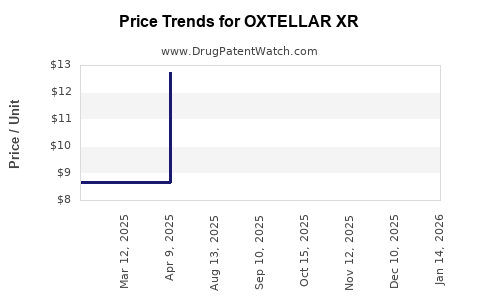
As of late 2022, the average wholesale price (AWP) for OXTELLAR XR was approximately $550 for a 30-day supply of a typical maintenance dose (600 mg twice daily). This price is aligned with existing extended-release AEDs such as Aptiom and Lamictal XR.
Cost structure analysis indicates:
- Per-unit manufacturing cost: Estimated at $60–$80, based on active pharmaceutical ingredient (API) costs and formulation expenses.
- Profit margin: Targeted at 25–35%, considering market competition and payer pressures.
Insurance coverage varies but generally favors branded AEDs with established efficacy, enabling premium pricing due to perceived clinical benefits.
Price Projection Models
Projected pricing over the next five years depends on:
- Patent protection status.
- Competition intensity.
- Market penetration rate.
- Reimbursement trends.
Scenario 1: Maintenance of Current Pricing
Assuming steady pricing and market share growth, revenues could reach:
- Year 1–2: \$300 million.
- Year 3–5: \$500–\$700 million, driven by increased adoption and expanded indications.
Scenario 2: Price Reduction Due to Competition
If generic versions or biosimilars enter the market, prices might decline by 10–20%, reducing revenue projections to:
- Year 1–2: \$250 million.
- Year 3–5: \$400–\$600 million.
Market Share Estimations
OXTELLAR XR could capture 10–15% of the extended-release segment within the first two years, expanding to 20% as brand recognition increases, based on adoption rates for similar drugs.
Validation and Key Factors Influencing Price
- Patent exclusivity: U.S. patents protecting OXTELLAR XR extend into 2028, delaying generics.
- Physician preference: Favorability toward extended-release formulations enhances market acceptance.
- Reimbursement policy: Favorable insurance coverage sustains premium pricing.
Risks and Opportunities
Risks
- Rapid erosion of pricing due to generic competition post-patent expiry.
- Regulatory hurdles delaying broader indications or formulations.
- Market saturation with established AEDs.
Opportunities
- Expanding indications to include generalized seizures.
- Developing combination therapies.
- Growing prevalence of epilepsy, especially in aging populations.
Key Takeaways
- OXTELLAR XR entered a competitive market with established alternatives.
- Initial pricing aligns with similar products, with potential for stability if patent protections hold.
- Revenue projections indicate growth potential, contingent on market acceptance and regulatory events.
- Competitive pressures could lead to price declines post-patent expiration.
FAQs
1. How does OXTELLAR XR compare to other extended-release AEDs?
It offers comparable efficacy and safety profiles, with a dosing schedule that may improve adherence over immediate-release formulations.
2. What are the main factors influencing its pricing?
Patent status, market share, insurance coverage, and competitive landscape.
3. What is the patent status of OXTELLAR XR?
Patent protections extend until 2028, delaying generic entries.
4. What is the potential market share within the first two years?
Between 10–15%, assuming successful adoption and physician acceptance.
5. How might future competition affect pricing?
Introduction of generics or biosimilars could reduce prices by 10–20% within three to five years post-patent expiry.
References
- ResearchAndMarkets. "Global Epilepsy Market," 2022.
- FDA. "Oxcarbazepine Extended-Release Tablets," Approval Letter, August 2021.