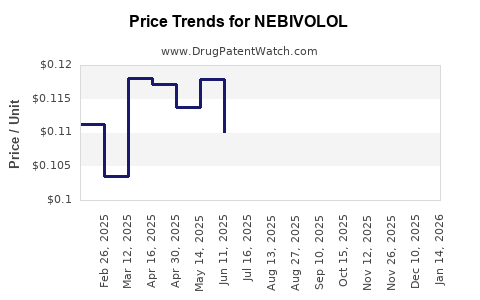
Last updated: February 16, 2026
What Is Nebivolol and Its Market Position?
Nebivolol is a selective beta-1 adrenergic receptor blocker primarily used to treat hypertension. Marketed under brand names such as Bystolic, it combines beta-blockade with vasodilating properties through nitric oxide release. Approved in multiple countries since 2007, it has gained a moderate share in the beta-blocker segment, with a focus on patients requiring blood pressure management with fewer side effects compared to older beta-blockers.
The global hypertension market was valued at approximately $27 billion in 2022, projected to grow at a CAGR of 3–4% through 2030[1]. Nebivolol's contribution remains modest due to generic competition and limited indications beyond hypertension and off-label uses.
How Does the Competitive Landscape Shape Up?
Nebivolol competes within a congested market including atenolol, metoprolol, carvedilol, and bisoprolol. Its distinguishing features are high selectivity for beta-1 receptors and vasodilatory effects, which appeal to patients intolerant of traditional beta-blockers.
Patent expirations impacted the branded market significantly. Bystolic's patent in the US expired in 2019[2], leading to increased generic availability. In markets with limited generic penetration, branded sales remain relevant; elsewhere, price competition dominates.
What Are the Regulatory and Patent Trends?
The original patent for nebivolol in the US held until 2019. Subsequent formulations and manufacturing processes may still be under data exclusivity or secondary patents, which can extend market protections until approximately 2025 in some markets[3].
Regulatory approvals exist in North America, Europe, and parts of Asia. China and India approved nebivolol for hypertension in the 2010s. Regulatory delays or differences can influence market entry and pricing.
What Are Projected Market Prices?
Pricing in the US:
- Branded (Bystolic): Average wholesale price (AWP) $4.50 per tablet (10 mg).
- Generic versions: $0.80–$1.20 per tablet, with a significant discount relative to branded.
Pricing in Europe and Asia:
- Prices vary based on healthcare systems. In the UK, nebivolol 5 mg costs approximately £0.30 per tablet (~$0.40).
- In India, generic prices can reach as low as $0.10 per tablet[4].
Factors influencing price:
- Patent status.
- Generic market entry.
- Healthcare reimbursement policies.
What Are Future Price and Market Volume Projections?
Market volume:
- Current global annual sales of nebivolol (including generics): estimated at $300–$400 million.
- The US comprises roughly 50–60% of sales.
- Growth driven by hypertension prevalence and aging populations.
Price projections:
- With patent expiration, prices are expected to decline further.
- Average prices for generics could decrease by an additional 20–30% over the next two years.
- Innovative formulations or combinations (e.g., fixed-dose combinations with other antihypertensives) could stabilize or increase prices marginally in niche segments.
Market outlook:
- The height of branded nebivolol sales is likely peaked; further growth depends on penetration into emerging markets and new indications.
- The generic market is expected to see consistent price erosion but volume growth in emerging markets can offset unit price decreases.
How Might Regulatory and Policy Changes Affect Prices?
- Stricter biosimilar and generic policies in the EU and US could accelerate price declines.
- Price controls in countries like India, China, and European nations may cap maximum allowable prices.
- Inclusion in national formularies influences accessibility and pricing in public healthcare systems.
What Are the Key Risks and Opportunities?
Risks:
- Patent expiry leading to price erosion.
- Competition from other vasodilating beta-blockers or new antihypertensive classes.
- Regulatory challenges or delays in approval in key markets.
- Off-label usage restrictions affecting off-label sales.
Opportunities:
- Expansion into new indications such as heart failure or ischemic heart disease.
- Development of combination therapies.
- Growth in emerging markets with increasing hypertension prevalence.
- Novel formulations—extended-release or fixed-dose combinations—can command higher prices.
Summary: Market Dynamics and Outlook
- Patent expiration has dramatically decreased nebivolol prices.
- The market is characterized by significant generic penetration, especially outside the US.
- Price declines are expected to continue, with regional differences influenced by regulatory policies.
- Growth in total sales volume depends on healthcare access expansion and new therapeutic uses.
- Limited innovation prospects constrain price stabilization potential; market growth relies on volume expansion.
Key Takeaways
- Patent expiry in 2019 led to a sharp decline in nebivolol's branded prices.
- Generic versions are priced significantly lower, with increased uptake in emerging markets.
- Volume growth in hypertension management sustains the overall market size.
- New indications and formulations offer limited potential for price increases but can support revenue stability.
- Regulatory and policy trends will continue to pressure prices, particularly in countries with active price controls.
FAQs
-
What is the primary current use of nebivolol?
Hypertension management.
-
When did the US patent for nebivolol expire?
2019.
-
How do generic prices compare to branded prices?
Generics are approximately 70–80% cheaper than the branded version.
-
What markets present the highest growth potential?
Emerging markets such as India and China.
-
Are there clinical advantages of nebivolol over other beta-blockers?
Its vasodilatory effect via nitric oxide release reduces certain side effects like fatigue and withdrawal symptoms.
References
[1] Global hypertension market report, 2023.
[2] U.S. Patent and Trademark Office records, 2019.
[3] Regulatory filings and patent databases, 2022.
[4] Market price data, Indian pharmaceutical market, 2023.