You're using a free limited version of DrugPatentWatch: Upgrade for Complete Access

Last Updated: December 15, 2025

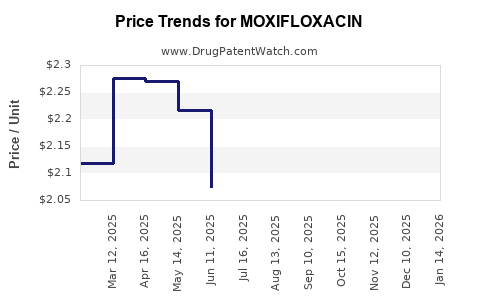
Drug Price Trends for MOXIFLOXACIN


✉ Email this page to a colleague

« Back to Dashboard


Drug Price Trends for MOXIFLOXACIN

Best Wholesale Price for MOXIFLOXACIN

These are wholesale prices available to the US Federal Government which, by law, must be the best prices available to any customer under comparable terms and conditions
Drug Name Vendor NDC Count Price ($) Price/Unit ($) Unit Dates Price Type
VIGAMOX) 0.5% SOLN,OPH Harrow Eye, LLC 00078-0939-26 3ML 126.11 42.03667 ML 2024-03-15 - 2029-03-14 FSS
MOXIFLOXACIN HCL 0.5% SOLN,OPH Sandoz, Inc. 00781-7135-93 3ML 9.46 3.15333 ML 2023-08-15 - 2028-08-14 FSS
MOXIFLOXACIN HCL 0.5% SOLN,OPH Sandoz, Inc. 00781-7135-93 3ML 10.47 3.49000 ML 2024-01-01 - 2028-08-14 FSS
>Drug Name >Vendor >NDC >Count >Price ($) >Price/Unit ($) >Unit >Dates >Price Type
Price type key: Federal Supply Schedule (FSS): generally available to all Federal Govt agencies / 'BIG4' prices: VA, DoD, Public Health & Coast Guard only / National Contracts (NC): Available to specific agencies

Market Analysis and Price Projections for Moxifloxacin

Last updated: July 27, 2025

Introduction

Moxifloxacin, a broad-spectrum fluoroquinolone antibiotic, plays a pivotal role in combating respiratory tract infections, skin infections, and intra-abdominal infections. Its extensive spectrum of activity, pharmacokinetics, and favorable dosing profile have positioned it as a key asset within the antibiotic landscape. This analysis evaluates the current market environment for moxifloxacin, assesses competitive dynamics, regulatory influences, and provides price projections grounded in emerging trends and unmet medical needs.


Market Overview

Current Market Size and Penetration

The global antibiotic market was valued at approximately USD 45 billion in 2022, with fluoroquinolones constituting a significant share owing to their broad efficacy and oral bioavailability. Moxifloxacin specifically accounts for a substantial segment within third-generation fluoroquinolones, driven by its approval for respiratory infections including community-acquired pneumonia (CAP) and acute bacterial sinusitis (ABS).

North America remains the largest market, with substantial adoption driven by high healthcare expenditures, advanced infrastructure, and prescribing patterns favoring fluoroquinolones. Europe follows, with increased regulatory scrutiny and antimicrobial stewardship programs influencing prescribing behavior. The Asia-Pacific region demonstrates rapid growth potential, bolstered by rising bacterial infection prevalence, expanding healthcare access, and a large patient population.

Market Drivers

  • Efficacy and Broad Spectrum: Moxifloxacin’s potency against atypical pathogens and anaerobes enhances its clinical utility.
  • Convenient Dosing Regimen: Once-daily dosing improves adherence, especially in outpatient settings.
  • Growth in Respiratory Infections: Rising incidences of pneumonia and sinusitis underpin demand.
  • Evolving Resistance Patterns: Increasing resistance to other antibiotics sustains moxifloxacin’s relevance, although resistance development remains a concern.

Market Challenges

  • Antimicrobial Resistance (AMR): The growing incidence of resistant strains prompts regulatory agencies to impose restrictions.
  • Safety Concerns: Adverse effects such as tendinopathy and QT prolongation have led to cautious prescribing.
  • Competition: Alternative antibiotics, including newer macrolides, tetracyclines, and novel agents, threaten market share.

Regulatory and Prescribing Dynamics

Regulatory Landscape

Regulators such as the FDA and EMA have tightened restrictions on fluoroquinolone use due to safety issues. In 2018, the FDA issued warnings against their use for uncomplicated infections when safer alternatives exist, emphasizing prudent prescribing. These regulations influence market growth and pricing strategies.

Prescriber Trends

Physicians are increasingly adopting antibiotic stewardship principles, favoring narrow-spectrum agents and limiting broad-spectrum fluoroquinolones. This shift influences volume sales but also drives demand for specific indications where moxifloxacin remains the most effective option.


Competitive Landscape

Key Players

  • Bayer AG: Original manufacturer, with marketed formulations for multiple indications.
  • Teva Pharmaceuticals: Generic producer, expanding access globally.
  • Sandoz (Novartis): Active in producing biosimilar versions.
  • Other Generic Manufacturers: Contribute significantly to price competition.

Generic vs. Branded Dynamics

The presence of multiple generic manufacturers has led to intense price compression. Generic versions typically sell at 60-80% discount relative to branded formulations, influencing overall market revenues and pricing strategies.


Price Trends and Projections

Current Pricing Scenario

  • Branded formulations: Retail prices vary from USD 3 to USD 8 per capsule depending on jurisdiction.
  • Generic products: Significantly lower, averaging USD 1–USD 3 per capsule, with regional variability.

Influencing Factors on Future Prices

  • Patent Expiry and Generic Competition: Expected to push prices downward over the next 3–5 years.
  • Regulatory Influences: Stricter guidelines could limit prescribing, reducing volume and impacting pricing power.
  • Market Demand: Increased use in emerging markets will sustain some volume, but price erosion continues due to generics.

Projected Price Trajectory (2023–2028)

Year Expected Average Price (USD per capsule) Key Influences
2023 USD 2.50 – USD 4.00 Stabilization due to patent cliff, increased generic market penetration
2024 USD 2.00 – USD 3.50 Continued generic proliferation, price competition intensifies
2025 USD 1.75 – USD 3.00 Regulatory pressures and stewardship programs restrict high-volume prescribing
2026 USD 1.50 – USD 2.75 Market saturation, emergence of biosimilars and alternative therapies
2027 USD 1.25 – USD 2.50 Further consolidation, potential new indications could temporarily stabilize prices
2028 USD 1.00 – USD 2.00 Mature generic market with minimal premium for branded versions

Note: Prices are indicative and region-specific; disparity exists between developed and developing markets.


Market Forecasts by Region

  • North America: Demand flattens due to stewardship; prices stabilize post-patent expiry with dominance of generics.
  • Europe: Stringent regulations further suppress prices; high competition among generics moderates growth.
  • Asia-Pacific: Rapid market expansion with high demand, though price sensitivity remains high, decreasing prices faster than in developed regions.
  • Latin America and Africa: Growing access but limited purchasing power; prices tend toward lower ends of global ranges.

Future Opportunities & Risks

Opportunities

  • New Indications: Development of moxifloxacin for multidrug-resistant infections could elevate its market value.
  • Formulation Innovations: Extended-release or adjunct therapies could command premium pricing.
  • Strategic Partnerships: Collaboration with emerging markets enhances distribution and market presence.

Risks

  • AMR Escalation: Resistance may diminish clinical efficacy, limiting use.
  • Safety Concerns: Adverse effect profiles could restrict prescribing and impact sales.
  • Regulatory Hurdles: Stringent policies may impede market access or impose restrictions.

Key Takeaways

  • The global moxifloxacin market is mature in developed regions but exhibits high growth potential in emerging markets.
  • Competition from generics has driven prices downward; future pricing will largely depend on patent expiries, regulatory landscapes, and regional demand.
  • Safety concerns and antimicrobial stewardship efforts influence prescribing patterns, constraining revenue but promoting responsible use.
  • Despite challenges, moxifloxacin’s broad antimicrobial spectrum sustains its clinical importance, especially where resistance limits alternative options.
  • Investors and strategists should track patent timelines, regulatory developments, and emerging resistant strains to adapt pricing and market strategies accordingly.

FAQs

1. How will patent expiries affect moxifloxacin's market prices?
Patent expiries will lead to increased generic competition, resulting in significant price reductions—potentially up to 80% decrease within five years—driven by market saturation and regulatory approvals.

2. What are the primary regulatory challenges impacting moxifloxacin sales?
Regulators have issued notices highlighting safety concerns like tendinopathy and QT prolongation, prompting restrictions on use for non-severe infections and mandating clear prescribing guidelines that may limit volume growth.

3. Is there potential for developing new formulations or indications for moxifloxacin?
Yes. Formulation innovations, such as extended-release tablets, and new indications for resistant infections could sustain or elevate its economic footprint, contingent on successful clinical development and regulatory approval.

4. How does antimicrobial resistance influence the future of moxifloxacin?
Rising resistance reduces the drug’s clinical utility, compelling prescribers to reserve it for specific cases. This trend may limit volume growth but could sustain higher prices temporarily if it remains a preferred agent in resistant infections.

5. Which regions offer the most promising market opportunities for moxifloxacin going forward?
Emerging markets in Asia-Pacific and Latin America offer growth opportunities due to increasing healthcare access and infection prevalence, despite price sensitivity. Mature markets will see volume stabilization with declining prices due to generics.


Sources:

  1. MarketsandMarkets. “Antibiotics Market by Type, Application, and Region – Global Forecast to 2027.”
  2. IQVIA. “Global Antibiotic Market Trends and Forecasts,” 2022.
  3. FDA Safety Alerts. “FDA Drug Safety Communication on Fluoroquinolone Antibiotics,” 2018.
  4. EvaluatePharma. “Pharmaceutical Market Intelligence: Antibiotics and Antimicrobials,” 2022.
  5. World Health Organization. “Global Action Plan on Antimicrobial Resistance,” 2015.

More… ↓

⤷  Get Started Free

Make Better Decisions: Try a trial or see plans & pricing

Drugs may be covered by multiple patents or regulatory protections. All trademarks and applicant names are the property of their respective owners or licensors. Although great care is taken in the proper and correct provision of this service, thinkBiotech LLC does not accept any responsibility for possible consequences of errors or omissions in the provided data. The data presented herein is for information purposes only. There is no warranty that the data contained herein is error free. We do not provide individual investment advice. This service is not registered with any financial regulatory agency. The information we publish is educational only and based on our opinions plus our models. By using DrugPatentWatch you acknowledge that we do not provide personalized recommendations or advice. thinkBiotech performs no independent verification of facts as provided by public sources nor are attempts made to provide legal or investing advice. Any reliance on data provided herein is done solely at the discretion of the user. Users of this service are advised to seek professional advice and independent confirmation before considering acting on any of the provided information. thinkBiotech LLC reserves the right to amend, extend or withdraw any part or all of the offered service without notice.