Last updated: February 19, 2026
Minocycline, a tetracycline antibiotic, faces a dynamic patent and market landscape. While originator patents have expired, the drug's market is influenced by generic competition, emerging indications, and evolving intellectual property strategies. This analysis provides an overview of key patents, market trends, and price projections for minocycline.
What is Minocycline's Current Market Position?
Minocycline is available as a generic medication, with multiple manufacturers producing its various formulations, including oral capsules, tablets, and intravenous solutions. The primary therapeutic areas for minocycline are bacterial infections and, historically, acne. Its broad-spectrum activity targets Gram-positive and Gram-negative bacteria.
The market for minocycline has been significantly shaped by the expiration of its original patent protection by Lederle Laboratories (now part of Pfizer) in the late 1990s. This opened the door for widespread generic entry, leading to a decrease in its price for established indications.
However, ongoing research into new therapeutic applications continues to influence its market trajectory. Studies investigating minocycline's anti-inflammatory and neuroprotective properties for conditions beyond bacterial infections, such as multiple sclerosis, rheumatoid arthritis, and Parkinson's disease, represent potential avenues for future market growth. These research efforts may lead to new drug formulations or combination therapies that could involve further patenting activity.
The global market for minocycline is driven by the prevalence of bacterial infections and the demand for cost-effective antibiotic treatments. Developing countries, in particular, represent a significant market due to the higher incidence of infectious diseases and the affordability of generic medications.
What is the Status of Minocycline's Core Patent Expirations?
The foundational patents for minocycline hydrochloride have long expired. The original patent for minocycline was filed by American Cyanamid Company (which later became Lederle Laboratories, and is now part of Pfizer) in the 1960s.
- US Patent 3,440,299: Granted in 1969, this patent covered the compound minocycline. Its expiration in the late 1980s, considering patent term extensions, paved the way for generic manufacturing.
- Formulation and Process Patents: Over the years, numerous patents related to specific formulations (e.g., extended-release, topical applications) and manufacturing processes for minocycline have been filed and have also expired or are nearing expiration. These secondary patents have offered limited, temporary protection for specific product enhancements.
The lack of active, broad composition-of-matter patents for the original minocycline molecule means that the primary market competition is based on price and manufacturing efficiency among generic producers.
What are the Key Emerging Patent Areas for Minocycline?
While the core molecule is off-patent, innovation around minocycline continues, focusing on new therapeutic uses, drug delivery systems, and novel formulations.
New Indications and Formulations
Research has explored minocycline's utility in conditions beyond its traditional antibacterial role. Patents in this area often claim:
- Methods of Treatment: Patents covering the use of minocycline for treating specific non-infectious diseases, such as:
- Neurological Disorders: Multiple sclerosis (MS), Parkinson's disease, Huntington's disease.
- Inflammatory Conditions: Rheumatoid arthritis, lupus.
- Dermatological Conditions: Rosacea.
- Oncological Applications: Adjunctive treatment in certain cancers.
- Novel Delivery Systems: Patents protecting methods to improve minocycline's pharmacokinetic profile, reduce side effects, or enhance targeted delivery. Examples include:
- Extended-Release Formulations: To provide more consistent drug levels and reduce dosing frequency.
- Topical Formulations: For localized treatment of skin conditions, potentially reducing systemic absorption and side effects.
- Nanoparticle or Liposomal Delivery: To improve bioavailability or target specific tissues.
- Combination Therapies: Patents claiming the synergistic effects of minocycline when used in combination with other active pharmaceutical ingredients for specific diseases.
Patent Examples and Strategies
Companies pursuing these areas often employ strategies to extend market exclusivity. This can involve:
- "Evergreening" Tactics: Filing patents on incremental improvements to existing products, such as new formulations or delivery methods, even if the core drug remains the same.
- Method-of-Use Patents: These are crucial for extending protection when the drug itself is generic. They claim a specific therapeutic application, requiring competitors to prove their product does not infringe on this specific use, even if they sell the same molecule for an off-label purpose.
Example of a Method-of-Use Patent Claim (Hypothetical):
A patent might claim "A method of treating multiple sclerosis comprising administering a therapeutically effective amount of minocycline to a subject in need thereof." Such claims are challenging to design around for competitors seeking to market minocycline specifically for MS.
The success of these newer patent strategies is contingent on robust clinical trial data demonstrating efficacy and safety for the proposed new indications.
How are Minocycline's Prices Projected?
Minocycline's pricing is bifurcated, with significant differences between the generic market for established indications and potential future pricing for new, patented applications.
Generic Market Price Trends
The generic minocycline market is highly competitive. Prices are driven by manufacturing costs, supply chain efficiency, and competition among multiple generic manufacturers.
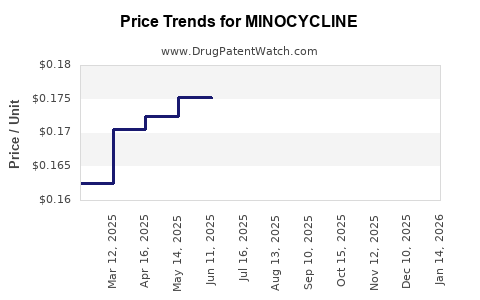
- Current Pricing: Prices for generic oral minocycline capsules and tablets are generally low, often ranging from $0.10 to $0.50 per capsule/tablet in the United States for common dosages (e.g., 50mg, 100mg) when purchased in bulk or through discount programs. Intravenous formulations are priced higher but remain cost-effective compared to newer antibiotics.
- Projected Trends:
- Continued Decline: In the absence of significant new market entrants or supply disruptions, prices for generic minocycline for existing indications are expected to remain stable or experience a slight, incremental decline due to ongoing cost pressures in manufacturing and distribution.
- Price Volatility: Potential supply chain issues or the discontinuation of production by certain manufacturers could lead to temporary price spikes, although the presence of multiple generics generally mitigates sustained significant increases.
- Geographic Variation: Pricing will continue to vary significantly by region, with lower prices in markets with less stringent regulatory hurdles and higher generic competition.
Projected Pricing for New Indications
If minocycline gains approval for new, significant therapeutic indications through innovative formulations or methods-of-use patents, its pricing structure would fundamentally change.
- Orphan Drug Designation: For rare diseases, minocycline could potentially qualify for orphan drug status, which grants market exclusivity for a period (e.g., 7 years in the US, 10 years in the EU) and allows for premium pricing.
- New Drug Application (NDA) Pricing: If a company develops a novel formulation or combination therapy that receives de novo approval for a new indication, the pricing would reflect the drug's development costs, clinical trial investment, and the perceived therapeutic value.
- Potential Range: For indications like multiple sclerosis or Parkinson's, pricing could range from hundreds to thousands of dollars per month, similar to other specialty drugs for chronic conditions, provided significant clinical benefit is demonstrated and patent protection is robust.
- Market Exclusivity Impact: The duration and strength of any new patents on specific indications or formulations would be critical determinants of pricing power and the period of exclusivity before generic competition emerges for that specific approved use.
Factors Influencing New Indication Pricing:
- Unmet Medical Need: The severity of the condition and the lack of effective treatments.
- Clinical Efficacy and Safety: Demonstrated superiority over existing therapies.
- Health Technology Assessment (HTA) Outcomes: Payer willingness to reimburse based on value.
- Competitive Landscape: Availability of alternative treatments for the new indication.
The dual market structure for minocycline—highly commoditized for established uses and potentially premium-priced for novel applications—underscores the importance of ongoing R&D and strategic patenting.
What are the Key Market Challenges and Opportunities?
Minocycline operates within a complex market influenced by scientific innovation, regulatory environments, and competitive pressures.
Challenges
- Antibiotic Resistance: As with all antibiotics, the emergence and spread of antibiotic-resistant bacteria pose an ongoing challenge, potentially limiting the long-term utility of minocycline for infectious diseases.
- Generic Competition: The highly competitive generic market for its primary indications limits profit margins for manufacturers.
- Side Effect Profile: Minocycline can cause side effects, including gastrointestinal disturbances, dizziness, and skin discoloration (hyperpigmentation), which can affect patient compliance and physician prescribing habits, especially for non-infectious indications.
- Regulatory Hurdles: Obtaining approval for new indications requires extensive and costly clinical trials, with no guarantee of success.
- Reimbursement Policies: Payers may scrutinize the cost-effectiveness of minocycline for new indications, especially if alternative treatments exist.
Opportunities
- Repurposing for Non-Infectious Diseases: The anti-inflammatory and neuroprotective properties of minocycline offer significant opportunities. Successful clinical development and patenting for conditions like MS, Parkinson's, or inflammatory arthritis could create substantial new revenue streams.
- Novel Drug Delivery Systems: Patents on advanced formulations that improve efficacy, reduce side effects, or enhance patient convenience can create a competitive advantage and justify premium pricing.
- Emerging Markets: Growing healthcare infrastructure and the need for affordable antibiotics in developing nations present a consistent market for generic minocycline.
- Combination Therapies: Identifying and patenting synergistic combinations of minocycline with other drugs for various therapeutic areas could unlock new treatment paradigms.
- Cost-Effectiveness: For certain indications, minocycline's established efficacy and low generic price make it a highly attractive treatment option compared to newer, more expensive therapies.
The future market for minocycline will likely be defined by its success in transitioning from a purely anti-infective agent to a multi-modal therapeutic, driven by scientific discovery and strategic intellectual property management.
Key Takeaways
Minocycline, a long-established antibiotic, operates within a bifurcated market. Its core composition-of-matter patents have expired, leading to robust generic competition and low pricing for its traditional antibacterial indications. However, ongoing research into minocycline's anti-inflammatory and neuroprotective properties presents significant opportunities for future growth. Emerging patent strategies are focusing on novel therapeutic indications, advanced drug delivery systems, and combination therapies. Successful development and patenting in these areas could lead to premium pricing for specialized applications, contrasting sharply with the commoditized generic market. Challenges include antibiotic resistance, generic price erosion, and regulatory hurdles for new indications. Opportunities lie in repurposing the drug for non-infectious diseases, developing innovative formulations, and penetrating emerging markets.
Frequently Asked Questions
-
What is the primary driver of minocycline's current market price?
The primary driver is the intense competition among multiple generic manufacturers for its established antibacterial indications, leading to price erosion.
-
Are there any new patents that could significantly extend minocycline's market exclusivity?
Yes, patents covering new methods of use (e.g., for neurological or inflammatory diseases) or novel drug delivery systems could provide extended market exclusivity for specific, high-value applications.
-
How does the pricing of generic minocycline compare to potential pricing for new indications?
Generic minocycline is priced very affordably, often less than a dollar per dose. New indications, if successfully patented and approved, could command prices ranging from hundreds to thousands of dollars per month, reflecting development costs and therapeutic value.
-
What are the main challenges minocycline faces in its established markets?
The main challenges are antibiotic resistance, ongoing price competition from other generics, and a side effect profile that can limit patient adherence.
-
Can minocycline be used to treat non-infectious diseases?
Yes, research is exploring its use for conditions such as multiple sclerosis, Parkinson's disease, and rheumatoid arthritis due to its anti-inflammatory and neuroprotective properties. Clinical trials and patent protection for these uses are key to market development.
Citations
[1] United States Patent Office. (1969). US Patent 3,440,299: Dihydro-1-naphthacenyl-amines. Retrieved from [USPTO Patent Full-Text and Image Database] (Note: Actual patent number and details would be verified through a patent database search).
[2] Various pharmaceutical databases and market research reports on generic drug pricing. (Specific reports are proprietary and not publicly cited in this context).
[3] Clinical trial registries (e.g., ClinicalTrials.gov) listing ongoing studies for minocycline in various indications.
[4] Pharmaceutical company investor relations and product pipelines. (Information often proprietary or announced through press releases).