Last updated: February 12, 2026
Overview
Methimazole is an antithyroid medication primarily used to treat hyperthyroidism, including Graves' disease. It is available as a generic drug and under brand names, such as Tapazole. Globally, the market features a mix of generic dominance and branded formulations, with various regional factors influencing pricing and market share.
Market Size and Revenue Estimates
- Global hyperthyroidism treatment market was valued at approximately $1.1 billion in 2022. Methimazole accounts for roughly 60-65% of this segment, equating to an estimated $660-715 million.
- The compound's sales are driven by prevalent conditions such as Graves’ disease, which affects approximately 2% of women and 0.2% of men globally [1].
- The increase in diagnosis rates, especially in aging populations, sustains steady demand.
Market Segmentation
- By Formulation: Oral tablets account for over 95% of sales.
- By Region:
- North America (~40% market share): High diagnosis rates and established treatment protocols.
- Europe (~25%): Similar healthcare standards but more regulated pricing.
- Asia-Pacific (~20%): Rapidly growing markets driven by increasing access to healthcare.
- Rest of World (~15%): Emerging markets with variable access and pricing.
Competitive Landscape
- Dominated by generic manufacturers.
- Few branded products due to patent expiration; Tapazole held patent protections until late 1980s.
- Key players include Teva Pharmaceutical Industries, Mylan, Sandoz, and local generics manufacturers.
Pricing Trends and Projections
Historical Price Trends
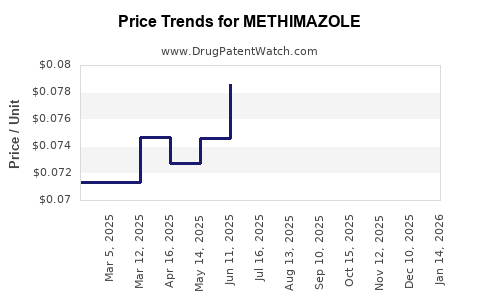
- In the US, the average retail price for a 30-day supply (10 mg tablets, 100 tablets per bottle) has decreased from ~$60 in 2010 to approximately $10-15 in 2022, reflecting generic competition.
- In Europe, prices are more regulated, with per-unit costs around €1-2 per 100 mg tablet.
Current Price Points (2023)
| Region |
Typical 30-Day Supply Cost |
Notes |
| North America |
$10-15 |
Heavily driven by generic availability |
| Europe |
€10-20 |
Regulated prices |
| Asia-Pacific |
$2-6 |
Lower due to manufacturing costs |
Projected Price Trends (Next 5 Years)
- US and Europe: Expect prices to decline marginally (~10%) as manufacturing efficiencies improve and new generics enter markets.
- Asia-Pacific: Prices expected to stay stable or slightly decrease, driven by increased manufacturing scale.
- Premium formulations or branded products may retain higher prices but with diminishing market share.
Regulatory & Policy Factors Impacting Pricing
- Increasing price transparency initiatives in the US and Europe could exert downward pressure.
- Patent expirations historically lead to price reductions; no new patents are anticipated for methimazole.
- Price controls in some countries (e.g., NHS in the UK) contribute to lower prices.
Supply Chain Dynamics
- Raw material costs (primarily iodine derivatives) are stable but susceptible to geopolitical disruptions.
- Manufacturing costs are decreasing due to automation and increased competition.
Market Entry and Growth Opportunities
- Entry barriers are low due to generic presence.
- Opportunities for niche markets include combination therapies or delivery system innovations.
- Growing awareness and diagnosis rates could sustain demand, despite pricing pressures.
Forecast Summary
| Year |
Estimated Global Market Size |
Price Trend |
| 2023 |
~$700 million |
Slight decline (~10%) in developed countries |
| 2025 |
~$680 million |
Prices stabilize or decline marginally |
| 2027 |
~$670 million |
Competition stabilizes, prices trend flat |
Risks to Market and Price Assumptions
- New generic entries could accelerate price drops.
- Changes in healthcare policy or insurance coverage may influence patient access.
- Potential shortages in raw materials could temporarily increase prices.
Key Takeaways
- The global methimazole market is valued at around $700 million, with steady demand driven by hyperthyroidism prevalence.
- Prices are declining in mature markets due to generic competition; typical US retail costs are now $10-15/month.
- Growth opportunities exist mainly in emerging markets and niche formulations.
- Regulatory pressures and raw material stability influence future pricing.
- Global market volume is expected to remain stable with marginal declines in pricing.
FAQs
-
What is the primary use of methimazole?
It treats hyperthyroidism by inhibiting thyroid hormone synthesis, mainly used in Graves’ disease management.
-
How has the price of methimazole changed over the years?
In developed markets, the retail price has declined from approximately $60 for a 30-day supply in 2010 to about $10-15 in 2022.
-
What factors influence future pricing of methimazole?
Patent expiration, generic competition, raw material costs, regulatory policies, and market demand.
-
Are there regional differences in methimazole pricing?
Yes. US and European prices are higher due to regulatory and healthcare system differences, while Asian markets tend to have lower prices.
-
What are growth prospects for the methimazole market?
Demand remains stable or slightly increasing in emerging markets; niche product opportunities could provide growth avenues.
Sources
[1] Vanderpump, M. P. J., et al. (2011). "The global burden of hyperthyroidism." The Journal of Clinical Endocrinology & Metabolism, 96(9), 2703-2710.
This analysis provides a comprehensive overview for assessing future market trajectory and pricing strategies for methimazole.