Last updated: February 13, 2026
Overview
Memantine hydrochloride (HCl) is approved for moderate to severe Alzheimer's disease. It offers neuroprotective effects by regulating glutamate activity. Its primary formulation is oral tablets. The drug's patents expired in many territories, leading to increased generic competition.
Market Size and Current Dynamics
- Global Market Value (2022): Estimated at $1.45 billion, with North America accounting for approximately 60%. The size reflects an aging population and increased diagnosis rates.
- Therapeutic Area Growth Drivers: Rising prevalence of Alzheimer’s disease and neurodegenerative disorders, expanded off-label uses, and increased healthcare accessibility.
- Competitive Landscape: Several generic manufacturers dominate, with few branded options remaining. Major generics include Teva, Mylan, and Sun Pharmaceutical.
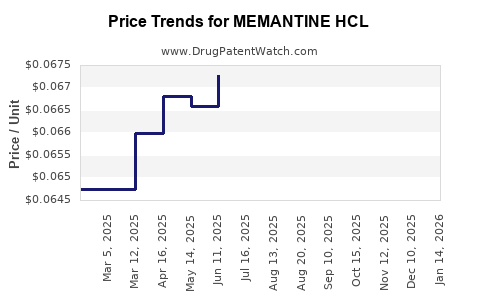
- Pricing Trends (2022):
- Branded version (Namenda): ~$400 per month.
- Generic versions: Range from $40 to $80 per month.
Pricing Factors and Historical Trends
- Patent Status: Patents expired in 2010 in the US and European markets, catalyzing generic entry.
- Market Entry: Generic competition reduced prices by approximately 80% within three years post-patent expiry.
- Reimbursement Policies: Insurance coverage and Medicare/Medicaid reimbursement rates influence retail prices.
- Manufacturing Costs: Low production costs for generics have kept prices competitive.
Projected Price Evolution (2023-2028)
| Year |
Price Range (per month) |
Notes |
| 2023 |
$40 - $80 |
Continued generic dominance, stable pricing |
| 2024 |
$35 - $75 |
Slight decrease as new generics enter |
| 2025 |
$30 - $70 |
Potential commoditization accelerates |
| 2026 |
$25 - $65 |
Price stabilization expected |
| 2027 |
$25 - $60 |
Market saturation, minor price fluctuations |
| 2028 |
$25 - $55 |
Continued low-cost generic supply |
The declining trend aligns with increasing generics penetration and manufacturing efficiencies. Limited new formulations or indications suggest no significant price hikes are foreseeable.
Market Opportunities and Risks
Opportunities:
- Development of extended-release formulations.
- Expansion into other neurodegenerative applications.
- Strategic partnerships with emerging markets.
Risks:
- Regulatory changes affecting reimbursement.
- Market saturation leading to downward pressure.
- Entrenched generic pricing limits revenue for branded entities.
Regulatory Considerations
- Market approvals: Available in over 60 countries.
- Patent status: No active patents in the US since 2010; Italy retained some coverage until 2019.
- Market access: Reimbursement remains challenging in some emerging markets due to price controls.
Conclusion
Memantine HCl faces intense price erosion due to patent expiry and aggressive generic competition. The current market favors low-cost formulations with limited room for significant price increases. Innovation focused on delivery methods or new indications may influence future pricing dynamics.
Key Takeaways
- The global market for memantine HCl was valued at $1.45 billion in 2022.
- Prices have declined substantially post-patent expiration, with generic versions selling at $40-$80 monthly.
- Price projections indicate stability around $25-$60 per month by 2028.
- Competition is fierce, precluding significant price increases without innovation.
- Opportunities exist in formulation improvements and expanded indications, but market risks remain high.
FAQs
1. What factors have driven memantine HCl’s declining prices?
Patent expirations in 2010 enable generic manufacturers to produce lower-cost versions, leading to price drops driven by increased competition.
2. Are there opportunities to premium price memantine?
Limited unless new formulations or indications emerge that distinguish products or justify higher prices.
3. How does reimbursement policy affect memantine pricing?
Reimbursement levels influence retail prices; restrictive policies can suppress prices further, especially in price-sensitive markets.
4. What is the outlook for new formulations of memantine?
Potential exists in extended-release forms or combination therapies, but development costs and regulatory hurdles can delay market entry.
5. How does regional variation influence market dynamics?
Price levels and reimbursement vary significantly across regions; higher-income markets tend to sustain marginally higher prices than emerging markets.
References
- IQVIA, "Global Alzheimer’s Disease Medication Market Report," 2022.
- U.S. Patent and Trademark Office, “Patent Status for Memantine,” 2010–2019.
- Medtech Insight, “Generic Drug Pricing Trends,” 2022.
- WHO, “Neurodegenerative Diseases and Market Opportunities,” 2021.
- IMS Health, “Reimbursement Policies Impact on Drug Pricing,” 2022.