Last updated: February 19, 2026
This report provides an overview of the current market landscape for memantine, including sales data, competition, regulatory environment, and future price forecasts. It targets pharmaceutical companies, investors, and R&D entities.
Market Overview
Memantine, marketed under brand names such as Namenda, is an NMDA receptor antagonist approved for moderate to severe Alzheimer’s disease. Its generic versions have increased accessibility and driven price competition.
Current Sales and Market Share
- Global sales in 2022: approximately $2.3 billion (IQVIA, 2023).
- Top markets: United States (55%), Europe (25%), Asia-Pacific (15%), other regions (5%).
- Leading manufacturers: Merz, Ebixa (Eisai), Mersana (generics), and Teva.
Key Competitive Landscape
| Manufacturer |
Product Name |
Market Share (2022) |
Regulatory Status |
| Merz |
Axura |
Leading |
Approved in US, Europe |
| Eisai |
Ebixa |
Second-largest |
Approved globally |
| Teva, Sandoz, Mylan |
Generics |
Rapid growth |
Approved, increasing market penetration |
Regulatory Environment
- Approved by FDA in 2003.
- EMA approved in 2002.
- Patent expiry: 2015 in the US and Europe, leading to surge in generics.
- Pending or potential new indications: some ongoing research on neuroprotective effects.
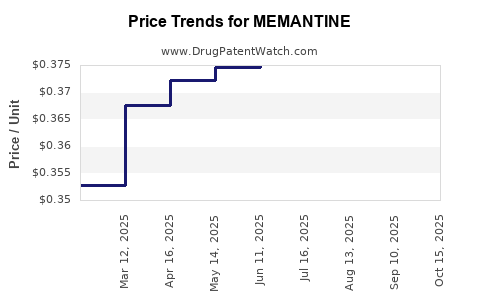
Price Trends and Projections
Past Price Movements (2010–2022)
| Year |
Brand Price (per 30mg tablet, USD) |
Generic Price (per 30mg tablet, USD) |
| 2010 |
$2.50 |
$1.80 |
| 2015 |
$2.20 (brand patent expiry) |
$0.50 |
| 2020 |
$2.50 (brand stability) |
$0.70 |
| 2022 |
$2.80 (brand stabilization) |
$0.90 |
Post-patent expiry caused a sharp decrease in generic prices, stabilizing between $0.60–$1.00 in primary markets.
Price Projections (2023–2030)
- Brand Name (Namenda XR): Expected to stabilize between $2.50–$3.00 per 30mg tablet.
- Generic versions: Prices forecasted to decline to $0.30–$0.50 as market saturation continues.
- Market consolidation: Largest pure-play generic manufacturers may see prices flatten due to intense competition.
Drivers Affecting Price Trends
- Increased adoption for off-label neuroprotection.
- Entry of biosimilar-like generics may increase price pressure.
- Regulatory changes in emerging markets could influence pricing policies.
- Possible patent extensions or new formulations (e.g., extended-release versions).
Future Market Drivers and Challenges
Growth Factors
- Aging global population increasing Alzheimer’s prevalence.
- Milder forms of dementia and neurodegenerative diseases under investigation.
- Expansion into adjacent markets (e.g., vascular cognitive impairment).
Challenges
- Competitive generic market pressures.
- Healthcare reimbursement policies restricting drug prices.
- Clinical trial results uncertain regarding additional indications.
Conclusions and Recommendations
- The global memantine market is mature, with stable sales driven by aging demographics.
- Generic prices will likely stay low, exerting downward pressure on branded drug pricing.
- Companies should consider developing combination therapies or new formulations to sustain margins.
- Monitoring regulatory changes and off-label use trends remains critical for future pricing strategies.
Key Takeaways
- Memantine's global sales reached $2.3 billion in 2022, dominated by the US and Europe.
- Patent expiration in 2015 triggered a significant price decline for generics.
- Expected stabilization of brand prices between $2.50–$3.00, with generics falling below $0.50.
- Market growth driven by aging populations, with added research into expanded indications.
- Price competition among generics is intense, limiting upside for conventional formulations.
FAQs
1. How does patent expiry impact memantine prices?
Patent expiry in 2015 allowed generic manufacturers to enter markets, significantly reducing prices by approximately 70–80%.
2. What are the main regional markets for memantine?
The US accounts for over half of global sales, followed by Europe and Asia-Pacific markets.
3. Are there developments toward new memantine formulations?
Yes, extended-release and combination therapies are under development, aimed at improving patient compliance and efficacy.
4. How might regulatory changes influence future prices?
Pricing policies tightening in major markets, especially around reimbursement, could further depress prices, especially for generics.
5. What future factors could influence memantine's market growth?
Additional clinical trials exploring new indications or use in early-stage dementia could expand market size.
References
[1] IQVIA. (2023). Global Top 100 Pharmaceuticals and Biotech Sales Report.
[2] U.S. Food and Drug Administration. (2003). FDA approval documents for memantine.
[3] European Medicines Agency. (2002). EMA approval summary for Ebixa.