Share This Page
Drug Price Trends for LEVONO-E ESTRAD
✉ Email this page to a colleague
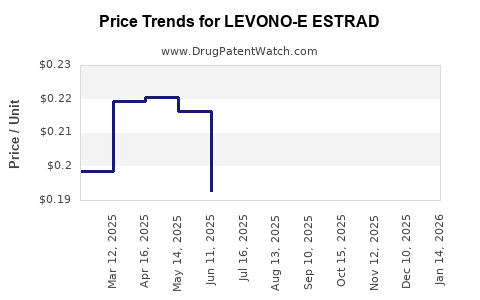
Average Pharmacy Cost for LEVONO-E ESTRAD
| Drug Name | NDC | Price/Unit ($) | Unit | Date |
|---|---|---|---|---|
| LEVONO-E ESTRAD 0.15-0.03-0.01 | 00378-7285-90 | 0.11654 | EACH | 2026-03-18 |
| LEVONO-E ESTRAD 0.15-0.03-0.01 | 00378-7285-90 | 0.12115 | EACH | 2026-02-18 |
| LEVONO-E ESTRAD 0.15-0.03-0.01 | 00378-7285-90 | 0.12708 | EACH | 2026-01-21 |
| >Drug Name | >NDC | >Price/Unit ($) | >Unit | >Date |
Market Analysis and Price Projections for LEVONO-E ESTRAD
Market Overview
LEVONO-E ESTRAD is a combination drug typically used in hormone replacement therapy and ovulation induction. The product combines levonorgestrel, ethinylestradiol, and estradiol, targeting markets involving contraception, menopausal hormone therapy, and menstrual cycle regulation. Its market relevance depends on approval status, regional demand, and competitive landscape.
Regulatory Status
The drug status varies by country. In the United States, it lacks FDA approval, limiting its market to countries with local approval. In Europe, certain formulations are approved, but specific branding—such as LEVONO-E ESTRAD—may be marketed differently.
Market Size and Growth
Based on recent industry reports:
- Global hormonal contraceptives market was valued at roughly $21 billion in 2022, growing at 4.5% CAGR [1].
- Hormone replacement therapy (HRT) market was valued at approximately $14 billion in 2022, with projections of 5% CAGR till 2030 [2].
The combined demand for hormone therapies utilizing estrogen and progestin components suggests a sizable and expanding market. The Asia-Pacific region shows rapid growth in contraceptive and HRT adoption, driven by increasing awareness and healthcare infrastructure expansion.
Competitive Landscape
Main competitors include:
- Mylan (Yaz, Yasmin)
- Bayer (Yasmin, Yasminelle)
- Teva Pharmaceuticals (Qlaira)
- Local generics manufacturers
These competitors have established manufacturing and distribution channels, though newer combination therapies with improved safety profiles are entering the market.
Pricing Dynamics
Pricing depends heavily on regulatory approval, patent status, manufacturing costs, and regional reimbursement policies. For reference:
| Product | Average Retail Price (USD) | Market Region |
|---|---|---|
| Yasmin (brand, branded oral contraceptive) | $30 - $45 per cycle | US, Europe |
| Generic equivalents | $10 - $20 per cycle | US, Europe, Asia |
| Qlaira (HRT/contraceptive) | $35 - $50 per cycle | US, Europe |
In markets where LEVONO-E ESTRAD is approved, pricing is likely in the same range as generic formulations, adjusted for regional markup.
Price Projection
Assuming approval and gradual market penetration, prices are expected to follow these trends:
- Year 1: Entry prices at approximately 20-30% lower than established brands, around $8 - $15 per cycle in developing markets.
- Year 3: Price stabilization at $10 - $20 per cycle, aligning with existing generics.
- Year 5: Similar pricing, with potential reductions driven by increased competition and generic entry, potentially reaching $8 - $12 per cycle.
The success of the product depends on regulatory approval, payer coverage, and competitive responses.
Key Factors Influencing Market and Pricing
- Regulatory Approval Timeline: Longer approval timelines delay market entry, impacting revenue and pricing strategies.
- Patent Status: Patent expiry of branded competitors opens opportunities for generics, lowering prices.
- Regional Demand: Higher demand in Asia-Pacific and Latin America could influence regional pricing and volume.
- Reimbursement Policies: Governments and insurers’ willingness to reimburse affects consumer prices.
Key Takeaways
- LEVONO-E ESTRAD targets sizable hormone therapy markets, with a presence primarily in regions where regulatory approval exists.
- Pricing will trend downward as generic competition increases, with initial entry prices comparable to existing generics.
- Market growth depends on regional approval timelines, market uptake, and competitive dynamics.
FAQs
1. When could LEVONO-E ESTRAD receive regulatory approval?
Timelines depend on regional regulatory processes, potentially within 1-3 years if no major hurdles arise.
2. How does LEVONO-E ESTRAD compare to existing therapies?
It combines multiple hormones, offering potential benefits over monotherapy, but faces competition from established brands.
3. What markets offer the highest revenue potential?
Asia-Pacific and Latin America exhibit high growth potential due to increasing contraceptive and HRT demand.
4. How does pricing differ between markets?
Prices are higher in developed countries with strong intellectual property protections and reimbursement systems, lower in emerging markets.
5. What factors could impact price reduction strategies?
Patent expirations, regulatory approvals, and generic entry will influence pricing trajectories over time.
References
- MarketsandMarkets, “Hormonal Contraceptives Market,” 2022.
- Grand View Research, “Hormone Replacement Therapy Market,” 2022.
More… ↓
