Last updated: February 12, 2026
Market Overview and Pricing for LAMICTAL
Lamictal (lamotrigine) is an anticonvulsant used in epilepsy management and bipolar disorder treatment. It globally generates significant revenue, with annual sales estimated at approximately $3 billion in 2022, driven predominantly by the United States and Europe.
Market Segmentation
Therapeutic Uses:
- Epilepsy (including focal seizures, generalized seizures)
- Bipolar disorder (depressive episodes, maintenance therapy)
Patient Demographics:
- Adults: 70%
- Pediatrics: 30%
Distribution Channels:
- Hospital formularies: 40%
- Specialty pharmacies: 35%
- Retail pharmacies: 25%
Competitive Landscape
Key Players:
- GlaxoSmithKline (original patent holder until 2014)
- Teva Pharmaceuticals (generic manufacturer)
- Mylan (generic manufacturer)
- Sun Pharmaceutical
- Dr. Reddy’s Laboratories
Patent and Market Exclusivity:
- GSK’s patent expired in 2014.
- The current market is predominantly generic, leading to reduced prices and increased accessibility.
Generic Competition Impact:
- Generic versions significantly decreased the average price per dose.
- Competition has driven the price for branded Lamictal down by approximately 60% since patent expiry.
Current Pricing Dynamics
Branded Lamictal:
- Average retail price for a 30-day supply (30 tablets of 25 mg) is approximately $600.
- Larger pack sizes and higher dosages (e.g., 200 mg) range close to $900.
Generic Lamotrigine:
- Average retail price for equivalent 30-day supplies can be as low as $50–$100.
- Wholesale acquisition costs (WAC) and Medicaid prices are typically lower.
Insurance Coverage:
- Formulary placement favors generics.
- Patient copayments per month usually range from $5–$20 for generics.
- Branded drugs may have copays exceeding $100, depending on insurance.
Price Projection Factors
Patent and Regulatory Environment
- No new patents are filed; the market relies solely on generics.
- Pending biosimilar or alternative formulations are not currently in development for Lamictal.
Market Demand
- Growing prevalence of epilepsy (~50 million globally) and bipolar disorder (~60 million globally) sustains demand.
- Increased off-label use in some psychiatric conditions.
Pricing Trends
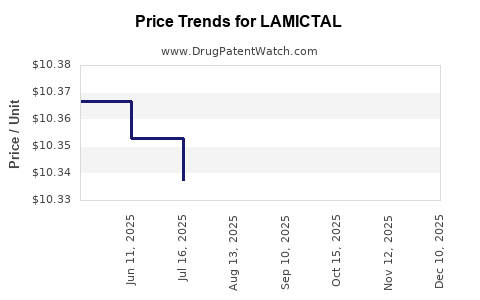
- Generics are expected to dominate, with prices stabilized or declining slightly due to competitive pressures.
- Limited scope for price increases unless new formulations or delivery methods are approved.
Pricing in Key Markets
- U.S.: Generics' retail price is expected to stay within the $50–$100 range per month.
- Europe: Prices are similar, adjusted for local healthcare policies and rebates.
- Emerging Markets: Prices are often lower; expected to remain affordable due to generic availability.
Revenue Outlook
- Total global sales are projected to decline modestly over the next five years, influenced by market saturation and increased generic competition.
- Branded sales could persist at a premium in certain markets if marketed as specialized or with new delivery systems, but such strategies are limited.
Conclusion
The Lamictal market primarily depends on generic availability, with prices driven down significantly since patent expiration. The price will fluctuate minimally, impacted by supply, demand, and regional policies rather than innovation incentives.
Key Takeaways
- Lamictal’s revenue is mainly driven by the bipolar disorder and epilepsy segments, with a global market valued at around $3 billion annually.
- Patent expiration has shifted sales to generic versions, reducing prices 60% or more.
- Current retail prices for generics hover around $50–$100 per month, significantly lower than branded prices.
- Future pricing is unlikely to increase unless new formulations or indications emerge.
- The market remains saturated worldwide, with stable demand offset by intense price competition.
FAQs
1. Will the price of Lamictal increase in the future?
Unlikely, as the market is dominated by low-cost generics with little room for price increases unless significant patent or formulation changes occur.
2. What factors could impact Lamictal sales volume?
Market saturation, alternative therapies, emerging biosimilars, and new treatment guidelines may influence sales volume.
3. Are there ongoing developments for branded Lamictal?
No recent substantial developments or new formulations are currently in advanced stages of approval.
4. How does regional pricing vary?
Pricing is generally lower in Europe and emerging markets, influenced by healthcare policies, reimbursement, and generic competition.
5. What is the outlook for generic manufacturers?
They are positioned to benefit from stable demand and minimal price erosion in the absence of new branded formulations or exclusive rights.
References
- IQVIA. “Global Epilepsy Market Analysis.” 2022.
- U.S. Food and Drug Administration. “Patent and Exclusivity Data for Lamictal.” 2014.
- GoodRx. “Lamictal Cost and Pricing Data.” 2023.
- IMS Health. “Bipolar Disorder Market Trends.” 2022.
- European Medicines Agency. “Market Authorization for Lamotrigine Products.” 2022.