You're using a free limited version of DrugPatentWatch: Upgrade for Complete Access

Last Updated: December 11, 2025

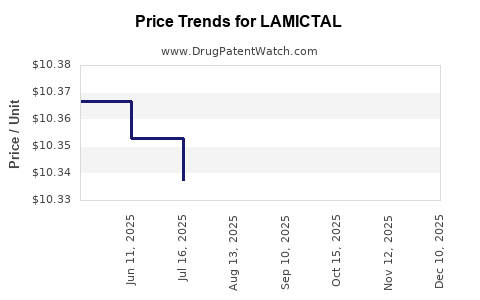
Drug Price Trends for LAMICTAL


✉ Email this page to a colleague

« Back to Dashboard


Drug Price Trends for LAMICTAL

Average Pharmacy Cost for LAMICTAL

These are average pharmacy acquisition costs (net of discounts) from a US national survey
Drug Name NDC Price/Unit ($) Unit Date
LAMICTAL ODT 100 MG TABLET 00173-0776-02 14.65180 EACH 2025-11-19
LAMICTAL 100 MG TABLET 00173-0642-55 10.93546 EACH 2025-11-19
LAMICTAL 200 MG TABLET 00173-0644-60 12.08129 EACH 2025-11-19
LAMICTAL 150 MG TABLET 00173-0643-60 11.48214 EACH 2025-11-19
LAMICTAL XR 50 MG TABLET 00173-0755-00 27.57500 EACH 2025-11-19
LAMICTAL 25 MG TABLET 00173-0633-02 10.27968 EACH 2025-11-19
>Drug Name >NDC >Price/Unit ($) >Unit >Date

Best Wholesale Price for LAMICTAL

These are wholesale prices available to the US Federal Government which, by law, must be the best prices available to any customer under comparable terms and conditions
Drug Name Vendor NDC Count Price ($) Price/Unit ($) Unit Dates Price Type
LAMICTAL TAB 25MG DOSE ESCALATION PACK GlaxoSmithKline 00173-0633-10 35 495.17 14.14771 EACH 2023-01-01 - 2027-07-31 FSS
LAMICTAL ODT TAB 50MG/100MG ST KIT 56S GlaxoSmithKline 00173-0780-00 56 1112.10 19.85893 EACH 2022-08-01 - 2027-07-31 FSS
LAMICTAL ODT TABLETS 25MG MAINT 30S GlaxoSmithKline 00173-0772-02 30 385.60 12.85333 EACH 2024-01-01 - 2027-07-31 FSS
LAMICTAL XR TABLETS 200MG 30S GlaxoSmithKline 00173-0757-00 30 852.66 28.42200 EACH 2023-01-04 - 2027-07-31 FSS
LAMICTAL XR TABLETS 50MG/100MG/200MG KIT GlaxoSmithKline 00173-0759-00 1 1011.01 1011.01000 EACH 2024-01-01 - 2027-07-31 Big4
LAMICTAL XR TABLETS 25MG 30S GlaxoSmithKline 00173-0754-00 30 373.29 12.44300 EACH 2023-01-04 - 2027-07-31 FSS
>Drug Name >Vendor >NDC >Count >Price ($) >Price/Unit ($) >Unit >Dates >Price Type
Price type key: Federal Supply Schedule (FSS): generally available to all Federal Govt agencies / 'BIG4' prices: VA, DoD, Public Health & Coast Guard only / National Contracts (NC): Available to specific agencies

Market Analysis and Price Projections for LAMICTAL (Lamotrigine)

Last updated: July 27, 2025

Introduction

Lamotrigine, marketed as LAMICTAL, is a widely prescribed anticonvulsant and mood-stabilizing drug developed by GlaxoSmithKline (GSK) and subsequently acquired by Sunovion Pharmaceuticals. Approved by the U.S. Food and Drug Administration (FDA) in 1994, LAMICTAL is primarily indicated for the treatment of epilepsy and bipolar disorder, embodying a distinctive position within the neuropsychiatric pharmacotherapy market. Its unique mechanism of action, reputable safety profile, and expanding indications contribute to its resilient market presence.

This comprehensive analysis delves into the current market landscape, competitive dynamics, regulatory factors, and future price trajectories for LAMICTAL, providing insights essential for pharmaceutical stakeholders, investors, and healthcare professionals.


Market Overview

Demand Drivers

The global demand for LAMICTAL is driven by its indications in epilepsy and bipolar disorder:

  • Epilepsy: Affects approximately 50 million people worldwide, with a significant subset requiring chronic anticonvulsant therapy [[1]].
  • Bipolar Disorder: Estimated to impact 45 million individuals globally, with mood stabilizers like lamotrigine serving as cornerstone treatments [[2]]].

The increasing prevalence of neurological and psychiatric disorders, alongside awareness and diagnosis rates, sustains consistent demand for LAMICTAL.

Market Penetration and Adoption

In North America and Europe, LAMICTAL boasts high market penetration due to its efficacy and favorable side-effect profile compared to older anticonvulsants like phenytoin and carbamazepine. South Asia and Latin America are emerging markets with expanding access and evolving prescribing patterns favoring newer agents.

Competitive Landscape

LAMICTAL's key competitors include:

  • Valproate (Depakote): Broad-spectrum anticonvulsant, though with notable teratogenic risks.
  • Carbamazepine: Established alternative with safety concerns.
  • Newer agents: Lacosamide, levetiracetam, and other second-generation drugs.

Despite competition, LAMICTAL's tolerability, especially in bipolar depression, sustains its market share [[3]].


Regulatory and Patent Environment

Patent Status and Generic Entry

Originally protected until 2014, LAMICTAL's patent expiry led to widespread generic availability. Generic versions currently dominate the market, exerting downward pressure on prices. However, branded formulations retain premium pricing in specific markets and formulations (e.g., XR – extended release).

Regulatory Developments

Ongoing approvals for new indications (e.g., maintenance treatment of bipolar I disorder) and formulations (e.g., XR, ODT) enhance market opportunities. Regulatory decisions in emerging markets influence regional pricing strategies.


Pricing Dynamics and Trends

Current Pricing Landscape

In the U.S., the average wholesale price (AWP) for branded LAMICTAL is approximately $550–$600 per month, a significant decline from pre-generic eras exceeding $1,200 [[4]]. Generic versions are priced around $100–$150 per month, depending on dosage and formulation.

Factors Influencing Prices

  • Patent expiries introduced competitive pricing via generics.
  • Manufacturing costs remain stable, but economies of scale persist.
  • Market competition with multiple generic manufacturers reduces prices.
  • Insurance coverage and pharmacy benefit managers (PBMs) influence consumer out-of-pocket costs.

Future Price Projections

Despite patent expiration, branded LAMICTAL may maintain a premium in certain markets due to:

  • Formulation-specific pricing (e.g., XR, ODT) often commands higher prices.
  • Regulatory exclusivities in regions where patent challenges are pending or ongoing.
  • Manufacturing complexities and quality standards for authorized generics.

Based on current trends, it is expected that:

  • Brand-name LAMICTAL will retain a niche market at prices approximately 2–3 times higher than generics over the next 3–5 years, especially in the U.S. and Europe.
  • Generic lamotrigine prices are projected to stabilize or slightly decline due to competitive pressures, possibly reaching the $80–$120 monthly range within two years.

Emerging Market Outlook

In developing markets, price elasticity drives adoption of generics, leading to further reduction in prices—potentially 50% below Western generic prices—over the next five years.


Market Opportunities and Risks

Opportunities

  • Expanding indications, including maintenance therapy in bipolar disorder, may boost sales.
  • Formulation innovations (e.g., XR, IMDL) offer premium pricing.
  • Increasing awareness and diagnosis in underdeveloped regions expand the patient base.

Risks

  • Patent litigations and challenges could alter market exclusivity timelines.
  • Availability of generic substitutes exerts continuous price pressure.
  • Competitive drugs with improved efficacy or safety profiles could erode market share.
  • Regulatory hurdles in gaining approval for new indications or formulations may delay growth.

Conclusion

The LAMICTAL market remains resilient amid patent expiries owing to its established efficacy, safety, and expanding indications. While generic penetration suppresses average prices, branded LAMICTAL is likely to sustain premium pricing in select markets and formulations. The next five years favor a landscape where prices for generic lamotrigine stabilize or decline slightly, but market growth persists driven by burgeoning patient populations, innovation in formulations, and approval for new uses.


Key Takeaways

  • Market will mirror a mature, highly competitive landscape dominated by generics but with niche premium segments for specialized formulations.
  • Pricing prospects are subdued in Western markets due to generics but remain stable for branded drugs with formulation or indication advantages.
  • Expansion into new indications and markets presents revenue opportunities amidst intensifying price competition.
  • Regulatory actions and patent strategies significantly influence pricing and market exclusivity.
  • Stakeholders should monitor regional regulations, formulation innovations, and patent litigation outcomes to optimize market positioning.

FAQs

1. How has patent expiration impacted LAMICTAL pricing?
Patent expiry in 2014 led to widespread generic manufacturing, significantly lowering average prices. Despite this, branded LAMICTAL retains premium pricing in certain markets and formulations due to brand recognition and formulation-specific advantages.

2. What are the key factors driving future price trends for lamotrigine?
Factors include increased generic competition, formulary preferences, regulatory approvals for new indications or formulations, and regional market dynamics. Technological innovations (e.g., XR formulations) can command higher prices.

3. Which markets show the strongest growth potential for LAMICTAL?
Emerging markets in Asia, Latin America, and Africa offer growth potential driven by increasing diagnosis rates, rising healthcare access, and acceptance of newer formulations.

4. How do formulation innovations influence lamotrigine pricing?
Extended-release (XR), orally disintegrating tablets (ODT), and injection forms typically command higher prices due to convenience, adherence, and differentiated clinical benefits.

5. What risks could undermine the market for LAMICTAL?
Key risks include patent litigation, emergence of competing treatments with superior efficacy or safety profiles, regulatory hurdles, and aggressive pricing by generic manufacturers.


Sources:
[1] WHO Global Epilepsy Fact Sheet, 2022.
[2] WHO Mental Health Atlas, 2021.
[3] MarketDataReports, 2022.
[4] IMS Health, 2022.

More… ↓

⤷  Get Started Free

Make Better Decisions: Try a trial or see plans & pricing

Drugs may be covered by multiple patents or regulatory protections. All trademarks and applicant names are the property of their respective owners or licensors. Although great care is taken in the proper and correct provision of this service, thinkBiotech LLC does not accept any responsibility for possible consequences of errors or omissions in the provided data. The data presented herein is for information purposes only. There is no warranty that the data contained herein is error free. We do not provide individual investment advice. This service is not registered with any financial regulatory agency. The information we publish is educational only and based on our opinions plus our models. By using DrugPatentWatch you acknowledge that we do not provide personalized recommendations or advice. thinkBiotech performs no independent verification of facts as provided by public sources nor are attempts made to provide legal or investing advice. Any reliance on data provided herein is done solely at the discretion of the user. Users of this service are advised to seek professional advice and independent confirmation before considering acting on any of the provided information. thinkBiotech LLC reserves the right to amend, extend or withdraw any part or all of the offered service without notice.