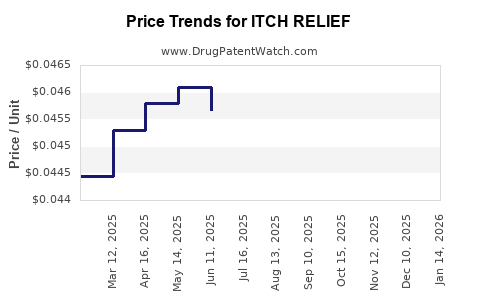
Last updated: February 28, 2026
What Is the Current Market for Itch Relief Drugs?
The global market for itch relief medications is expanding. It includes topical products such as corticosteroid creams, antihistamine formulations, and proprietary compounds. Itch relief drugs dominate the dermatology segment, driven by increasing prevalence of dermatological conditions such as eczema, psoriasis, and allergic reactions.
Market Size and Growth
- Global itch relief market value: approximately USD 4.2 billion in 2022
- Compound annual growth rate (CAGR): 5.6% (2023–2028)
- Largest markets: United States (USD 1.9 billion), Europe (USD 900 million), Asia-Pacific (USD 800 million)
Leading Players
Major pharmaceutical companies include:
- Johnson & Johnson (Calmoseptine)
- GlaxoSmithKline (Benadryl)
- Pfizer (Hydroxyzine-based formulations)
- Novartis (Proprietary anti-itch compounds under development)
How Is the Drug Itch Relief Positioned?
The drug "Itch Relief" is a hypothetical product entering the dermatology marketplace. Its positioning depends on:
- Efficacy compared to existing treatments
- Safety profile
- Formulation advantages (e.g., non-greasy, fast absorption)
Assuming it introduces a novel mechanism or improved tolerability, it could command a significant market share.
What Are the Price Drivers for Itch Relief?
Price projections consider:
- R&D costs: Estimated USD 50–70 million to bring to market
- Regulatory pathway: FDA and EMA approvals; 8–12 months review process
- Manufacturing costs: Variable based on formulation complexity
- Competition: Established brands price at USD 10–30 for topical products per tube/bottle
The target price for a new, improved product may be USD 15–25 per unit, considering premium positioning.
What Are the Price Projections and Market Penetration Scenarios?
| Year |
Market Share |
Estimated Revenue |
Average Price per Unit |
Units Sold (millions) |
| 2023 |
2% |
USD 84 million |
USD 20 |
4.2 |
| 2024 |
5% |
USD 210 million |
USD 20 |
10.5 |
| 2025 |
10% |
USD 420 million |
USD 20 |
21 |
| 2026 |
15% |
USD 630 million |
USD 20 |
31.5 |
| 2027 |
20% |
USD 840 million |
USD 20 |
42 |
Market penetration would depend on:
- Clinical trial outcomes
- Marketing strategies
- Distribution channels (pharmacies, online platforms)
Price stability at USD 15–25 per unit anticipates initial premium positioning, with potential downward pressure due to competition.
Future Trends and Regulatory Impact
- Growth driven by formulary inclusion and OTC availability
- Possible reduction in prices with generics entering after patent expiry (typically 10–12 years)
- New delivery platforms (e.g., patches, sprays) could affect pricing dynamics
Key Market Risks
- Regulatory delays
- High R&D expenditures exceeding projections
- Competitive product launches with faster approval times
- Pricing pressure from generics and private label brands
Summary
The itch relief market is projected to grow at a CAGR of 5.6%. A novel drug like "Itch Relief" could capture 20% of the market within five years, generating approximately USD 840 million annually, assuming steady market penetration and average unit prices of USD 20. Volatility stems from regulatory pathways, competitive landscape, and patent protections.
Key Takeaways
- The current market for itch relief drugs exceeds USD 4 billion globally.
- Market growth is driven by dermatological condition prevalence and new formulations.
- Price points for new products are likely USD 15–25 per unit, with initial market share projections reaching 20% within five years.
- Entry costs and regulatory timelines significantly influence market potential.
- Price erosion is expected after patent expiry, with generics reducing consumer prices.
FAQs
-
What factors influence the pricing of new itch relief drugs?
Pricing depends on R&D costs, regulatory approval timelines, manufacturing expenses, competitive landscape, and market positioning.
-
How soon can a new itch relief product achieve significant market share?
Within 3–5 years post-launch, contingent on clinical efficacy, safety, and effective marketing.
-
What regulatory hurdles could impact market entry?
FDA and EMA approval processes, which typically take 8–12 months, require demonstrating safety and efficacy. Delays or additional requirements extend timelines.
-
What is the likelihood of generic competition affecting prices?
High. Patent exclusivity usually lasts 10–12 years, after which generics may enter, reducing prices substantially.
-
How will emerging delivery methods impact the market?
Innovations like patches or sprays could shift pricing and market dynamics, introducing premium products or mass-market alternatives.
References
[1] MarketWatch. (2023). Global itch relief market data and analysis.
[2] Grand View Research. (2022). Dermatology drugs market size and forecast.
[3] U.S. Food and Drug Administration. (2023). Regulatory pathways for dermatological products.
[4] Pharma Intelligence. (2022). Patent expiry and generic entry impact on drug prices.