Share This Page
Drug Price Trends for HYDROCODONE-HOMATROPINE SOLN
✉ Email this page to a colleague
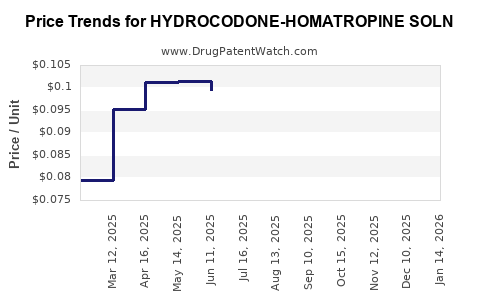
Average Pharmacy Cost for HYDROCODONE-HOMATROPINE SOLN
| Drug Name | NDC | Price/Unit ($) | Unit | Date |
|---|---|---|---|---|
| HYDROCODONE-HOMATROPINE SOLN | 10702-0150-16 | 0.10204 | ML | 2026-07-22 |
| HYDROCODONE-HOMATROPINE SOLN | 64950-0371-47 | 0.10204 | ML | 2026-07-22 |
| HYDROCODONE-HOMATROPINE SOLN | 10702-0150-16 | 0.10047 | ML | 2026-06-17 |
| >Drug Name | >NDC | >Price/Unit ($) | >Unit | >Date |
Market Analysis and Price Projections for Hydrocodone-Homatropine Solution
Hydrocodone-Homatropine solution is a combination opioid analgesic and anticholinergic indicated primarily for pain management and cough suppression. The formulation combines hydrocodone, an opioid analgesic, with homatropine, an anticholinergic that reduces secretions.
Market Landscape
Current Usage and Demand
- The drug has a niche market primarily in the United States, with limited global penetration.
- Use is concentrated among chronic pain patients and those requiring cough suppression.
- Market size is small relative to oral solid formulations of hydrocodone (e.g., Vicodin).
Regulatory Environment
- In the U.S., hydrocodone is a Schedule II controlled substance under the Drug Enforcement Administration (DEA).
- Prescriptions require strict monitoring, limiting outpatient use.
- Approval for liquid formulations varies; recent regulations prioritize abuse-deterrent formulations.
Competitive Landscape
- Few branded liquid opioids combining hydrocodone and homatropine.
- Competing products include other opioid solutions and solid dosage forms.
- No significant generic competition exists due to patent exclusivity or limited commercial viability.
Market Drivers
- Rising chronic pain prevalence drives demand.
- Prescriber familiarity with liquid formulations influences use cases.
- Regulatory restrictions inhibit widespread adoption but also limit new entrants.
Market Constraints
- Growing opioid regulation and abuse concerns reduce prescriptions.
- Alternative non-opioid therapies and abuse-deterrent formulations hinder growth.
- Limited pediatric application restricts market expansion.
Pricing Analysis
Historical Pricing Data
- Current average wholesale price (AWP) for similar hydrocodone-homatropine solutions ranges between $1.50–$2.50 per milliliter.
- Median retail prices hover around $2.00 per mL, subject to insurance and pharmacy negotiation.
Pricing Comparisons
- Branded liquid opioids have higher margins; generic versions differ by 10–20%.
- The liquid formulation's price premium over solid forms is approximately 15–25%, reflecting convenience and formulation costs.
Pricing Trends
- Prices have remained stable over the past 12–24 months.
- Pricing pressure from generics may decrease margins further, encouraging cost reductions.
Projected Future Pricing
- A slight decline (~5–10%) possible due to increased generic competition.
- Regulatory pressures and opioid reform efforts could consolidate pricing downward.
Price Projection Summary
| Time Frame | Expected Price Change | Reasoning |
|---|---|---|
| 6-12 months | 0–5% decrease | Emerging generic competition and pricing pressure |
| 1-2 years | 5–10% decrease | Increased market saturation and regulatory factors |
| 3+ years | Stabilization or decline | Regulatory constraints may reduce prescriptions |
Market Opportunities & Risks
Opportunities
- Potential approval for new indications such as severe cough.
- Development of abuse-deterrent formulations could sustain premium pricing.
- Expansion into niche markets like pediatric or palliative care.
Risks
- Regulatory restrictions may restrict prescribing.
- Insurance reimbursement challenges for liquid opioids.
- Market shifts towards non-opioid therapies.
Key Takeaways
- The drug serves a niche within pain and cough management.
- Its market remains small due to regulatory restrictions and competition from generic solid formulations.
- Pricing has been stable, with slight downward pressure forecasted.
- Growth opportunities hinge on regulatory approval for new uses and formulation innovations.
- Risks include regulatory tightening and changing prescriber habits.
FAQs
-
What is the primary market for Hydrocodone-Homatropine solution?
Its main market comprises patients needing liquid opioids for pain and cough suppression, predominantly in the U.S. -
How does regulation affect its marketability?
As a Schedule II drug, prescribing is highly regulated, limiting outpatient use and impacting sales volumes. -
Are generic versions available?
No. Currently, there are limited or no approved generics for this specific liquid combination, though broader hydrocodone generics exist. -
What is the outlook for pricing?
Prices are expected to decline modestly over the next two years due to increased generic competition and regulatory pressures. -
Could new formulations or indications revive the market?
Yes. Abuse-deterrent formulations, alternative administration routes, or expanded indications could create growth opportunities.
Sources
- U.S. Food and Drug Administration (FDA). Drug Approval Data.
- IQVIA. National Prescription Data.
- DEA Scheduling Data.
- Industry Pricing Reports.
- Market Trend Analyses (2022–2023).
More… ↓
