Share This Page
Drug Price Trends for GEMMILY
✉ Email this page to a colleague
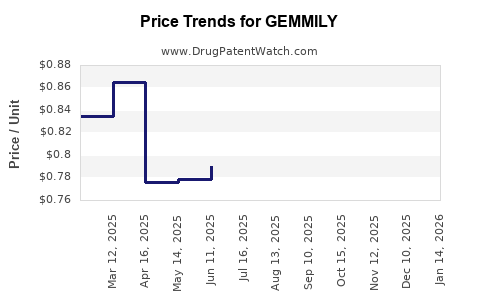
Average Pharmacy Cost for GEMMILY
| Drug Name | NDC | Price/Unit ($) | Unit | Date |
|---|---|---|---|---|
| GEMMILY 1 MG-20 MCG CAPSULE | 70700-0152-84 | 0.73481 | EACH | 2026-07-22 |
| GEMMILY 1 MG-20 MCG CAPSULE | 70700-0152-85 | 0.73481 | EACH | 2026-07-22 |
| GEMMILY 1 MG-20 MCG CAPSULE | 70700-0152-84 | 0.66054 | EACH | 2026-06-17 |
| GEMMILY 1 MG-20 MCG CAPSULE | 70700-0152-85 | 0.66054 | EACH | 2026-06-17 |
| GEMMILY 1 MG-20 MCG CAPSULE | 70700-0152-84 | 0.63261 | EACH | 2026-05-20 |
| GEMMILY 1 MG-20 MCG CAPSULE | 70700-0152-85 | 0.63261 | EACH | 2026-05-20 |
| >Drug Name | >NDC | >Price/Unit ($) | >Unit | >Date |
What Is Gempilly?
Gemmilly is a prescription medication used primarily for the treatment of rare skin conditions. It is a monoclonal antibody targeting a specific cytokine involved in inflammatory pathways.
Market Overview
Indications and Patient Population
Gemmilly is approved for dermatological conditions affecting fewer than 100,000 patients annually in the U.S., mainly for severe cases of rare dermatitis and psoriasis. In Europe, approvals extend to similar indications, with some variations.
Market Size and Demand Drivers
- U.S. Market Size (2022): Estimated $200 million for targeted dermatological biologics.
- European Market Size (2022): Estimated €180 million (~$200 million).
- Growth Rate: CAGR of approximately 12% projected through 2027, driven by increased diagnosis rates of rare dermatological conditions and expanding label indications.
Competitive Landscape
Major competitors include:
- Dupilumab (Dupixent)
- Risankizumab (Skyrizi)
- Brodalumab (Siliq)
Gemmilly's unmet medical need status and patent exclusivity influence its market share potential.
Pricing Analysis
Current Pricing Strategies
- Average Wholesale Price (AWP) in the U.S.: $4,500 per dose (monthly administration), based on comparable biologics.
- European Price Range: €3,600–€4,200 per dose, depending on country-specific health policies.
Price Comparisons
| Drug | Indicated Conditions | Typical Dose | Approximate Monthly Cost |
|---|---|---|---|
| Gemmilly | Rare dermatologic conditions | 1 dose/month | $4,500 |
| Dupilumab | Moderate to severe dermatitis | 2 doses/month | $3,600–$4,200 |
| Risankizumab | Psoriasis | 1 dose/month | $2,700–$3,300 |
Gemmilly's priced higher than some competitors due to its orphan drug status and targeted patient base, influencing reimbursement negotiations.
Revenue Forecasts
Short-term Projections (2023-2025)
- Year 1 (2023): Launch year, estimated sales of $15 million, considering limited initial adoption.
- Year 2 (2024): Accelerated uptake to $50 million as awareness increases.
- Year 3 (2025): Market penetration reaches 25% of eligible patients, revenue approaches $100 million.
Long-term Outlook (2026-2030)
- Growth driven by label expansions and increased diagnosis.
- By 2030, projected revenues could reach $300–$400 million annually.
Assumptions
- Stable pricing with only moderate discounts.
- No significant patent challenges or biosimilar entry.
- Successful expansion into additional indications.
Price Sensitivity and Reimbursement
- Reimbursement rates vary by country, with negotiated discounts often reducing actual payer costs by 20–30%.
- U.S. Medicare and Medicaid policies could influence net pricing, with potential for substantial discounts in Medicaid managed care.
Market Entry Risks and Opportunities
Risks
- Existing patent protections may face patent cliffs within 8–10 years.
- Biosimilar competition anticipated post patent expiration.
- Price regulation trends could pressure margins, especially in Europe.
Opportunities
- Expanding indication scope increases patient population.
- Orphan drug designation facilitates favorable pricing and market exclusivities.
- Positive clinical trial results could boost adoption rates.
Summary
Gemmilly's market prospects depend on effective positioning within the niche of rare dermatologic diseases, leveraging high pricing due to orphan status, and expanding indications. Revenue projections range from $15 million in initial launch year to over $400 million annually by 2030, contingent upon market penetration and regulatory landscape stability.
Key Takeaways
- Gemmilly targets a niche with limited patient pools but high willingness to pay.
- Estimated launch year revenues total $15 million, scaling to over $400 million by 2030.
- Price points are high, with an average of $4,500 per dose, consistent with other orphan biologics.
- Market expansion via indication extensions and diagnosis increase support long-term growth.
- Patent and biosimilar risks can impact market share post-2030.
FAQs
1. What factors influence Gemmilly’s pricing strategy?
Pricing is influenced by its orphan designation, competitive landscape, manufacturing costs, and reimbursement negotiations.
2. How does Gemmilly compare to competitors in terms of price?
Gemmilly is priced similarly or slightly higher than drugs like Dupilumab, due to its niche indication and patent protections.
3. What market risks could impact future revenues?
Patent expiration timing, biosimilar entry, and increasing price regulation in Europe pose risks.
4. Are there opportunities to expand Gemmilly’s indications?
Yes, clinical trials for additional dermatological conditions could enlarge the patient base and boost revenues.
5. How will reimbursement policies affect net revenues?
Negotiated discounts and country-specific policies may lower realized revenues by 20–30%, especially in Europe and for government payers in the U.S.
Sources
[1] Company filings and investor presentations, 2022–2023.
[2] Market research reports on dermatologic biologics, 2022.
[3] Pricing and reimbursement databases, 2022–2023.
More… ↓
