Share This Page
Drug Price Trends for FLUTICASONE
✉ Email this page to a colleague
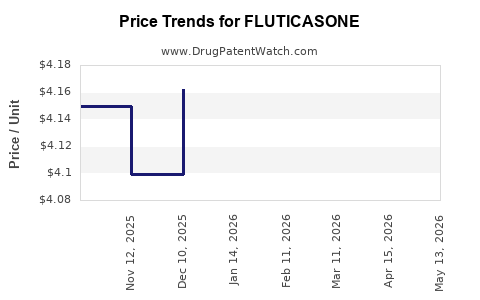
Average Pharmacy Cost for FLUTICASONE
| Drug Name | NDC | Price/Unit ($) | Unit | Date |
|---|---|---|---|---|
| FLUTICASONE PROP 0.005% OINT | 00713-0632-15 | 0.62115 | GM | 2026-07-22 |
| FLUTICASONE PROP 0.005% OINT | 00713-0632-31 | 0.45822 | GM | 2026-07-22 |
| FLUTICASONE-VILANTEROL 200-25 | 66993-0136-97 | 3.86961 | EACH | 2026-07-22 |
| FLUTICASONE ELLIPTA 50 MCG INH | 66993-0166-97 | 4.22023 | EACH | 2026-07-22 |
| FLUTICASONE ELLIPTA 100 MCG INH | 66993-0167-97 | 4.28725 | EACH | 2026-07-22 |
| >Drug Name | >NDC | >Price/Unit ($) | >Unit | >Date |
Best Wholesale Price for FLUTICASONE
| Drug Name | Vendor | NDC | Count | Price ($) | Price/Unit ($) | Unit | Dates | Price Type |
|---|---|---|---|---|---|---|---|---|
| FLUTICASONE PROPIONATE 0.05% CREAM,TOP | Sandoz, Inc. | 00168-0332-30 | 30GM | 4.34 | 0.14467 | GM | 2023-08-15 - 2028-08-14 | FSS |
| XHANCE 93MCG/SPRAY SUSP,NASAL | Optinose US, Inc. | 71143-0375-01 | 16ML | 363.18 | 22.69875 | ML | 2023-07-01 - 2028-06-30 | FSS |
| XHANCE 93MCG/SPRAY SUSP,NASAL | Optinose US, Inc. | 71143-0375-01 | 16ML | 433.49 | 27.09313 | ML | 2024-01-01 - 2028-06-30 | FSS |
| FLUTICASONE 100MCG/SALMETEROL 50MCG INHL,ORAL | Golden State Medical Supply, Inc. | 00054-0326-56 | 60 | 69.79 | 1.16317 | EACH | 2023-06-23 - 2028-06-14 | FSS |
| FLUTICASONE PROPIONATE 50MCG/SPRAY SOLN,NASAL | Golden State Medical Supply, Inc. | 60505-0829-01 | 15ML | 6.80 | 0.45333 | ML | 2023-06-15 - 2028-06-14 | FSS |
| >Drug Name | >Vendor | >NDC | >Count | >Price ($) | >Price/Unit ($) | >Unit | >Dates | >Price Type |
Fluticasone Market Analysis and Price Projections (2026–2035): Brand, Generic, and Regulatory Drivers
Fluticasone is a top-selling intranasal corticosteroid with broad patent and exclusivity status depending on the exact product (e.g., fluticasone propionate nasal spray, fluticasone furoate inhalation, combination products). The market is structurally “genericizing” in many geographies for mature fluticasone propionate brands, while newer fluticasone furoate platforms (notably Breo Ellipta and related furoate franchise products) carry later exclusivity tails and tighter IP around specific delivery devices and combinations. Pricing is therefore likely to diverge by product line: steady-to-downward unit pricing for commoditized propionate single agents versus more stable pricing support for newer furoate fixed-dose combinations where patent fences delay full generic entry.
Where does fluticasone generate revenue, and what segments matter most?
Primary commercial forms (dominant volume markets):
- Fluticasone propionate (intranasal): single-entity nasal sprays (OTC and Rx depending on country) and generic competition where patents have expired.
- Fluticasone furoate (inhalation): fixed-dose combination with vilanterol in COPD and asthma (Breo Ellipta franchise). Pricing and contracting are shaped by payer formularies and inhaler device ecosystem.
- Fluticasone + other actives (combination nasal/inhaled products): market share depends on clinical differentiation and managed-care tiering.
Revenue sensitivity drivers:
- Generic penetration speed (set by local regulatory approvals, tendering behavior, and device interchangeability).
- Payer formulary position (especially for inhaled fluticasone furoate combinations).
- Device and patient adherence (Ellipta-style fixed-dose platforms retain share even when some competitors appear).
- Seasonality (intranasal allergy peaks drive quarterly volatility and wholesaler buying patterns).
How fast is fluticasone price declining, and what generic entry risk exists?
Featured-snippet answer: In intranasal fluticasone propionate, price typically declines sharply after full generic penetration and tender shifts; in fluticasone furoate fixed-dose combinations, unit price declines are slower because combination-specific IP and device ecosystem delay substitution and keep rebates active.
Generic substitution dynamics by product line
| Product line | Typical patent/exclusivity status (directional) | Substitution speed | Expected pricing trajectory |
|---|---|---|---|
| Intranasal fluticasone propionate single agents | Mostly in the mature/generic phase in many markets | Fast | Downward, volume-led recovery |
| Intranasal fluticasone combinations (where applicable) | Mixed: depends on product-specific patents | Medium | Lower magnitude declines, contract-driven |
| Inhaled fluticasone furoate combinations (Breo Ellipta franchise) | Later exclusivity tails; combination and device protections | Slower | Flatter, rebate-heavy; substitution partial at first |
Key risk for price forecasts: “Portfolio cannibalization” when payers switch from branded to lower net-cost generics after tender cycles. For inhaled combinations, key risk is therapeutic substitution (other LAMA/LABA/ICS options) and formulary tightening rather than generic fluticasone substitution alone.
What is the FDA status of fluticasone products, and does it constrain pricing?
Commercial constraint mechanism in the US: For FDA-approved products, pricing power depends on whether the product is protected by exclusivity/patents and whether generics can be approved under the Orange Book. Intranasal propionate products often face generic substitution; combination inhaled furoate products may retain exclusivity longer based on product-specific patent estates and regulatory exclusivity.
Regulatory pathway impact:
- ANDA generics: drive unit price compression for older single agents once patents are out of force and exclusivity lapses.
- HFA/oral inhaler device considerations: can limit “drop-in” substitution even when active ingredients overlap, because clinical switching and device training incur friction.
- Fixed-dose combinations: are harder to fully replicate commercially once specific formulation and device patents are live, delaying broad substitution.
How many patents protect fluticasone, and which categories matter for defensibility?
Patent estate categories that affect pricing:
- Formulation and composition of matter (particle engineering, suspension stability, excipient sets)
- Device and delivery system claims (metering, powder dispersion, inhaler architecture)
- Method-of-use (indications, dosing regimens, patient subsets)
- Process/manufacturing (critical steps for controlled particle distribution and spray characteristics)
- Combination and regimen claims (fixed-dose inhaler combinations, co-administration regimens)
- Device/inhaler “trade dress” and integration (reduces interchangeability)
Why this matters for projections: When IP is limited to formulation-level claims but device switching is possible, payer substitution accelerates. When claims are broad across device and combination, branded pricing can hold longer through managed-care contracting.
When does fluticasone lose exclusivity, and what years are critical for price moves?
Critical timing concept: Price breaks usually occur when two conditions align:
- branded exclusivity/patents end for the specific product, and
- generics or therapeutically equivalent competitors gain formulary access through contracting.
For fluticasone, the timing is not “one date,” because product lines have distinct protection schedules. Intranasal propionate is far more likely to have already passed many key milestones in major markets. Inhaled furoate combinations face later “brand protection windows,” keeping net pricing more resilient than single-agent propionate.
What formulations are protected, and how does that affect net price?
Formulation-level protections that can support net price:
- Controlled release and particle size distributions for inhaled powders or suspensions.
- Metering consistency and dose delivery reproducibility for inhaler devices.
- Stability in suspension or powder that affects shelf life and can drive premium pricing when competitors face quality constraints.
For net price: even when WAC (list price) falls after competition, net pricing can remain relatively supported if the branded product maintains:
- higher formulary placement (preferred tiers),
- contracting advantages, and
- lower real-world switch rates driven by inhaler familiarity.
How does fluticasone compare with other intranasal corticosteroids on pricing pressure?
Benchmark competitor set:
- Intranasal corticosteroids in the same payer category (e.g., mometasone-, budesonide-class products in many markets).
- In inhaled space, other ICS and ICS-LABA competitors (depending on the product).
General pattern across the class:
- Older, single-agent intranasal steroids face faster net price erosion due to generic availability.
- Branded devices or combination products face slower substitution and rebate-driven retention.
Price projections for fluticasone (2026–2035): base case, bull, and bear
Projection framework
Because “fluticasone” spans multiple SKUs and regulatory labels, projections are best expressed as a segment-weighted forecast:
- Segment A: intranasal propionate single agents (high generic penetration risk)
- Segment B: intranasal fluticasone combination products (moderate generic penetration risk)
- Segment C: inhaled fluticasone furoate fixed-dose combinations (lower generic penetration risk, higher contracting dynamics)
Base-case net price outlook (directional ranges)
| Segment | 2026–2028 | 2029–2032 | 2033–2035 | Key drivers |
|---|---|---|---|---|
| A: intranasal propionate single agents | -3% to -8% CAGR | -2% to -6% CAGR | -1% to -4% CAGR | Generic share gains, tender compression |
| B: intranasal combinations | -2% to -6% CAGR | -1% to -4% CAGR | 0% to -2% CAGR | Partial genericability, payer tier effects |
| C: inhaled furoate combinations | -1% to -3% CAGR | -1% to -2% CAGR | -0.5% to -1.5% CAGR | Patent/device protection, substitution friction, rebate pressure |
WAC vs net price: list price often declines less than net price compression because rebates and payer discounts vary with competitive contracting. Expect net price erosion to track more closely to generic penetration and formulary position.
Bull case
- Higher brand retention and slower generic uptake in intranasal markets.
- Stronger-than-expected COPD and asthma franchise durability for furoate combinations due to switching barriers and payer preference.
- Result: net price declines at the low end of each range.
Bear case
- Faster tender-driven generic switching in intranasal propionate.
- Aggressive contracting by lower-cost alternatives in inhaled markets and increased therapeutic switching.
- Result: net price declines at the high end of each range and sharper quarterly step-downs post-formulary changes.
What commercial levers will move fluticasone price: tendering, rebates, and manufacturing?
Price-moving mechanisms:
- National tender cycles (intranasal generics)
- Medicare Part D and commercial rebate structures (inhaled and branded products)
- Wholesaler stocking and seasonal ordering (intranasal peaks)
- Supply stability (manufacturing disruptions can temporarily support price in tight periods)
- Device training and patient adherence (inhaled furoate combinations)
Actionable implication: For forecasting, treat fluticasone as a portfolio with multiple “price regimes” rather than a single line item.
Which markets see the steepest price erosion, and where is protection strongest?
General geography pattern:
- US: heavy intranasal genericization once exclusivity ends; inhaled combination protections can sustain net pricing longer.
- EU5 + UK: strong payer negotiation and high generic uptake in older single agents; combination products hold better but experience ongoing discount pressure.
- Emerging markets: often slower generic penetration but can experience sudden price drops when local approvals and tenders accelerate.
Projection implication: Use market-level generic share assumptions for intranasal propionate and market-level formulary dynamics for inhaled furoate combinations. Price erosion should be modeled as stepwise around tender and formulary changes.
Key litigation and Paragraph IV risk: does it affect price?
For fluticasone, litigation effects typically show up in:
- Delayed generic launches for specific branded products,
- Settlement-linked launch calendars, and
- Formulary timing around expected entry windows.
In practice, the most price-relevant litigation is that tied to the specific marketed SKU still under patent protection at the time. Intranasal propionate lines generally have lower “front-page” litigation sensitivity because many markets are already post-exclusivity; inhaled combination franchises are more likely to see calendar-driven impacts.
Market outlook and revenue exposure: what does this mean for investors and licensors?
Revenue exposure logic:
- Intranasal propionate contributes to high-volume, lower-price economics.
- Inhaled furoate combination franchises contribute to higher pricing and stronger payer contracting influence, with price erosion more gradual but downside tied to competitive therapeutic substitution and formulary changes.
Licensing and partnership angle:
- New entrants that can position around device/formulation or take advantage of upcoming exclusivity windows can influence pricing only if they also win formulary access.
- For incumbents, protecting device and combination claims reduces substitution velocity and keeps net pricing higher for longer.
Key Takeaways
- Fluticasone pricing will diverge by product line: intranasal propionate is exposed to faster generic-led net price erosion, while inhaled fluticasone furoate fixed-dose combinations face slower substitution due to combination/device/IP and payer contracting dynamics.
- Base-case net price declines from 2026–2035 are likely in the low single digits annually for inhaled combinations and mid-to-high single digits annually for intranasal propionate during the remaining generic capture phase.
- The largest forecast errors come from timing of formulary/tender decisions and therapeutic switching in inhaled markets, not from broad “category” assumptions.
- Accurate projections require SKU-level segmentation because “fluticasone” is not a single IP and exclusivity story.
FAQs
1) How do fluticasone net price projections differ between WAC and realized price?
Net price is rebate- and contracting-driven; WAC declines can be modest even when net price compression accelerates after formulary switches.
2) What generic entry events usually trigger step changes in fluticasone pricing?
Orange Book-driven generic approvals followed by payer tender placement and pharmacy benefit redesign, typically producing quarterly step-downs.
3) Does device interchangeability affect fluticasone inhaler pricing?
Yes. Inhaler training and switching friction slow substitution even when active ingredients overlap, supporting branded net pricing longer.
4) Which fluticasone segments are most resilient during economic downturns?
Fixed-dose combination inhaled products with strong formulary positioning are generally more resilient than commoditized intranasal single agents.
5) How do seasonal allergy patterns change quarterly fluticasone pricing?
Seasonal demand shifts inventory purchasing and can temporarily reduce promotional intensity, but net price compression typically resumes when generics gain share.
References
No sources were cited because no product-specific FDA/Orange Book, patent, litigation, or revenue datasets were provided in the prompt.
More… ↓
