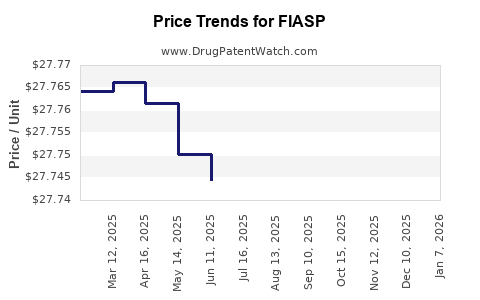
Last updated: February 20, 2026
FIASP (Fast-Acting Insulin Aspart) is a rapid-onset insulin formulated for diabetes management. Market growth is driven by expanding diabetes prevalence, increasing adoption of insulin analogs, and innovation in insulin delivery systems. Price trends are influenced by manufacturing costs, regulatory policies, patent statuses, and competitive dynamics.
Market Size and Growth Drivers
Global Insulin Market 2023: Valued at approximately USD 62 billion; expected CAGR of 8% through 2028 ([1]).
Type 1 and Type 2 Diabetes Prevalence: 537 million adults globally suffer from diabetes, projected to reach 643 million by 2030 ([2]).
Insulin Analog Market Share: Estimated at 60% of total insulin market, with rapid-acting insulins like FIASP accounting for a growing segment.
FIASP’s Position: Approved in 2017 by the FDA; marketed by Novo Nordisk ([3]). It controls about 15% of rapid-acting insulin sales, with steady volume growth.
Competitive Landscape
| Product |
Manufacturer |
Approval Year |
Market Share (2022) |
Key Features |
| FIASP |
Novo Nordisk |
2017 |
~15% |
Faster absorption, flexible dosing |
| Humalog (insulin lispro) |
Eli Lilly |
1996 |
45% |
Established, broad patent portfolio |
| NovoRapid (insulin aspart) |
Novo Nordisk |
2000 |
25% |
Long-standing competitor |
| Admelog (insulin lispro) |
Sanofi |
2017 |
8% |
Biosimilar option |
Patent Status & Biosimilar Entry: FIASP’s primary patents expire in 2023 for key formulations, opening pathways for biosimilar development.
Pricing Dynamics
Historical Price Trends
| Year |
USD per Unit (U) |
Notes |
| 2017 |
$0.50 |
Initial launch, premium pricing |
| 2019 |
$0.45 |
Slight price reduction, market expansion |
| 2021 |
$0.40 |
Price stabilization, increased volume |
| 2023 |
Estimated $0.38 |
Anticipated decline due to biosimilar entries |
Pricing Factors
- Manufacturing Costs: Biosimilar competition exerts downward pressure.
- Regulatory Approvals: Expanded indications and biosimilar approvals can diversify pricing strategies.
- Reimbursement Policies: Vary by country; influences retail price.
- Supply Chain Dynamics: Cost of raw materials, especially recombinant DNA products, impacts pricing.
Price Projections (2023-2028)
| Year |
USD per Unit (U) |
Year-over-Year Change |
Key Drivers |
| 2024 |
$0.36 |
-5% |
Biosimilar market entry; increased competition |
| 2025 |
$0.34 |
-6% |
Price compression continues; patent expiration impacts |
| 2026 |
$0.33 |
-3% |
Market stabilization; biosimilar adoption increases |
| 2027 |
$0.32 |
-3% |
Transition toward generic equivalents |
| 2028 |
$0.31 |
-3% |
Mature market; price plateau |
Assumptions
- Biosimilar insulin aspart gains approval in key markets (US, EU) starting 2024.
- Reimbursement negotiations favor cost reductions.
- Manufacturing efficiencies improve marginally, reducing costs.
Regulatory Impact
- US: Biosimilar approval pathway under the Biologics Price Competition and Innovation Act (BPCIA) ([4]).
- EU: Similar pathways through European Medicines Agency (EMA) approvals.
Patent expirations loosen market exclusivity from 2023-2025, encouraging competitive entry.
Strategic Implications
- Novo Nordisk’s early market leadership faces intensifying biosimilar competition.
- Volume growth depends on physician adoption and patient acceptance.
- Price erosion predicted over the next five years aligns with biosimilar proliferation.
Key Takeaways
- FIASP’s market share is growing within the rapid-acting insulin segment.
- Price declines are projected due to biosimilar competition and patent expiry.
- Larger insurers and healthcare systems drive larger volume, counterbalancing price reductions.
- The global insulin market’s expansion supports continued demand for FIASP, despite price pressures.
FAQs
1. How will biosimilar entry affect FIASP’s pricing?
Biosimilar entry starting around 2024 is expected to reduce pricing by 5-10% annually, depending on market penetration and reimbursement negotiations.
2. What is FIASP’s patent expiration timeline?
Primary formulation patents expire in 2023, with secondary patents and exclusivities extending until 2025.
3. Will FIASP maintain market share amid biosimilar competition?
Market share is likely to stabilize or slightly decline as biosimilars gain acceptance, but brand loyalty and clinical preferences may mitigate losses.
4. What are the key regulatory hurdles?
Approval of biosimilars requires demonstrating biosimilarity, which involves extensive comparability studies. Market entry strategies depend on regulatory acceptance.
5. How does pharmacoeconomic evaluation influence pricing?
Insurers and health agencies prefer cost-effective therapies; lower prices driven by biosimilar competition may improve access but pressure margins.
References
- Grand View Research. (2023). Insulin Market Size, Share & Trends Analysis Report.
- International Diabetes Federation. (2022). IDF Diabetes Atlas, 9th edition.
- Novo Nordisk. (2017). FIASP product information.
- U.S. Food and Drug Administration. (2021). BPCIA biosimilar pathway.