Last updated: February 13, 2026
Market Overview and Price Projections for Escitalopram Oxalate
Escitalopram oxalate is a selective serotonin reuptake inhibitor (SSRI) used primarily to treat major depressive disorder, generalized anxiety disorder, and other affective conditions. It is marketed under brand names such as Lexapro, with generic versions widely available.
Current Market Size and Revenue
Global prescription sales of escitalopram stood at approximately $3 billion in 2022, according to IQVIA data. The U.S. accounts for roughly 70% of this market, with annual prescriptions exceeding 50 million units. Emerging markets, including China and India, are experiencing rapid growth due to rising mental health awareness.
Key Market Players
- Lundbeck/Forest: Original patent holder with branded Lexapro until patent expiry.
- Teva, Mylan, Sandoz: Leading generic manufacturers.
- Pfizer, Ranbaxy: Also involved in manufacturing and distribution.
Patent and Regulatory Status
- Original patent expired in the U.S. in August 2012.
- Several key patents in Europe expired between 2011-2014.
- Several formulations, such as extended-release versions, continue patent protection in select jurisdictions until 2025.
Revenue Trends and Future Growth Drivers
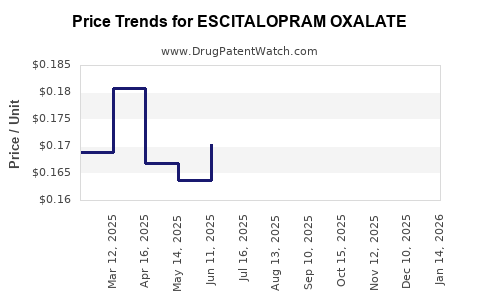
The onset of generics has driven down the price of escitalopram, decreasing the average retail price from around $3 per pill for branded versions in 2012 to approximately $0.50 for generics in 2022.
Demand for mental health medications has increased, partly driven by the COVID-19 pandemic, which has elevated the incidence of depression and anxiety diagnoses globally.
Emerging markets are contributing to growth due to increased healthcare infrastructure and the expansion of mental health services.
Price Projections (2023-2030)
Short-Term (2023–2025)
- Prices will stabilize at the current generic average price of $0.50–$0.70 per pill.
- Volume growth expected to increase prescription counts by 3-5% annually in developed markets.
- Market penetration for generics will intensify, further driving down prices.
Mid-Term (2026–2028)
- Price decline may plateau or decline slightly, reaching approximately $0.40–$0.50 per pill in developed markets due to increased generic competition.
- Emerging markets could see prices ranging from $0.20–$0.40 per pill owing to diverse pricing regulations and economic factors.
Long-Term (2029–2030)
- Price stability is likely as patent protections end in most jurisdictions and market saturation occurs.
- New formulations (e.g., extended-release) may command higher prices but at lower volumes.
- Regulatory changes and patent extensions could temporarily influence price trajectories.
Factors Influencing Market and Prices
- Patent Litigation and Litigation Risks: Ongoing patent challenges could delay generic entry.
- Government Price Controls: Countries like India and parts of Europe impose price caps that limit market prices.
- Formulation Innovations: Once patents on extended-release formulations expire, prices may drop for these versions.
- Healthcare Policy Changes: Increased coverage for mental health treatments can boost demand.
- Supply Chain Dynamics: Disruptions or increases in manufacturing capacity impact availability and pricing.
Comparative Pricing: Branded vs. Generic
| Version |
Price Per Pill (2022) |
Prescriptions (millions) |
Market Share (2022) |
| Branded (Lexapro) |
~$3.00 |
5 million |
20% |
| Generic (multiple) |
~$0.50–$0.70 |
45 million |
80% |
In markets where patent protections end, the price disparity narrows, favoring generics.
Key Takeaways
- The global escitalopram market exceeded $3 billion in 2022.
- Patent expirations and increased generic competition have driven prices down sharply since 2012.
- Demand growth driven by rising mental health awareness and diagnosis rates is expected to continue.
- Prices are projected to stabilize around $0.40–$0.70 per pill in the mid-term, with potential for further decline in emerging markets.
- Innovation in formulations could sustain higher prices for certain versions, but overall market prices are expected to move downward over time.
FAQs
Q1: When will generics dominate the escitalopram market?
A1: Generic versions currently hold approximately 80% of the market and are expected to maintain dominance through 2025, with continued growth in emerging markets.
Q2: Are there price differences between markets?
A2: Yes. Prices are generally higher in developed countries like the U.S. (~$0.50–$0.70 per pill for generics) due to higher healthcare spending, while prices in emerging markets can be as low as $0.20 per pill.
Q3: How will patent expirations impact prices?
A3: Patent expirations lead to increased generic competition, reducing prices and expanding access.
Q4: What factors could alter price projections?
A4: Regulatory changes, patent litigation outcomes, formulation patents, and healthcare policies influence market prices.
Q5: Will new formulations command higher prices?
A5: Yes. Extended-release or combination formulations can retain premium pricing, although their market volume may be limited.
References
- IQVIA. (2022). Prescription Market Data.
- European Patent Office. (2014). Patent Expiry Dates for Sertraline.
- FDA. (2022). Drug Approvals and Patent Data.
- IMS Health. (2022). Global Mental Health Medication Trends.
- Bloomberg Intelligence. (2023). Enterprise and Patent Market Trends.