Last updated: February 13, 2026
Market Overview and Price Projections for Enalapril Maleate
Enalapril Maleate remains a key medication in the treatment of hypertension and congestive heart failure. Its market position is influenced by patent status, generic availability, manufacturing capacity, regulatory environment, and competition from other ACE inhibitors.
Product Profile and Regulatory Status
Enalapril Maleate is an angiotensin-converting enzyme (ACE) inhibitor approved for multiple cardiovascular indications. Originally marketed under brand names like Vasotec, the patent expired globally by 2005. Since then, numerous generic manufacturers have entered the market, significantly reducing its price point.
Approval regulators include the U.S. Food and Drug Administration (FDA), the European Medicines Agency (EMA), and corresponding agencies worldwide. The drug is listed in the WHO's Model List of Essential Medicines, emphasizing its importance in global health.
Market Dynamics and Drivers
Patent and Patent Expiry
Patent expiry in key markets led to widespread generic competition. This resulted in price erosion and increased market penetration. Generic versions now account for more than 90% of prescriptions in many regions, including the U.S. and Europe.
Competitive Landscape
Multiple manufacturers produce enalapril, including Teva, Mylan (now part of Viatris), and Sandoz. Competition has driven prices down globally, with variations depending on regional policies, procurement practices, and healthcare infrastructure.
Market Size and Growth
The global antihypertensive drugs market is projected to reach $32.4 billion in 2024, with ACE inhibitors constituting approximately 25%. The enalapril segment specifically held an estimated market share of $2.3 billion in 2022.
Key markets include the U.S., Europe, and emerging economies such as India and China. Growth in these regions correlates with increasing hypertension prevalence, improved healthcare access, and government procurement programs.
Price Analysis and Projections
Current Pricing (2023 Data)
| Region |
Typical Daily Dose |
Price per Tablet |
Approximate Annual Cost (60 tablets/month) |
| U.S. |
10 mg |
$0.10 - $0.20 |
$72 - $144 |
| Europe |
10 mg |
€0.05 - €0.15 |
€36 - €108 |
| India |
10 mg |
₹5 - ₹15 |
₹1,800 - ₹5,400 |
Prices vary based on generic manufacturer, pharmacy procurement, and regional pricing policies.
Price Trends
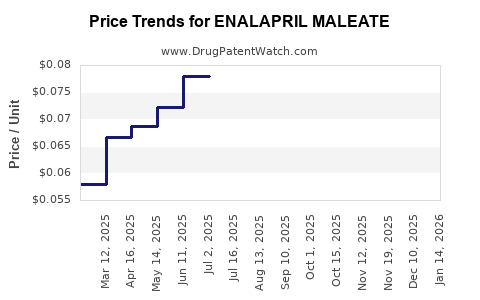
Since patent expiration, prices have declined by approximately 70% in developed markets. In developing countries, reductions are less pronounced due to procurement costs and regulatory factors.
Future Price Projections (Next 5 Years)
Price stability is expected as generic competition saturates markets. However, factors such as supply chain disruptions, raw material costs, and regional price regulations could influence prices.
| Region |
Projected Price Change (2023-2028) |
Rationale |
| U.S. |
-10% to 0% |
Market saturation, stable demand, potential new entrants |
| Europe |
-5% to 0% |
Regulatory limits on price reductions |
| India |
0% to -10% |
High competition, procurement volume influence |
The trend indicates largely stable or decreasing prices, with developed markets approaching price floors dictated by manufacturing costs.
Market Challenges and Opportunities
Challenges
-
Regulatory Barriers: Stringent approval processes and import restrictions can limit market access.
-
Pricing Regulations: Government price controls, especially in Europe and emerging markets, cap potential price increases.
-
Switching Trends: Transition to newer ACE inhibitors or ARBs in some regions could decrease demand.
Opportunities
-
Expanding Access: Growing healthcare infrastructure in emerging markets increases overall volume.
-
Combination Formulations: Fixed-dose combinations with other antihypertensives provide incremental revenue.
-
Biosimilar Development: While no biosimilar exists for enalapril, innovations could clarify pathways for future formulations.
Summary
Enalapril Maleate has experienced significant price declines following patent expiration. The drug maintains a substantial market share due to its efficacy, affordability, and WHO recognition. Price stabilization is expected domestically but may fluctuate regionally based on regulatory policies and supply conditions. Growth prospects hinge on expanding treatment access in developing economies and potential pipeline innovation.
Key Takeaways
- Generic competition has drastically reduced enalapril prices since patent expiry, particularly in North America and Europe.
- The global antihypertensive market, with ACE inhibitors representing a quarter of the segment, remains sizable.
- Price projections indicate stabilization or further reductions thanks to market saturation.
- Market challenges include regulatory and competitive pressures; opportunities arise from expanding access and combination therapies.
- Developing regions offer growth potential due to increasing hypertension prevalence, despite lower pricing trends.
FAQs
1. Will enalapril prices rise again?
Unlikely in established markets due to intense generic competition and price regulation. Slight increases could occur if supply constraints or raw material costs rise.
2. Are there branded versions still available?
Branded enalapril products exist but are primarily used in markets with limited generic penetration, often at higher prices.
3. How does enalapril compare to other ACE inhibitors?
Enalapril is among the oldest and most studied ACE inhibitors, with comparable efficacy to newer agents like ramipril. Cost and patent status influence its market share.
4. What are the side effects influencing prescribing patterns?
Common side effects include cough, hyperkalemia, and hypotension. Tolerance profiles may lead clinicians to prefer alternatives in certain cases.
5. What is the outlook for biosimilars or patents?
No biosimilars exist; enalapril is a small-molecule drug. No new patents are imminent but future formulations could emerge.
References
- IQVIA, "Global Prescription Drug Market Report," 2022.
- WHO, "Model List of Essential Medicines," 22nd edition, 2021.
- U.S. FDA, "Enalapril Maleate Drug Approval," 1985.
- MarketWatch, "Antihypertensive Drugs Market Size & Trends," 2024.
- Grand View Research, "ACE Inhibitors Market Analysis," 2022.