Last updated: February 12, 2026
Market Overview for Cyclosporine
Cyclosporine is an immunosuppressant primarily used to prevent organ rejection after transplantation and treat autoimmune disorders such as psoriasis and rheumatoid arthritis. It holds a dominant position in transplant medicine, with a significant presence in autoimmune conditions.
Market Size and Revenue
The global cyclosporine market was valued at approximately $2.2 billion in 2022. Growth is driven by increasing organ transplant procedures worldwide, expanding autoimmune disease prevalence, and technological advances in drug formulations.
Key Market Segments
- Therapeutic Use: Organ transplant (predominant), autoimmune diseases
- Formulations: Oral capsules, intravenous solutions, topical formulations
- End Users: Hospitals, clinics, specialty pharmacies
Regional Market Distribution
| Region |
Market Share |
Key Countries |
| North America |
45% |
U.S., Canada |
| Europe |
30% |
Germany, France, U.K. |
| Asia-Pacific |
15% |
China, Japan, India |
| Rest of World |
10% |
Latin America, Middle East |
Growth is most robust in Asia-Pacific, driven by emerging healthcare infrastructure, rising transplantation rates, and increasing autoimmune disease diagnosis.
Competitive Landscape
Major pharmaceutical companies manufacture cyclosporine, including:
- Novartis: Produces Sandimmune and Neoral
- Pfizer: Produces Prograf
- Gentium (recorded acquisition by Italfarmaco): Produces other formulations
- Generics manufacturers: Significant market share due to patent expirations
Patent expiry for brand-name cyclosporine formulations occurred mostly between 2010-2018, leading to increased generic competition. This has exerted downward pressure on prices and margins.
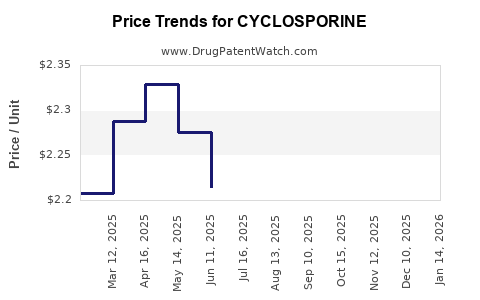
Price Trends and Projections
Historical Pricing
- Brand-name (e.g., Neoral): Starting around $700-$1,000 per month in 2010, with regional variations.
- Generics: Prices declined sharply post-patent expiration, with some generic versions available for less than $200 per month by 2020.
Current Price Range (2023)
| Formulation |
Estimated Monthly Cost |
Notes |
| Brand-name |
$800 – $1,200 |
Based on U.S. market pricing |
| Generics |
$150 – $250 |
Widely available, competition drives prices down |
Price Volatility Factors
- Patent litigation or exclusivity extensions
- Regulatory approvals for biosimilars or new formulations
- Supply chain disruptions affecting manufacturing costs
- Healthcare policy changes influencing reimbursement and pricing
Future Price Trajectories (2024-2028)
- Price stabilization or slight decline: As generics cement market share, prices are unlikely to revert to pre-patent-expiration levels.
- Premium formulations: Innovations in formulations delivering improved bioavailability may command higher prices, potentially offsetting generic price declines.
- Potential impact of biosimilars: If biosimilar versions gain approval and adoption, prices could decrease further, with estimates suggesting a 10-20% decline over the next five years.
Regulatory and Policy Impact
- Pricing regulations in regions such as the EU and U.S. influence pricing dynamics.
- Healthcare reforms promoting biosimilar adoption may disrupt current market equilibria.
- Patent litigations can temporarily extend exclusivity and influence prices.
Technological Trends
- Development of more targeted formulations may allow better patient compliance and therapeutic outcomes, possibly commanding premium prices.
- Increased adoption of biosimilars can reduce overall market prices.
Investment and R&D Outlook
Research is ongoing into new immunosuppressants with improved safety profiles, which may affect the demand and pricing for traditional cyclosporine products.
Key Takeaways
- The market for cyclosporine was valued at about $2.2 billion in 2022.
- The patent expiration of leading formulations has led to increased generic competition and price reductions.
- Current prices for branded versions are $800-$1,200 per month; generics are $150-$250.
- Price trends suggest continued declines in the generics segment, with possible stabilization for branded products.
- Regulatory policies and innovations will significantly influence future pricing and market share.
FAQs
1. How does generic competition influence cyclosporine prices?
Generic competition has driven prices down significantly since patent expirations, with generics typically priced 75-80% lower than brand-name versions. As more generics enter the market, prices tend to stabilize at lower levels.
2. What regions are seeing the most growth for cyclosporine?
Asia-Pacific exhibits the fastest growth, driven by rising transplantation procedures, autoimmune disease prevalence, and healthcare infrastructure improvements.
3. Are biosimilars expected to impact the cyclosporine market?
If biosimilars gain approval and adopt market acceptance, they could further reduce prices, potentially by 10-20% over five years, and increase accessibility.
4. What are the main factors affecting future prices?
Regulatory changes, patent litigation, supply chain stability, and technological advancements in formulations are primary drivers of future price movements.
5. What is the outlook on development of new immunosuppressants?
Ongoing R&D aims to produce safer, more effective immunosuppressants, which could affect demand and pricing for existing drugs like cyclosporine.
References
- Industry Reports and Market Data. (2022). Global Cyclosporine Market Analysis.
- IMS Health. (2023). Pharmaceutical Price Trends.
- U.S. FDA Approvals Database. (2023). Biosimilar and generic approvals.
- European Medicines Agency. (2023). Patent and Pricing Policies.
- MarketWatch. (2023). Future Outlook for Immunosuppressants.
Note: Data and projections are based on industry reports and publicly available market insights as of early 2023.