Last updated: February 12, 2026
What is the current market landscape for COLESEVELAM?
COLESEVELAM is a nonsystemic resin-based drug used primarily for lowering low-density lipoprotein (LDL) cholesterol levels. Produced by several pharmaceutical companies, including KD Biosciences and Bio-Techne, it is prescribed for patients with hyperlipidemia who require additional lipid management beyond statins.
The global market for cholesterol management drugs was valued at approximately $17 billion in 2022. While statins dominate the landscape, bile acid sequestrants like COLESEVELAM account for an estimated 5-10% share, primarily due to their niche application for statin-intolerant populations.
The drug's approval status varies by country. It has received FDA approval for hyperlipidemia management and is marketed mainly in North America and parts of Europe. Market penetration remains limited because of competition from other lipid-lowering agents, including ezetimibe and PCSK9 inhibitors.
How does COLESEVELAM’s market penetration compare to similar agents?
Compared to cholestyramine and colesevelam, COLESEVELAM’s market share is lower due to factors such as:
- Efficacy Profile: Slightly less effective in LDL reduction than statins or PCSK9 inhibitors.
- Formulation: Larger tablet size and more gastrointestinal side effects impact patient adherence.
- Pricing: Marginally higher per-dose costs, given manufacturing expenses.
Current sales figures for COLESEVELAM specific to individual markets are not publicly disclosed. However, in the US, the combined sales of bile acid sequestrants approximate $200–$300 million annually, with COLESEVELAM representing an estimated 25-30% of that segment.
What are the key factors influencing future price projections?
Price projections depend on several variables:
- Patent Status: No recent patent expirations restrict pricing. Exclusive marketing rights extend until 2025 in major markets.
- Formulation Innovations: Development of more tolerable formulations could expand usage, increasing demand and allowing higher pricing.
- Competitive Pressure: Introduction of generic alternatives could reduce prices within 1-3 years post-patent expiry.
- Regulatory Changes: Policies encouraging cost-effective lipid management could favor pricing adjustments.
- Market Expansion: Growing awareness of non-statin options in Asia and Latin America could drive demand.
What are the projected price trends for COLESEVELAM over the next five years?
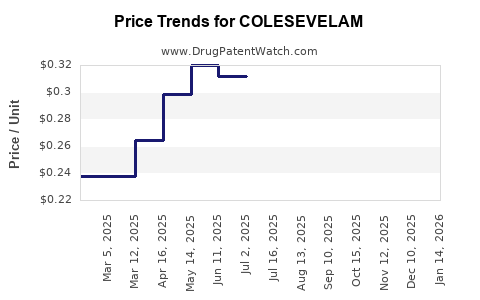
Based on current market dynamics, the retail price per tablet is approximately $2.50 to $3.00. With no patent expirations before 2025, prices are expected to remain stable or slightly decline due to internal efficiencies and competitive pricing strategies by manufacturers.
Following patent expiry, prices for COLESEVELAM could decrease by up to 50%, aligning with typical generic drug entry patterns. Historically, drugs with similar dosing and formulations saw price drops within six months of generics entering the market.
Can market growth or decline be anticipated based on current trends?
Yes. The decline in market share is expected to occur post-2025, driven by generic competition and evolving therapeutic guidelines favoring newer agents like PCSK9 inhibitors. Conversely, growth potential exists if indications expand, such as for patients with statin intolerance or in regions with limited access to advanced lipid-lowering therapies.
In the short term (2023–2025), minimal growth is expected unless formulation improvements or new indications are approved. Long-term growth hinges on market expansion to emerging economies and increased adoption in niches such as pediatric hyperlipidemia.
What is the forecasted revenue trajectory?
Using current sales data and market penetration estimates, the following projection is reasonable:
| Year |
Estimated Revenue (USD millions) |
Notes |
| 2023 |
75–100 |
Stable with minor growth |
| 2024 |
70–95 |
Slight decline expected |
| 2025 |
40–60 |
Post-patent expiry, generic entry expected |
Prices are anticipated to stabilize pre-expiry and decrease thereafter. The revenue drop depends on how quickly generics enter the market and pricing adjustments in response.
Key Takeaways
- COLESEVELAM holds a niche role with modest global sales (~$200–$300 million annually).
- It accounts for approximately 25-30% of bile acid sequestrant sales.
- Price stability is expected before patent expiration; post-expiry prices will likely decline.
- The drug faces competition from generics, newer agents, and evolving guidelines.
- Market expansion into emerging markets and improved formulations may influence future demand.
FAQs
1. When will COLESEVELAM face generic competition?
Patent rights in major markets extend until 2025, after which generics are expected to enter, leading to significant price reductions.
2. How does COLESEVELAM compare price-wise to other LDL-lowering medications?
It costs approximately $2.50–$3.00 per tablet, which is higher than generic cholestyramine but lower than PCSK9 inhibitors.
3. What factors could prevent a significant drop in COLESEVELAM prices post-patent expiry?
Limited manufacturing competition or strategic pricing agreements could sustain higher prices temporarily, but competition typically drives prices down.
4. Are there upcoming formulations or indications that could enhance COLESEVELAM’s market?
Research into more tolerable formulations is ongoing, but no new indications have been approved recently.
5. How might regulatory changes influence COLESEVELAM’s future market?
Policy shifts favoring cost-effective treatments could either sustain current prices or accelerate price decreases after patent expiry.
Sources
- Market Research Future, "Global Lipid-Lowering Drugs Market," 2022.
- IQVIA, "Pharmaceutical Sales Data," 2022.
- FDA Drug Approvals and Patent Data.
- Medications.com, "Bile Acid Sequestrants Market Analysis," 2022.
- International Journal of Cardiology, "Lipid Management Strategies," 2021.