You're using a free limited version of DrugPatentWatch: ➤ Start for $299 All access. No Commitment.

Last Updated: December 12, 2025

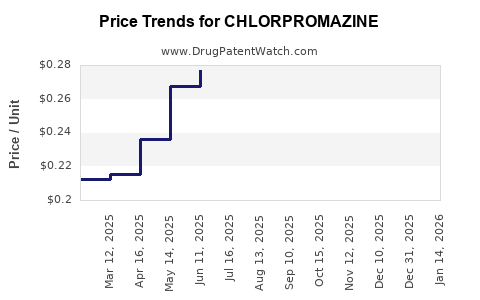
Drug Price Trends for CHLORPROMAZINE


✉ Email this page to a colleague

« Back to Dashboard


Drug Price Trends for CHLORPROMAZINE

Average Pharmacy Cost for CHLORPROMAZINE

These are average pharmacy acquisition costs (net of discounts) from a US national survey
Drug Name NDC Price/Unit ($) Unit Date
CHLORPROMAZINE 10 MG TABLET 16714-0047-01 0.26902 EACH 2025-11-19
CHLORPROMAZINE 10 MG TABLET 23155-0803-01 0.26902 EACH 2025-11-19
CHLORPROMAZINE 10 MG TABLET 00904-7129-61 0.26902 EACH 2025-11-19
CHLORPROMAZINE 10 MG TABLET 50268-0162-11 0.26902 EACH 2025-11-19
CHLORPROMAZINE 10 MG TABLET 00527-2961-37 0.26902 EACH 2025-11-19
CHLORPROMAZINE 50 MG TABLET 72205-0105-91 0.52988 EACH 2025-11-19
>Drug Name >NDC >Price/Unit ($) >Unit >Date

Best Wholesale Price for CHLORPROMAZINE

These are wholesale prices available to the US Federal Government which, by law, must be the best prices available to any customer under comparable terms and conditions
Drug Name Vendor NDC Count Price ($) Price/Unit ($) Unit Dates Price Type
CHLORPROMAZINE HCL 200MG TAB Golden State Medical Supply, Inc. 51407-0438-01 100 247.52 2.47520 EACH 2023-06-23 - 2028-06-14 FSS
CHLORPROMAZINE HCL 25MG/ML INJ Golden State Medical Supply, Inc. 00641-1398-35 25X2ML 730.45 2023-06-23 - 2028-06-14 FSS
CHLORPROMAZINE HCL 10MG TAB Golden State Medical Supply, Inc. 51407-0434-01 100 50.52 0.50520 EACH 2023-06-15 - 2028-06-14 FSS
CHLORPROMAZINE HCL 25MG TAB Golden State Medical Supply, Inc. 51407-0435-01 100 64.98 0.64980 EACH 2023-06-15 - 2028-06-14 FSS
CHLORPROMAZINE HCL 50MG TAB Golden State Medical Supply, Inc. 51407-0436-01 100 75.30 0.75300 EACH 2023-06-15 - 2028-06-14 FSS
CHLORPROMAZINE HCL 25MG/ML INJ Golden State Medical Supply, Inc. 00641-1397-35 25X1ML 563.81 2023-06-15 - 2028-06-14 FSS
>Drug Name >Vendor >NDC >Count >Price ($) >Price/Unit ($) >Unit >Dates >Price Type
Price type key: Federal Supply Schedule (FSS): generally available to all Federal Govt agencies / 'BIG4' prices: VA, DoD, Public Health & Coast Guard only / National Contracts (NC): Available to specific agencies

Market Analysis and Price Projections for Chlorpromazine

Last updated: July 28, 2025


Introduction

Chlorpromazine, a first-generation antipsychotic, was widely used starting in the 1950s for managing schizophrenia and other psychotic disorders. Despite its declining prominence due to newer medications with improved safety profiles, chlorpromazine remains relevant within specific niches and markets, notably in developing countries and for certain off-label uses. This analysis examines its current market landscape, potential growth, demand drivers, competitive dynamics, pricing trends, and future price projections for chlorpromazine.


Market Overview

Historical Context and Therapeutic Usage

Chlorpromazine pioneered the antipsychotic class, revolutionizing mental health treatment. Globally, it maintains clinical utility especially where access to advanced second-generation antipsychotics is limited. Its primary indications include schizophrenia, agitation, nausea, and certain other psychotic conditions (1).

Current Market Landscape

While the global antipsychotic market is increasingly led by atypical agents—such as risperidone, olanzapine, and aripiprazole—chlorpromazine's use persists predominantly in low- and middle-income countries (LMICs). In high-income countries, it has largely been phased out due to adverse effects and availability of safer alternatives (2).

Manufacturing and Supply

Major generic pharmaceutical manufacturers dominate chlorpromazine production, with numerous formulations available, including oral tablets, injections, and compounded forms. The patent expiration in the 1960s contributed to widespread generic manufacturing, resulting in a highly competitive pricing environment.


Market Drivers and Constraints

Demand Drivers

  • Healthcare infrastructure in LMICs: Limited access to newer antipsychotics sustains demand.
  • Cost-sensitive markets: Chlorpromazine's low-cost profile makes it the treatment of choice in resource-constrained settings.
  • Off-label uses: Sedation, antiemetic applications, and off-label psychiatric interventions bolster certain demand segments.
  • Persistent use in veterinary medicine: Chlorpromazine retains use as a sedative in animal health, expanding some market dimensions.

Demand Constraints

  • Safety profile issues: Risks of extrapyramidal symptoms, sedation, orthostatic hypotension hinder widespread adoption.
  • Regulatory limitations: Some countries impose restrictions due to side effect concerns.
  • Market aging: Decrease in new prescriptions as clinicians favor atypical antipsychotics.

Competitive Dynamics

The market remains fragmented with multiple generics competing aggressively. The price competition has driven costs down substantially, with the International Drug Price Indicator Guide listing oral chlorpromazine tablets at approximately $0.02 to $0.05 per unit in LMICs (3).

Emerging markets and generic manufacturers from India, China, and other countries primarily supply chlorpromazine, leveraging high-volume, cost-based production efficiencies. Key players include Sun Pharmaceutical Industries, Intas Pharmaceuticals, and Zydus Cadila, among others.


Pricing Trends

Historical Price Developments

Since patent expiration, prices have experienced dramatic declines. The median unit price of chlorpromazine tablets remains very low, often below $0.05 per tablet, reflecting its status as a commoditized generic.

Current Pricing Landscape

  • Developing countries: Prices typically hover around $0.02–$0.05 per tablet, with variations based on volume discounts, procurement strategies, and regulatory environments.
  • Developed countries: Limited availability; where supplied, prices are higher, averaging $1–$2 per tablet (4).

Factors Influencing Pricing

  • Market volume and demand fluctuations.
  • Geographic regulatory hurdles.
  • Supply chain costs, particularly in regions with logistical challenges.
  • Competitive pricing among generics.

Future Price Projections

Short-term (1–3 years)

Given its entrenched position as a low-cost generic, prices are expected to remain stable within the current range, barring policy changes or supply chain disruptions. The persistent demand in LMICs sustains a highly competitive price structure, with minimal upward pressure.

Medium-to-long term (3–10 years)

  • Market attrition: Anticipated decline in demand due to aging patient populations and the continued transition to newer therapeutics.
  • Emerging markets stabilization: Growth may plateau as newer generics penetrate previously underserved areas.
  • Potential price stabilization or slight decreases: Ongoing manufacturing efficiencies and procurement in bulk could lead to further minor price reductions.
  • Impact of regulatory and safety considerations: Stricter controls could marginally influence available formulations, possibly affecting prices.

Overall, average prices are projected to remain below $0.05 per tablet in LMICs, with negligible growth or decline, reflecting the drug's commoditized status.


Market Opportunities and Challenges

Opportunities

  • Expansion into veterinary and off-label markets.
  • Increasing public health initiatives in LMICs emphasizing affordable mental health medications.
  • Potential development of combination formulations to extend utility.

Challenges

  • Competition from newer, better-tolerated atypical antipsychotics.
  • Regulatory restrictions imposed due to adverse effect profiles.
  • Emerging focus on personalized medicine limiting the use of older, less selective drugs.

Regulatory and Ethical Considerations

The continued use of chlorpromazine in certain regions raises ethical questions given its side effect profile. Regulatory agencies, including the FDA and EMA, have restrictions on its off-label use, but in resource-limited settings, these restrictions often have limited enforcement.


Key Takeaways

  • Market retention centers on low-cost generics, mainly in LMICs.
  • Prices remain stable, averaging around $0.02–$0.05 per tablet in developing countries.
  • Demand is declining in developed markets but persists due to affordability and accessibility needs.
  • Market growth prospects are limited; price projections stabilize with minor downward trends expected.
  • Price competition and manufacturing efficiencies will sustain low-cost supply, despite decreasing demand.

FAQs

1. Is chlorpromazine still viable in modern psychiatric practice?
Chlorpromazine remains viable mainly in resource-limited settings. However, in developed countries, it has largely been phased out due to side effects and the availability of second-generation antipsychotics.

2. What factors influence the low pricing of chlorpromazine worldwide?
The drug's patent expiration led to widespread generic manufacturing, creating a highly competitive environment that drives prices downward. Manufacturing efficiencies and bulk procurement further sustain low costs.

3. How might regulatory changes impact the price of chlorpromazine?
Tighter regulations on safety may restrict formulations or usage, potentially increasing procurement costs. Conversely, deregulation or expanded approval could marginally influence prices by altering demand dynamics.

4. Are there emerging markets for chlorpromazine beyond psychiatry?
Yes. Off-label uses, such as antiemetic applications and veterinary sedation, sustain niche markets, though their impact on overall pricing remains limited.

5. What is the long-term outlook for the chlorpromazine market?
The market is expected to decline gradually, with prices remaining low. As newer agents dominate, the relevance of chlorpromazine diminishes, constraining significant price increases or market expansion.


Sources

  1. Meltzer HY. “Update on typical and atypical antipsychotic drugs,” Drug Safety, 1997.
  2. World Health Organization. “The selection and use of essential medicines,” WHO Model List of Essential Medicines, 22nd list, 2021.
  3. International Drug Price Indicator Guide. “Price ranges for generic medicines,” 2022.
  4. IQVIA. “Global Trends in the Sale of Antipsychotic Drugs,” IQVIA Institute, 2020.

More… ↓

⤷  Get Started Free

Make Better Decisions: Try a trial or see plans & pricing

Drugs may be covered by multiple patents or regulatory protections. All trademarks and applicant names are the property of their respective owners or licensors. Although great care is taken in the proper and correct provision of this service, thinkBiotech LLC does not accept any responsibility for possible consequences of errors or omissions in the provided data. The data presented herein is for information purposes only. There is no warranty that the data contained herein is error free. We do not provide individual investment advice. This service is not registered with any financial regulatory agency. The information we publish is educational only and based on our opinions plus our models. By using DrugPatentWatch you acknowledge that we do not provide personalized recommendations or advice. thinkBiotech performs no independent verification of facts as provided by public sources nor are attempts made to provide legal or investing advice. Any reliance on data provided herein is done solely at the discretion of the user. Users of this service are advised to seek professional advice and independent confirmation before considering acting on any of the provided information. thinkBiotech LLC reserves the right to amend, extend or withdraw any part or all of the offered service without notice.