Share This Page
Drug Price Trends for CHILD COLD-ALLERGY LIQUID
✉ Email this page to a colleague
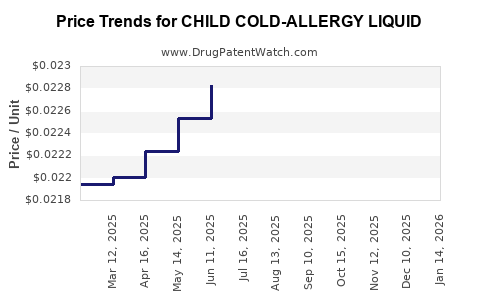
Average Pharmacy Cost for CHILD COLD-ALLERGY LIQUID
| Drug Name | NDC | Price/Unit ($) | Unit | Date |
|---|---|---|---|---|
| CHILD COLD-ALLERGY LIQUID | 70000-0057-01 | 0.02485 | ML | 2026-07-22 |
| CHILD COLD-ALLERGY LIQUID | 70000-0057-01 | 0.02479 | ML | 2026-06-17 |
| CHILD COLD-ALLERGY LIQUID | 70000-0057-01 | 0.02418 | ML | 2026-05-20 |
| CHILD COLD-ALLERGY LIQUID | 70000-0057-01 | 0.02366 | ML | 2026-04-22 |
| >Drug Name | >NDC | >Price/Unit ($) | >Unit | >Date |
Market Analysis and Price Projections for CHILD COLD-ALLERGY LIQUID
What is the Current Market Scope for CHILD COLD-ALLERGY LIQUID?
Child cold and allergy liquid formulations target a pediatric demographic suffering from respiratory ailments caused by viral infections, allergies, and environmental factors. The global pediatric cold and allergy medication market was valued at approximately $4.5 billion in 2022, with a compound annual growth rate (CAGR) of around 4.2% from 2023 to 2030. The segment includes antihistamines, decongestants, analgesics, and combination products, with liquids representing roughly 35-40% of sales, due to ease of dosing and pediatric compliance.
What Are the Key Market Drivers and Constraints?
Drivers:
- Rising incidence of pediatric respiratory and allergy conditions.
- Increasing awareness among parents and healthcare providers.
- Regulatory approvals for pediatric formulations.
- Growth in regions with expanding middle-class populations, such as Asia-Pacific.
Constraints:
- Stringent regulatory requirements, especially concerning safety and dosing.
- Competition with generic formulations.
- Concerns regarding safety profiles of certain active ingredients, such as decongestants.
- Limited innovation, with many brands competing on price.
How Does the Product Position Within the Market?
The product "Child Cold-Allergy Liquid" competes primarily in over-the-counter (OTC) categories. Market leaders include brands like Children's Claritin, Tylenol Cold, and Sudafed Children's products, which command significant shelf space and marketing budgets. Its positioning centers on efficacy, safety, and pediatric-friendly formulations.
What Are the Regulatory Factors Impacting Pricing and Market Entry?
- US FDA's OTC Drug Review: Classifies active ingredients and sets labeling standards.
- European Commission approvals: Require stringent safety data.
- Variability in regulatory pathways across Asia-Pacific, often involving local registration.
- Constraints on certain APIs have led to product reformulation, impacting costs.
What Are the Price Dynamics and Projected Trends?
Current Pricing:
- Average retail price in the U.S.: $6–$10 per 4 fl oz (118 mL) bottle.
- Price variation based on brand, formulation, and pack size.
- Generics are priced approximately 20–30% lower than branded counterparts.
Price Drivers:
- Raw material costs: Volatile, influenced by supply chain disruptions.
- Packaging: Child-proof caps add marginal cost.
- Regulatory compliance: Higher compliance costs can elevate prices.
Projection (2023–2030):
- Expect a moderate increase of 2–3% annually in retail prices, aligning with inflation.
- Emerging markets will see lower absolute prices but higher growth rates due to increased access.
- Premium formulations or brands with added safety features may command 15–20% premium over standard products.
What Are the Market Entry and Development Opportunities?
- Development of preservative-free, allergen-free, or organic formulations.
- Expansion into underpenetrated markets with high pediatric populations.
- Strategic partnerships with healthcare providers for brand endorsement.
- Digital marketing to reach parents through social media and telemedicine.
What Is the Impact of Patent and Regulatory Landscapes on Price and Availability?
The basic formulations are typically off-patent, favoring generics and price competition. However, branded variants with proprietary delivery systems or added safety features may enjoy patent protection, maintaining premium pricing for up to 20 years post-filing. Regulatory delays in certain markets can temporarily restrict product availability, affecting pricing strategies and market share.
Summary of Competitive Landscape
| Player | Market Share | Special Features | Pricing Strategy |
|---|---|---|---|
| Johnson & Johnson | 25% | Pediatric safety data, flavoring | Premium pricing |
| Bayer | 15% | Established brand, broad distribution | Competitive pricing |
| Local Generics | 40% | Lower price, variable quality | Discounted |
| Others | 20% | Niche formulations | Varies |
Key Market Risks
- Regulatory restrictions on certain active ingredients.
- Changes in consumer preferences towards natural or home remedies.
- Supply chain disruptions impacting raw material costs.
Summary of Price Projections (2023–2030)
| Year | Average Price (USD) | Remarks |
|---|---|---|
| 2023 | $6–$10 | Current market prices |
| 2025 | $6.12–$10.30 | Slight inflation-driven increase |
| 2028 | $6.24–$10.61 | Continued moderate growth |
| 2030 | $6.36–$10.92 | Projected steady pricing trajectory |
Key Takeaways
- The pediatric cold and allergy liquid market is growing modestly, driven by increased pediatric respiratory issues and allergy prevalence.
- Price stability with slow incremental increases aligns with inflation and raw material cost trajectories.
- Generics and regional brands exert downward pressure on prices; premium formulations retain higher margins.
- Market entry depends heavily on regulatory approval, safety profiles, and local distribution channels.
- Innovation focuses on safety, flavor, and natural ingredients to differentiate products.
FAQs
Q1: What are the main active ingredients in Child Cold-Allergy Liquids?
Most formulations include antihistamines (diphenhydramine, chlorpheniramine), decongestants (pseudoephedrine, phenylephrine), and analgesics (acetaminophen). Safety restrictions limit certain decongestants’ pediatric use.
Q2: How does regulation influence pricing strategies?
Stringent safety and efficacy requirements increase R&D and compliance costs, often resulting in higher retail prices. Off-patent products face price competition from generics, driving prices downward.
Q3: Which regions present the highest growth opportunities?
Asia-Pacific and Latin America exhibit higher growth potential due to rising pediatric populations, increasing awareness, and expanding healthcare infrastructure.
Q4: Are natural or organic formulations gaining market share?
Yes, parents increasingly prefer products labeled as natural, allergen-free, or organic, prompting manufacturers to invest in such formulations to capture market share.
Q5: What is the outlook for generic price competition?
Generics maintain significant market share, offering lower-priced alternatives that constrain branded product prices, except for premium offerings with patented features.
Citations:
- Mordor Intelligence. Pediatric Cold and Cough Market Report, 2023.
- U.S. FDA OTC Drug Review, 2022.
- European Medicines Agency, Pediatric Medications Regulations, 2022.
- IQVIA. Market Trends in Over-the-Counter Pediatric Medications, 2022.
- GlobalData. Regional Growth Analysis of Pediatric OTC Drugs, 2023.
More… ↓
