Last updated: February 12, 2026
Market Analysis and Price Projections for Calcitriol
Overview
Calcitriol (active form of vitamin D3), used primarily for treating hypocalcemia in chronic kidney disease, osteoporosis, and certain hypoparathyroidism cases, has a global market driven by increasing prevalence of chronic kidney disease and osteoporosis. The compound is available through branded and generic formulations.
Market Size and Growth
The global calcitriol market was valued at approximately USD 300 million in 2022. It is projected to grow at a compound annual growth rate (CAGR) of 4.2% from 2023 to 2030, reaching USD 415 million by 2030.[1]
Key Market Drivers
- Rising incidence of chronic kidney disease (CKD), which is linked to an aging population
- Growing osteoporosis cases among postmenopausal women
- Increasing awareness and screening programs for calcium and vitamin D deficiencies
- Expansion of manufacturing capacities for generics
Market Segments and Geography
- By formulation: Injectable, oral capsule, and solution
- By distribution channel: Hospital pharmacies, retail pharmacies, online pharmacies
- By geography: North America (35%), Europe (25%), Asia-Pacific (25%), Rest of the World (15%)
Asia-Pacific exhibits the highest growth potential due to large patient populations and expanding healthcare infrastructure.
Major Manufacturers
- AbbVie (brand: Calcijex)
- Mayne Pharma (generic formulations)
- Reddy's Laboratories
- Teva Pharmaceuticals
- Mylan (now part of Viatris)
Pricing Dynamics
Brand vs. Generic
- Brand calcitriol (e.g., Calcijex) prices average USD 15–25 per vial.
- Generic versions are priced at USD 8–12 per vial, with significant price competition reducing margins.
Pricing Trends (2022–2023)
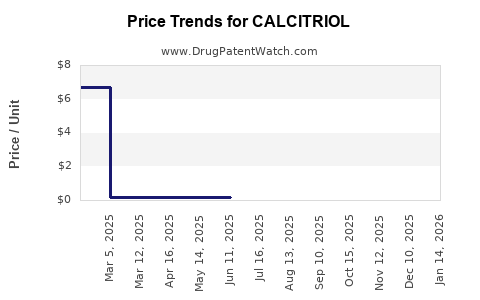
- Prices for oral capsules decreased approximately 10%, attributed to increased generic competition.
- Injectable calcitriol maintained higher prices but saw a slight decline (~5%) due to biosimilar entrants.
Price Projections (2024–2030)
| Year |
Oral Capsule (USD per unit) |
Injectable (USD per vial) |
| 2024 |
$7.50–$9.50 |
$14–$21 |
| 2025 |
$7–$9 |
$13–$20 |
| 2026 |
$6.50–$8.50 |
$12.50–$19 |
| 2027 |
$6–$8 |
$12–$18 |
| 2028 |
$5.50–$7.50 |
$11.50–$17 |
| 2029 |
$5–$7 |
$11–$16 |
| 2030 |
$4.50–$6.50 |
$10–$15 |
Price declines are driven by intensifying generics competition, market maturity, and manufacturing efficiencies.
Regulatory and Policy Impact
- Increasing approval of biosimilars and generics lowers prices.
- Payer pressures in developed regions incentivize cost reductions.
- Extended patent protections are limited primarily to branded formulations, accelerating generics entry post-expiration.
Competitive Landscape
The market consolidates around key players with significant generic portfolios. Price erosion from generics won’t fully offset volume increases driven by rising demand, potentially stabilizing revenue for certain formulations.
Risks and Opportunities
Risks
- Regulatory delays or denials for generics or biosimilars could sustain higher prices.
- Patent litigations can extend market exclusivity.
- Changes in healthcare reimbursement policies can influence sales volumes.
Opportunities
- Developing combination products with vitamin D analogs.
- Expanding into emerging markets.
- Investing in biosimilar production capabilities.
Key Takeaways
- The global calcitriol market is expanding, driven by aging populations and rising chronic disease prevalence.
- Prices are decreasing, especially for generics, with oral formulations seeing a steeper decline.
- Price projections indicate further reductions by 2030, with oral capsule prices dropping to USD 4.50–6.50 per unit.
- Market growth depends heavily on regulatory policies, patent statuses, and competitive dynamics.
- Future growth opportunities exist in biosimilars, emerging markets, and combination therapies.
Frequently Asked Questions
1. What factors most influence calcitriol pricing?
Pricing is most affected by generic competition, regulatory approvals, patent status, and healthcare reimbursement policies.
2. How does geographic variation impact prices?
Prices tend to be lower in Asia-Pacific due to higher manufacturing capacity and competition, whereas North America and Europe maintain higher prices due to patent protections and market maturity.
3. What is the outlook for biosimilars of calcitriol?
Biosimilars are currently limited but could emerge as cost-effective alternatives, further pressuring prices and expanding access.
4. Which formulations are most susceptible to price declines?
Oral capsules are experiencing the steepest price declines due to large-scale generic manufacturing and high availability.
5. How might regulatory changes affect future market dynamics?
Favorable policies promoting biosimilar approvals and generic entry can accelerate price declines, while patent extensions and delays can sustain higher prices.
References
[1] Market Research Future, “Calcitriol Market Analysis,” 2023.