Last updated: February 12, 2026
Overview of BARACLUDE
Baraclude (entecavir) is an antiviral medication approved by the FDA in 2005 for the treatment of chronic hepatitis B virus (HBV) infection. Its mechanism involves inhibiting HBV replication, reducing viral load, and decreasing the risk of cirrhosis and hepatocellular carcinoma. It is marketed by BMS (Bristol-Myers Squibb).
Market Size and Growth Potential
Current Market Scope
- Global HBV prevalence: Approximately 296 million people are infected worldwide, with an estimated 887,000 deaths annually due to HBV-related liver disease (WHO, 2021).
- Market segments: Treatment-naive patients, those switching from other antivirals, and patients requiring long-term management.
- Therapeutic landscape: Includes tenofovir disoproxil fumarate (Viread), tenofovir alafenamide (Vemlidy), and lamivudine. Entecavir holds a significant share due to high efficacy and resistance profile.
Market Trends
- Increasing prevalence: Rising HBV cases in Asia-Pacific and Africa provide expanding markets.
- Regulatory approvals: Expanding indications for various HBV infections broaden potential user base.
- Generic entry: Pending patent expirations could impact pricing but currently limited due to patent protections.
Competitive Landscape
| Drug |
Developer |
Approval Year |
Market Share (2022) |
Notable Features |
| Entecavir (Baraclude) |
Bristol-Myers Squibb |
2005 |
40% |
High potency, low resistance, long-term safety |
| Tenofovir (Viread) |
Gilead Sciences |
2001 |
35% |
Widely used, resistance concerns at monotherapy |
| Tenofovir alafenamide |
Gilead Sciences |
2016 |
20% |
Better renal and bone safety profile |
| Lamivudine |
GSK |
1998 |
5% |
Resistance common, less favored |
Price and Cost Dynamics
Current Pricing
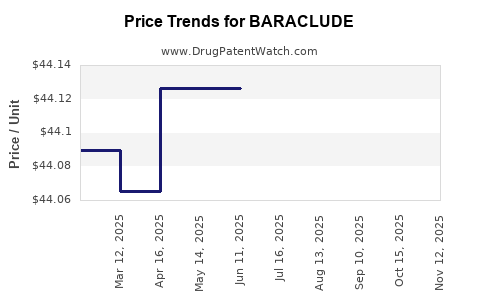
- Brand-name entecavir (U.S.): Approximately $2,200–$2,800/month per patient (GoodRx, 2023).
- International markets: Prices vary, often lower in low- and middle-income countries, ranging from $20–$100/month.
Cost Drivers
- Manufacturing and R&D costs: High initial R&D, especially for formulations and formulations innovating to extend patent life.
- Market exclusivity: Patent protections secure pricing power; expected to expire around 2026 in the U.S.
- Pricing strategies: Branded pricing remains high in patent-protected environments; discounts are common in negotiated insurance deals.
Price Projections
| Timeline |
Price Range (U.S.) |
Notes |
| 2023–2025 |
$2,200–$2,800 |
No generic competition; brand dominant |
| 2026–2028 |
$1,500–$2,200 |
Patent expiration begins, generic entry risks increase |
| 2028+ |
$300–$1,000 |
Market-wide generic competition stabilizes prices |
Future Market Considerations
- Patent expiration: Once generics enter the market, prices could drop by 50–80%, depending on regional health policies.
- New formulations: Extended-release or combination therapies could influence prices.
- Treatment guidelines: Updates recommending monotherapy or combination regimens could shift market dynamics.
Strategic Implications
- In licensing and partnerships: Opportunities exist to expand into regions with high HBV prevalence.
- R&D investment: Focus on developing formulations with lower production costs or enhanced safety to justify premium pricing.
- Regulatory landscape: Monitoring patent laws and biosimilar policies will be critical for pricing strategies.
Key Takeaways
- Entecavir (Baraclude) has maintained a leading market position since 2005, driven by efficacy and resistance profile.
- The global HBV burden sustains a sizable market, with potential for growth in underserved regions.
- Pricing remains high within patent protection; significant reductions are expected following patent expiration around 2026.
- Competitive pressure from tenofovir formulations and emerging generics will influence future pricing.
- Strategic positioning should focus on geographic expansion, formulation innovation, and anticipation of patent expirations.
FAQs
Q1: How does Baraclude compare in price and efficacy to its main competitors?
A1: Entecavir is generally more potent and has a lower resistance rate than lamivudine but is comparable in price to tenofovir-based therapies during patent protection, with differences arising from regional pricing and insurance negotiations.
Q2: What are the primary factors that could reduce Baraclude's market share?
A2: The introduction of cheaper generics post-2026, competition from tenofovir formulations with favorable safety profiles, and evolving treatment guidelines favoring combination therapies.
Q3: What regions offer the greatest growth opportunities?
A3: Asia-Pacific and Africa, due to high HBV prevalence and increasing access to healthcare infrastructure.
Q4: How might patent expiration affect pricing?
A4: Prices could decrease by 50–80%, depending on market competition and regulatory policies.
Q5: Are there ongoing R&D efforts to improve upon Baraclude?
A5: Yes, research focuses on formulations with better safety profiles, extended-release versions, and combination therapies, which could influence future market positioning.
[1] World Health Organization, "Global hepatitis report," 2021.
[2] GoodRx, "Entecavir Prices," 2023.