Last updated: February 13, 2026
What Is BALSALAZIDE DISODIUM?
Balsalazide disodium is an oral, prodrug of mesalamine (5-aminosalicylic acid) used primarily for the treatment of ulcerative colitis. Approved by the FDA in 2007, it is marketed under brand names such as Colazal and Giazo. The drug functions by delivering mesalamine directly to the colon, reducing inflammation.
What Is the Current Market Scope?
Market Size and Revenue
The global inflammatory bowel disease (IBD) therapy market, including ulcerative colitis treatments, was valued at approximately $6.2 billion in 2022. Balsalazide disodium comprises a minor segment within this, estimated at around $150 million to $200 million globally. The market share mainly resides in North America (about 60%), with Europe accounting for 25% and Asia-Pacific 10%.
Patient Population
An estimated 1 million Americans suffer from ulcerative colitis, with approximately 20% on balsalazide as part of maintenance therapy. The number of new cases annually ranges from 10,000 to 20,000 in the US.
Competitive Landscape
Main competitors include mesalamine formulations: Pentasa, Asacol, Lialda, and Delzicol. Balsalazide's unique benefit is its targeted colon delivery, which appeals to specific physician segments and patients with colon-specific inflammation.
What Are the Key Price and Reimbursement Dynamics?
Price per Unit
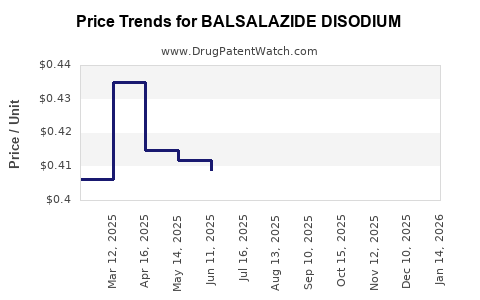
- Balsalazide disodium (generic): approximately $8–$12 per capsule.
- Brand name (Colazal): approximately $15–$20 per capsule.
Insurance and Reimbursement
Both private insurers and Medicare cover balsalazide, with coverage dependent on formulary placement. Generic versions have reduced patient out-of-pocket costs, fostering broader patient access. Reimbursement levels influence provider prescribing patterns and market penetration.
What Are Projected Market Trends?
Increasing Prevalence
The ulcerative colitis patient base is projected to grow at 2–3% annually, driven by environmental and dietary factors. By 2030, prevalence is expected to increase by approximately 30% globally.
Treatment Paradigm Shifts
Biologics and small molecules targeting cytokines and the immune response are expanding treatment options. However, balsalazide remains a key therapy for mild to moderate cases and maintenance therapy.
Patent and Regulatory Landscape
- Balsalazide disodium itself has no recent patent protections; its patent expiration occurred around 2015.
- Generics dominate sales, limiting pricing power.
- Future development may focus on combination therapies or novel formulations.
What Are Market Drivers and Limiters?
Drivers
- Increasing IBD prevalence.
- Favorable safety profile over corticosteroids.
- Preference for colon-specific drugs to minimize systemic effects.
Limiters
- Competition from generic formulations of mesalamine.
- Advances in biologic and small-molecule treatments.
- Limited innovations in balsalazide formulations.
What Are Price Projections for 2023–2028?
| Year |
Estimated Market Size |
Price Point (USD per capsule) |
Key Factors |
| 2023 |
$180 million |
$8–$12 (generic); $15–$20 (brand) |
Stable demand, generic proliferation |
| 2024 |
$190 million |
Slight price decline expected |
Increased generic competition |
| 2025 |
$200 million |
Price stabilization expected |
Market maturity |
| 2026 |
$210 million |
Marginal price decrease |
Entry of biosimilars for related drugs |
| 2027 |
$220 million |
Price consolidation |
Shrinking premium for brand names |
| 2028 |
$230 million |
Similar to previous years |
Steady treatment rates |
Key Takeaways
- Balsalazide disodium holds a modest market segment within IBD therapies, with revenues around $150–200 million globally.
- The market faces pricing compression due to widespread generic availability.
- Growing ulcerative colitis prevalence supports continued demand but does not significantly expand market share.
- Competition from newer treatments limits long-term growth potential.
- The drug remains relevant as a colon-specific therapy for mild to moderate cases, with future prospects tied to formulation innovations or combination therapies.
FAQs
1. Is balsalazide disodium likely to regain patent protection?
No. The patent expired around 2015, and no new patent filings are expected to provide exclusivity.
2. How does balsalazide compare to other mesalamine formulations?
It offers targeted delivery to the colon, which can improve efficacy for specific patient groups. Price and dosing differences influence physician preference.
3. What developments could impact the balsalazide market?
Introduction of biosimilars, new oral therapies, and better formulations could reduce demand. Conversely, increased ulcerative colitis prevalence supports steady use.
4. Are biosimilars affecting the balsalazide market?
Biosimilars primarily target biologic therapies. Their impact on balsalazide, a small molecule, is limited but indicative of broader market trends toward lower-cost options.
5. What regulatory changes could influence pricing?
Price controls or increased reimbursement pressures could compress margins. Regulatory approval of new formulations or combination therapies might create opportunities.
Sources:
[1] IQVIA. "The Global Use of Medicine," 2022.
[2] GlobalData. "Inflammatory Bowel Disease Market Analysis," 2022.
[3] FDA. "Drug Approvals and Patent Data," 2007, 2015.
[4] Statista. "Ulcerative Colitis Prevalence Estimates," 2022.