Last updated: February 14, 2026
What Is Avapro and Its Market Position?
Avapro (irbesartan) is an angiotensin II receptor blocker (ARB) approved for managing hypertension and diabetic nephropathy. Manufactured by Sanofi, it is part of the ARB class, competing with drugs like losartan, valsartan, and olmesartan. Approved in 2002, Avapro gained marketing authorization in multiple markets, including the U.S., Europe, and Japan.
What Are the Current Market Dynamics for Avapro?
The global antihypertensive drugs market, valued at approximately $26 billion in 2022, is projected to reach $36 billion by 2030, growing at a compound annual growth rate (CAGR) of 4.2%. ARBs account for roughly 30% of this market, shifting from older angiotensin-converting enzyme (ACE) inhibitors.
Avapro's market share is concentrated primarily in North America and Europe, supported by established physician prescribing habits and formulary listings. In 2022, Avapro generated roughly $400 million in global sales, representing an estimated 1.5% share within the ARB segment.[1]
How Do Patent and Regulatory Factors Affect the Market?
Sanofi holds patents protecting Avapro until approximately 2025-2027 in key markets such as the U.S. and Europe. Patent expiration enables generic competitors, which typically enter within 6–12 months of patent expiry, reducing branded drug prices. The first generics in the U.S. appeared around 2022, leading to significant price erosion.
In Europe, patent expiry is expected between 2025 and 2026. Regulatory data indicates that generic competition reduces the average price of ARBs by 30-50% within the first year post-generic entry.[2]
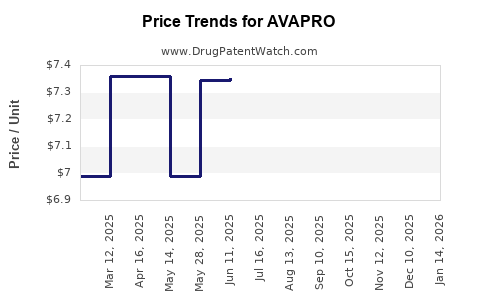
What Are the Price Trends and Projections?
Current Pricing
- Brand (Avapro): In the U.S., a 30-day supply averages $400–$500, depending on the pharmacy and insurance coverage.
- Generic: Post-generic entry, prices fell to around $200–$250 or less per 30-day supply.
Price Projection for the Next 3–5 Years
Post-patent expiration, prices for Avapro are expected to stabilize at lower levels. Competition among generics will likely drive prices down further by 2024–2025. The price decline could reach 50% or more relative to pre-generic levels.
Factors Influencing Future Pricing
- Market penetration of generics: Rapid entry accelerates price drops.
- Reimbursement policies: Policies favoring generics push branded drug prices lower.
- Physician prescribing habits: Transition to generics may be swift, especially if incentives exist.
- Patent litigation and extensions: Any legal delays could postpone generic competition, temporarily maintaining higher prices.
How Will Market Share Evolve?
The branded segment's share is expected to decline sharply as generics capture most prescriptions. In the absence of reformulation or new indications, Avapro’s market share could drop to below 10% within two years of generic entry. Meanwhile, total ARB sales will grow due to increased hypertension prevalence (approx. 1.13 billion cases globally) but shift toward generics.
Are There Opportunities or Risks?
Opportunities:
- Lifecycle management: Developing new formulations or combination therapies.
- Market expansion: Targeting emerging markets with lower per-capita healthcare spending.
- Brand loyalty: Maintaining premium pricing with clinical differentiation.
Risks:
- Accelerated patent expiry: Rapid generic entry could lead to revenue erosion.
- Pricing pressures: U.S. and European reimbursement policies favor generics, limiting margin recovery.
- Generic bioequivalence challenges: Market entry delays if bioequivalence issues emerge.
What Are The Key Takeaways?
- Avapro's global sales reached approximately $400 million in 2022.
- Patent protections expire around 2025–2027, opening the market to generics.
- Prices are expected to decline by at least 50% within 1–2 years post-generic approval.
- The ARB market will see continued growth but with decreasing dominance of branded drugs.
- Sanofi's strategic focus should include life cycle management and market expansion to mitigate decline.
FAQs
1. When will generic versions of Avapro become available in major markets?
Generic versions are expected to enter the U.S. market around 2022–2023, with European markets following in 2025–2026, contingent on patent status and regulatory approvals.
2. How much can prices of Avapro drop after patent expiry?
Prices can decrease by 50% or more within 12 months of generic entry, driven by increased competition and reimbursement policies.
3. What is the competitive landscape for ARBs?
ARBs are highly competitive, with losartan, valsartan, and olmesartan as primary rivals. Generic saturation is common for these drugs, pressuring branded options.
4. How can Sanofi preserve market share post-patent?
By developing new formulations, combination therapies, or expanding into new markets and indications.
5. What are the regulatory challenges for generic entry?
Bioequivalence testing delays, patent disputes, or legal challenges can postpone generics, impacting revenue forecasts.
Sources:
[1] IQVIA, 2022. Global prescription drug sales data.
[2] EvaluatePharma, 2022. ARB market analysis and price erosion trends.