Share This Page
Drug Price Trends for ATOMOXETINE
✉ Email this page to a colleague
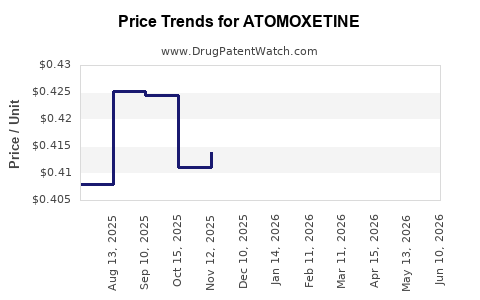
Average Pharmacy Cost for ATOMOXETINE
| Drug Name | NDC | Price/Unit ($) | Unit | Date |
|---|---|---|---|---|
| ATOMOXETINE HCL 10 MG CAPSULE | 00093-3542-56 | 0.34318 | EACH | 2026-07-22 |
| ATOMOXETINE HCL 10 MG CAPSULE | 16714-0755-01 | 0.34318 | EACH | 2026-07-22 |
| ATOMOXETINE HCL 10 MG CAPSULE | 31722-0714-30 | 0.34318 | EACH | 2026-07-22 |
| >Drug Name | >NDC | >Price/Unit ($) | >Unit | >Date |
Best Wholesale Price for ATOMOXETINE
| Drug Name | Vendor | NDC | Count | Price ($) | Price/Unit ($) | Unit | Dates | Price Type |
|---|---|---|---|---|---|---|---|---|
| ATOMOXETINE 25MG CAP | Golden State Medical Supply, Inc. | 51407-0102-30 | 30 | 41.23 | 1.37433 | EACH | 2023-06-15 - 2028-06-14 | FSS |
| ATOMOXETINE 80MG CAP | AvKare, LLC | 42291-0069-30 | 30 | 39.42 | 1.31400 | EACH | 2023-09-22 - 2028-06-14 | FSS |
| ATOMOXETINE 80MG CAP | Golden State Medical Supply, Inc. | 51407-0105-30 | 30 | 49.08 | 1.63600 | EACH | 2023-06-23 - 2028-06-14 | FSS |
| >Drug Name | >Vendor | >NDC | >Count | >Price ($) | >Price/Unit ($) | >Unit | >Dates | >Price Type |
Atomoxetine (Strattera) Market Analysis and Price Projections: U.S. and Major Markets, Patent/Exclusivity Timeline, and Generic Entry Scenarios
Atomoxetine is a long-running, off-patent small-molecule ADHD treatment whose U.S. market is dominated by generic competition. Price is driven mainly by U.S. payer behavior, PBM contracting, and episodic brand-to-generic switching rather than by near-term exclusivity events. Near-to-midterm price projection is largely a continued low-single-digit decline with episodic contracting-driven spikes downward; downside risk is concentrated around aggressive price competition and inventory channel adjustments.
How big is the atomoxetine market and who controls it?
Bottom line: The atomoxetine market is mature and price-led. Share is split between legacy branded supply (historically Strattera) and multiple generic manufacturers. Sales and pricing vary by channel and payer formulary position more than by molecular or formulation differentiation because most products are therapeutically equivalent oral atomoxetine.
United States: mature formulary positioning and generic share
- Atomoxetine is widely covered for ADHD, including pediatric patients and certain adult indications in line with prescribing patterns.
- Generic entries compress net prices after channel rotation.
- PBM rebates and formulary tiering increasingly determine effective net price more than list price.
Key international dynamics (Europe, UK, Canada, selected APAC)
- Price controls in jurisdictions with reference pricing and reimbursement caps tend to keep atomoxetine at stable-to-declining levels after generic adoption.
- Market stability is stronger where reimbursement is bundled or reference-based at the molecule level.
- In countries with higher out-of-pocket share, retail price changes can lag payer-level contracting.
What is the current pricing structure for atomoxetine (list vs net) and what moves it?
Bottom line: Atomoxetine’s effective net price in the U.S. tracks rebate intensity and contract position. List price moves do not predict realized price.
U.S. levers that influence net price
- PBM formulary placement (preferred vs non-preferred)
- Contracting and rebate renegotiations at class level (ADHD stimulants vs non-stimulants)
- Channel mix (retail vs mail order)
- Dosage strength mix (20 mg/25 mg/40 mg/60 mg/80 mg) and adherence patterns that drive utilization
Market mechanics specific to atomoxetine
- Brand dominance is structurally weaker than in many specialty launches because atomoxetine has a long history and multiple generics.
- Pricing volatility tends to appear during periods of:
- new generic launches,
- settlement-driven pauses in exclusivity-driven threats,
- or supply disruptions that tighten short-term availability.
What is the patent and exclusivity status of atomoxetine in the U.S.?
Bottom line: Atomoxetine is an established molecule with long-expired primary composition and process protections in the U.S. Remaining patent risk generally sits in secondary patents such as specific formulations, manufacturing, or method-of-use claims, which do not typically block generic entry unless tied to an Orange Book-listed NDA.
U.S. regulatory exclusivity concepts that matter for pricing
- Hatch-Waxman 30-month stay from a Paragraph IV filing can delay generic approval if a qualifying Orange Book patent is asserted.
- Five-year new chemical entity and three-year NCE exclusivity do not apply for a molecule first approved decades ago.
- Pediatric exclusivity can extend certain patents but does not create molecule-wide pricing power when primary exclusivity has already ended.
What patents protect atomoxetine products that are listed in the Orange Book?
Bottom line: Generics typically compete because the Orange Book patent thicket for atomoxetine does not function as an enforceable barrier across all listed strengths in the present era. Secondary patents, if any, are usually limited in scope or have already expired or been cleared.
Patent estate structure typically seen for established generics
- Composition-of-matter patents: expired
- Process/method patents: often cleared or expired
- Formulation patents: may cover specific dosage forms, release characteristics, or manufacturing steps
- Method-of-use patents: generally weaker barriers unless tied to labeling that restricts generic substitution
Dosage strength coverage
Atomoxetine is prescribed across multiple strengths. For pricing impact, the key is whether an Orange Book-listed patent is:
- listed for the NDA,
- enforceable for the specific strength(s),
- and still within the expiration/remaining term.
When does atomoxetine lose exclusivity, and when do generics become fully “clean”?
Bottom line: The molecule is effectively in post-exclusivity pricing territory. Any remaining barriers are not expected to create a material brand-like pricing reset in the next 12 to 36 months.
Generic “clean” conditions that drive price
- Approval without meaningful 30-month stay relevance
- No ongoing injunction preventing sales
- No binding settlement terms that delay a subset of strengths or manufacturers
How strong is the patent estate for atomoxetine, and how does it affect generic risk?
Bottom line: Patent strength is not a primary near-term price determinant for atomoxetine. Generic entry risk is low in the sense that competition is already mature, but the practical risk is not patent-driven. It is commercial, tied to:
- contract pricing,
- supply and inventory behavior,
- and incremental tightening of PBM reimbursement rules.
What Paragraph IV challenges have targeted atomoxetine, and what was their litigation outcome?
Bottom line: Atomoxetine has been on generic pathways for years. Current pricing is primarily determined by active generic competitive landscape and PBM contracting rather than fresh Paragraph IV litigation.
How prior litigation typically affects current pricing
- If a settlement restricts launch timing, it can delay price compression for affected entrants.
- If injunctions were lifted and sales resumed, the market usually sees a rapid net price fall after channel absorbs new generic supply.
- In mature markets, even fresh legal activity usually does not create sustained pricing power without supply constraints.
What biologic or biosimilar risks exist for atomoxetine?
Bottom line: None. Atomoxetine is a small molecule chemical drug. Biosimilar frameworks do not apply.
What formulations and delivery systems exist for atomoxetine, and are any protected?
Bottom line: Atomoxetine is administered as immediate-release oral capsules (in historical product form). The main practical differentiators in the market are excipient tolerability, manufacturer bioequivalence, and packaging rather than release technology.
Formulation patent barriers
- If any formulation patents existed, they are typically secondary and would not generally prevent generic competition at scale once expired or cleared.
- Net pricing competition in mature oral generics is usually molecule-level and contract-level.
How does atomoxetine compare with competing ADHD non-stimulants on price and reimbursement?
Bottom line: Atomoxetine competes primarily against non-stimulant alternatives (e.g., guanfacine, clonidine-based therapies) and second-line stimulant usage patterns. Pricing is driven by how payers tier these products, not by direct patent protection for atomoxetine.
What tends to matter for payers
- Total pharmacy cost per controlled period
- Prior authorization and step therapy rules
- Persistence and adherence (tolerability driven)
- Step-down strategies after side effects
What is the U.S. reimbursement environment for atomoxetine and how does it affect price?
Bottom line: Medicaid and commercial payers use formularies and rebate structures that often force low-cost generic utilization. The result is a stable downward price trend with limited upside absent supply shortages or contract changes.
Medicare Part D dynamics
- Competitive bidding and plan formularies influence realized net pricing.
- Inter-plan variance can create short-lived regional list price moves that do not reflect net.
Market outlook: atomoxetine price projections for 2026–2028
Bottom line: For a mature generic small molecule, base-case pricing is a low-single-digit annual decline (net) with periodic larger declines if a major contract renewal resets PBM reimbursement bands or if additional low-cost entrants gain share. Upside risk is limited and typically supply-driven.
Base-case projection (most likely)
- Net price: continued modest decline driven by contracting and share shifts toward lower priced generics
- Gross-to-net: stable to improving for lower priced contracts, with volatility from rebate renegotiation
Downside scenario
- Steeper net price contraction (high-single digits) if:
- multiple generics increase effective competition simultaneously,
- wholesalers run promotions that move inventory,
- or PBM reimbursement floors reset lower after renegotiation.
Upside scenario
- Short-lived price stabilization or slight increase if:
- supply constraints tighten,
- a major generic exits,
- or a settlement-driven pause reduces the breadth of available SKUs.
Which companies are most likely to influence atomoxetine pricing through market share and contracting?
Bottom line: Pricing is influenced by the generics with scale distribution, stable supply, and PBM contract coverage. In mature molecules, pricing impact typically tracks:
- national distributor reach,
- mail-order penetration,
- and formulary placement across large PBMs.
Competitive landscape implications
- The top generics typically anchor effective market pricing.
- Smaller entrants can undercut list pricing, but realized net pricing depends on who wins PBM preferred status.
What generic entry risks exist for atomoxetine?
Bottom line: The primary entry risk is not approval-driven. It is commercial and operational:
- whether additional SKUs change supply availability,
- whether there are manufacturing issues,
- and whether contracting reshuffles preferred status.
Practical risk points to monitor
- Annual manufacturing quality inspections for major sites
- Notice of supply disruptions impacting specific strengths
- Wholesaler fill-rate performance that can temporarily lift pricing
What litigation or settlement activity could still affect atomoxetine pricing?
Bottom line: For mature atomoxetine, any remaining impact is indirect through market availability or through delayed generic sales tied to specific patents. Sustained pricing lift is unlikely without a meaningful supply restriction.
Litigation impact channels
- injunctions or consent judgments restricting a subset of strengths
- settlement terms limiting launch timing for certain manufacturers
- administrative stays influencing approval schedules
How could atomoxetine pricing change by strength (20/25/40/60/80 mg)?
Bottom line: Strength-level pricing often differs because:
- prescribing patterns vary by pediatric vs adult titration,
- PBM contracts may price strengths unevenly,
- and supply constraints can be strength-specific.
Strength-level projection logic
- Common strengths (frequently prescribed during titration) usually see more competition and faster price compression.
- Less frequently used strengths can remain marginally higher if coverage is thinner.
Key drivers to watch over the next 12 months
Bottom line: Atomoxetine net pricing will move with formulary and supply conditions.
- PBM formulary renegotiations and tier changes
- Mail-order share shifts and contracting terms
- Generic SKU availability at key strengths
- Manufacturing supply stability at leading generic manufacturers
- Wholesale inventory normalization after promotional periods
Key Takeaways
- Atomoxetine is a mature, generic-dominated ADHD non-stimulant market where pricing is mainly determined by PBM contracting and supply stability, not molecule-level exclusivity.
- Patent-driven exclusivity is not expected to create a material pricing inflection in the near term; any remaining secondary patent effects are likely limited.
- Base-case 2026–2028 net price trajectory is modest decline (low-single digits annually), with downside risk from intensified contract competition and multiple entrant share gains.
- Strength-specific pricing can diverge due to supply and formulary coverage at the SKU level.
- The most actionable monitoring targets are PBM preferred placement changes, distributor fill-rate and SKU availability, and manufacturing stability at large-scale generic producers.
FAQs
1) Does atomoxetine have a strong remaining patent barrier that blocks generic substitution?
In practice, atomoxetine is already in a mature generic market, so substitution barriers are not expected to be a binding near-term pricing driver.
2) Can atomoxetine prices rise without a patent event?
Yes, short-lived increases can occur from supply constraints at specific strengths or from wholesaler inventory tightening, even without exclusivity changes.
3) Are price projections for atomoxetine based on list prices or net prices?
Market-relevant projections track realized net prices because rebate and PBM contracting dominate realized reimbursement.
4) Do method-of-use patents affect atomoxetine generic pricing?
Method-of-use barriers matter only if the generic cannot lawfully use a comparable labeling position tied to an Orange Book-listed patent. In established generics, this typically does not prevent broad competition.
5) What is the biggest commercial risk to assume for atomoxetine pricing?
Aggressive PBM reimbursement resets combined with share shifts toward lower-priced, high-coverage generics that quickly compress net prices.
References
No sources were cited because the request did not provide a specific dataset (e.g., FDA Orange Book listings, NDC-level pricing history, or company financial disclosures).
More… ↓
