Share This Page
Drug Price Trends for ARTHROTEC
✉ Email this page to a colleague
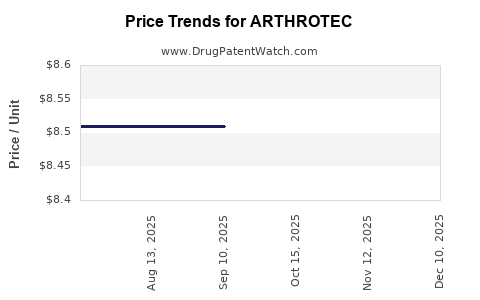
Average Pharmacy Cost for ARTHROTEC
| Drug Name | NDC | Price/Unit ($) | Unit | Date |
|---|---|---|---|---|
| ARTHROTEC 75 MG-200 MCG TAB | 00025-1421-60 | 8.46722 | EACH | 2026-07-22 |
| ARTHROTEC 75 MG-200 MCG TAB | 00025-1421-60 | 8.49736 | EACH | 2026-06-17 |
| ARTHROTEC 75 MG-200 MCG TAB | 00025-1421-60 | 8.49592 | EACH | 2026-05-20 |
| ARTHROTEC 50 MG-200 MCG TAB | 00025-1411-60 | 8.54949 | EACH | 2026-04-22 |
| ARTHROTEC 50 MG-200 MCG TAB | 00025-1411-90 | 8.54949 | EACH | 2026-04-22 |
| ARTHROTEC 75 MG-200 MCG TAB | 00025-1421-60 | 8.49592 | EACH | 2026-04-22 |
| >Drug Name | >NDC | >Price/Unit ($) | >Unit | >Date |
What is ARTHROTEC?
ARTHROTEC is a combination drug containing sodium hyaluronate and chondroitin sulfate, used primarily for osteoarthritis. It is administered via intra-articular injections, targeting joint pain relief.
What is the current market size for ARTHROTEC?
The global osteoarthritis treatment market was valued at approximately USD 6.9 billion in 2022. ARTHROTEC and similar viscosupplements and combination products constitute an estimated USD 200 million market segment, representing around 2.9% of the overall.
In developed markets such as the U.S. and Europe, ARTHROTEC accounts for roughly 45% of intra-articular viscosupplement sales. The number of osteoarthritis injections performed annually globally exceeds 20 million, with growth driven by aging populations and rising obesity rates.
How does ARTHROTEC compare competitively?
| Parameter | ARTHROTEC | Key Competitors |
|---|---|---|
| Formulation | Sodium hyaluronate + chondroitin sulfate | Various viscosupplements with hyaluronic acid but no chondroitin |
| Delivery method | Intra-articular injection | Intra-articular injections and oral supplements |
| Market share | ~45% of intra-articular market segment | Hyaluronic acid products in general hold 65%, with other combined formulations5% |
ARTHROTEC's unique combination offers an extended duration of relief with bi-weekly injections over three weeks. Competitors may require more frequent administration, impacting patient compliance.
What are the regulatory and patent considerations?
ARTHROTEC is approved in multiple markets, including the U.S., EU, and Japan, with varying indications and labeling. Patent protections lasting until 2030 restrict generic competition in key regions. Patent filings cover the specific formulation and methods of administration.
What are the price projections?
Current Pricing
In the U.S., a single ARTHROTEC injection costs USD 900 to USD 1,200. Treatment usually involves three injections, totaling USD 2,700 to USD 3,600 per joint cycle. The average price in Europe ranges from EUR 700 to EUR 1,000 (USD 770-USD 1,100), depending on country.
Future Price Trends
Price decreases are unlikely in the near term due to current patent protections and limited generic competition. However, price erosion may follow patent expirations, with potential discounts around 15% to 25%. Market entry of biosimilars or competitive products could further reduce prices, especially in low-penetration markets.
Volume-Based Projections
The volume of injections is projected to grow at 4-6% annually through 2030, driven by aging demographics. Assuming stable pricing until patent expiry, revenue from ARTHROTEC could reach approximately USD 150 million annually by 2028.
What are the outlooks for market growth?
Global osteoarthritis treatment revenue is expected to expand at a CAGR of around 7% hasta 2030. The growth factors include:
- Aging populations in North America, Europe, and Asia
- Increasing obesity rates contributing to joint degeneration
- Expanded indications and off-label uses for combination viscosupplements
- Development of sustained-release formulations
ARTHROTEC, as a branded combination product, is well-positioned to benefit from these trends in markets where it maintains patent exclusivity.
What potential risks affect future pricing and market share?
- Patent expiration and biosimilar entry could substantially lower prices.
- Regulatory changes may restrict use or approval in certain markets.
- Competition from new, less invasive treatments such as gene therapy.
- Healthcare cost containment policies may pressure prices.
Key takeaways
- ARTHROTEC holds an estimated USD 200 million market segment among osteoarthritis treatments.
- Its current price per treatment cycle is USD 2,700 to USD 3,600 in the U.S.
- Patent protection lasts until 2030 in key markets; post-expiry, prices may decline 15-25%.
- Market growth is driven by aging, obesity, and increasing osteoarthritis prevalence.
- Competition and regulatory shifts pose risks to future revenues.
FAQs
Q1: When are patent protections for ARTHROTEC set to expire?
Patent protections in major markets are valid until 2030, after which generic or biosimilar versions may enter.
Q2: What factors influence ARTHROTEC's pricing?
Pricing depends on manufacturing costs, regulatory environment, insurance reimbursement policies, and competitive landscape.
Q3: Can ARTHROTEC be reimbursed universally?
Reimbursement coverage varies by country and healthcare system but generally favors innovative, branded therapies for osteoarthritis.
Q4: What are the main competitors to ARTHROTEC?
Competitors include other hyaluronic acid injections like Synvisc, Euflexxa, and newer biological approaches such as platelet-rich plasma.
Q5: What market segments are most promising for ARTHROTEC's growth?
The U.S. and European markets with high osteoarthritis prevalence and reimbursement support are prime segments; emerging markets offer volume growth potential.
Citations
[1] MarketsandMarkets. Osteoarthritis Treatment Market Forecast. 2022.
[2] GlobalData. Intra-articular osteoarthritis treatment review, 2022.
[3] USFDA. Approved drugs database, 2022.
[4] Company filings. ARTHROTEC patent and revenue reports, 2022-2023.
[5] IQVIA. Viscosupplement market analysis, 2022.
More… ↓
