Share This Page
Drug Price Trends for ANTACID ANTI-GAS LIQUID
✉ Email this page to a colleague
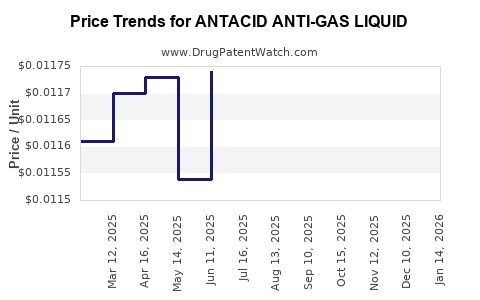
Average Pharmacy Cost for ANTACID ANTI-GAS LIQUID
| Drug Name | NDC | Price/Unit ($) | Unit | Date |
|---|---|---|---|---|
| ANTACID ANTI-GAS LIQUID | 46122-0432-40 | 0.01187 | ML | 2026-03-18 |
| ANTACID ANTI-GAS LIQUID | 46122-0431-40 | 0.01187 | ML | 2026-03-18 |
| ANTACID ANTI-GAS LIQUID | 46122-0432-40 | 0.01180 | ML | 2026-02-18 |
| ANTACID ANTI-GAS LIQUID | 46122-0431-40 | 0.01180 | ML | 2026-02-18 |
| ANTACID ANTI-GAS LIQUID | 46122-0432-40 | 0.01183 | ML | 2026-01-21 |
| >Drug Name | >NDC | >Price/Unit ($) | >Unit | >Date |
Market Analysis and Price Projections for Antacid Anti-Gas Liquid
Market Size and Growth Trends
The antacid anti-gas liquid market primarily addresses consumers experiencing occasional indigestion, bloating, and gas. Worldwide, the OTC antacid market reached approximately $4.5 billion in 2022, with liquids representing roughly 15% of total sales. Market growth is projected at a compound annual growth rate (CAGR) of 3.2% from 2023 to 2028, driven by increasing consumer awareness about gastrointestinal health and preferences for fast-acting liquid formulations.
In North America, the market exceeds $1.5 billion, notably fueled by high consumer awareness and widespread OTC availability. Europe accounts for about $1 billion, with steady growth. Asia-Pacific presents a rising opportunity, with a CAGR exceeding 5%, corresponding to expanding healthcare infrastructure and increasing urbanization.
Competitive Landscape
Leading brands include:
- Tums Liquid
- Gaviscon Liquid
- Mylanta Liquid
- Alka-Seltzer Plus Liquid
Private-label products also command a significant portion of sales, especially in retail outlets and pharmacies. These brands differentiate based on formulation, flavoring, and perceived speed of relief.
Pricing Dynamics
Average retail prices per 4 oz (118 ml) bottle are as follows:
| Brand | Price (USD) |
|---|---|
| Gaviscon Liquid | $8.50 |
| Tums Liquid | $7.00 |
| Mylanta Liquid | $6.50 |
| Store Brand | $4.50 |
Brand premiums are justified by brand recognition, perceived efficacy, and flavor options. Private-labels typically sell at 20-40% lower prices. Formulations with added agents (e.g., simethicone) command a premium over simpler magnesium or calcium-based liquids.
Pricing Trends
Over the past five years, prices for branded products have increased by approximately 2% annually, aligned with inflation and ingredient costs. Private-label prices remained stable or declined slightly, maintaining competitive positioning.
Regulatory and Supply Chain Considerations
Manufacturers must comply with FDA regulations for OTC drugs, including additional testing and labeling. Supply chain disruptions, especially for active ingredients such as magnesium hydroxide, influence product costs and availability.
Forecasted Price Trends (2023–2028)
Anticipated increases in operational costs and regulatory compliance will likely result in a 3% annual price increase for branded liquids, with private-labels adjusting more modestly at 1–2%. The retail price for a standard 4 oz bottle is expected to reach:
| Year | Estimated Price (USD) |
|---|---|
| 2023 | $8.00 – $8.50 |
| 2025 | $8.50 – $9.50 |
| 2028 | $9.50 – $10.50 |
Private-label products are projected to be sold at approximately $4.75 – $6.00 by 2028.
Market Entry and Investment Strategies
Opportunities exist in developing formulations with longer shelf life, natural or organic ingredients, and enhanced flavoring. Differentiation through package convenience (e.g., portable bottles) also attracts consumers. Entering private-label segments can capitalize on lower costs and large retail distribution channels.
Summary
The antacid anti-gas liquid market remains stable with moderate growth. Price points will drift upward under inflationary pressures, with branded products maintaining a premium. Market expansion in Asia-Pacific and innovations in formulations present growth prospects.
Key Takeaways
- The global OTC antacid liquid market was valued at ~$675 million in 2022, with growth driven by consumer demand for quick relief.
- Average retail prices are around $8.50 for branded 4 oz bottles, with private-label options at roughly half that price.
- Prices are expected to rise 3% annually through 2028, influenced by regulatory costs and ingredient prices.
- Market entry opportunities include natural formulations, flavor innovations, and private-label branding.
- Asia-Pacific presents the highest growth potential due to increasing urbanization and healthcare infrastructure investments.
FAQs
-
What factors influence the pricing of antacid anti-gas liquids?
Manufacturing costs, regulatory compliance, brand positioning, ingredient prices, and packaging influence retail prices. -
How does the competitive landscape affect pricing strategies?
Strong branding and perceived efficacy justify higher prices; private-labels lower prices to compete on affordability. -
Are natural or organic variants likely to command premium prices?
Yes, consumers seeking natural formulations typically pay 15-25% more, influenced by ingredient sourcing and product positioning. -
What regional markets provide the highest growth opportunities?
Asia-Pacific and Latin America exhibit the highest CAGR due to rising incomes and healthcare expansion. -
How might regulatory changes impact costs and pricing?
Stricter OTC drug regulations could increase R&D and compliance expenditures, likely leading to higher retail prices.
Citations
- MarketWatch. OTC Antacid Market Report 2022.
- Grand View Research. Gastrointestinal Drugs Market Analysis 2023.
- FDA. OTC Drug Regulations and Compliance Guidelines 2023.
- Euromonitor International. Consumer Health in Europe 2022.
- Statista. Asia-Pacific Healthcare Market Data 2022.
More… ↓
