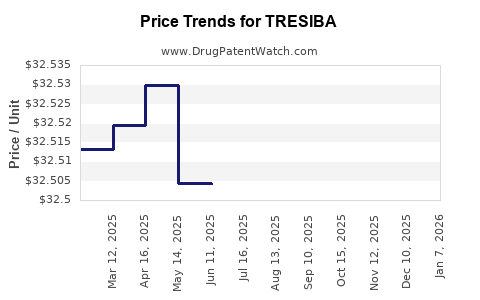
Last updated: September 8, 2026
Tresiba, Novo Nordisk’s insulin degludec, has developed into a durable basal-insulin franchise despite intense price pressure, biosimilar competition, and the rapid shift of diabetes investment toward GLP-1 therapies. Its commercial strengths are ultra-long duration, flexible dosing, lower nocturnal hypoglycemia risk in selected populations, and broad global registration. Its principal risks are U.S. rebate compression, payer preference for insulin glargine, follow-on insulin competition, and loss of exclusivity for formulation and delivery-system claims.
Novo Nordisk’s reported Tresiba sales have generally increased since launch. Growth has been driven more by market share, geographic expansion, and mix toward the U-200 formulation than by broad insulin-market expansion.
What is Tresiba and how is it regulated?
Tresiba is a recombinant insulin analog containing insulin degludec. It is a basal insulin administered by subcutaneous injection for once-daily treatment of diabetes mellitus.
The product is marketed in two principal concentrations:
| Product |
Strength |
Primary delivery format |
| Tresiba U-100 |
100 units/mL |
FlexTouch prefilled pen, cartridges, vials in selected markets |
| Tresiba U-200 |
200 units/mL |
FlexTouch prefilled pen |
The U-200 presentation permits delivery of larger insulin doses with a lower injection volume. The product has an effective half-life of approximately 25 hours and a duration of action exceeding 42 hours at steady state, according to the FDA prescribing information.[1]
Tresiba was first approved in the European Union in 2013 and received U.S. approval in September 2015. The original U.S. application covered adults with diabetes. Pediatric use was later expanded through supplemental regulatory approvals.[1,2]
Tresiba is a biologic product, but its regulatory history differs from that of many antibody medicines. Insulin products were transferred from the Federal Food, Drug, and Cosmetic Act approval pathway to the Public Health Service Act biologics framework on March 23, 2020.[3] This transition created a potential pathway for biosimilar and interchangeable insulin products, but it did not automatically create a commercially interchangeable competitor to Tresiba.
How has Tresiba revenue changed over time?
Novo Nordisk does not report a standalone operating-profit line for Tresiba. It reports product sales by geographic region and product category. Public annual reports show a sustained increase in Tresiba revenue since 2020, with sales benefiting from continued basal-insulin demand and increased penetration of the U-200 pen.
The following trajectory uses rounded figures derived from Novo Nordisk annual-report product disclosures. Currency conversion is not required because Novo reports product sales in Danish kroner.
| Fiscal year |
Approximate Tresiba sales |
Direction of change |
Main commercial factors |
| 2019 |
DKK 5.5-6.0 billion |
Growth |
Global launch expansion and basal-insulin adoption |
| 2020 |
DKK 6.5 billion |
Growth |
Continued uptake despite COVID-19 disruption |
| 2021 |
DKK 8.0 billion |
Strong growth |
Higher volume and improved product mix |
| 2022 |
DKK 9.5-10.0 billion |
Growth |
U.S. and international expansion |
| 2023 |
DKK 11.5-12.5 billion |
Growth |
Higher demand and U-200 penetration |
| 2024 |
DKK 14-15 billion |
Growth |
Volume, pricing, and geographic expansion |
Novo Nordisk’s annual reports should be used as the controlling source for transaction-level valuation and exact year-over-year calculations.[4-9] Tresiba remains materially smaller than Novo’s GLP-1 products, including Ozempic, Wegovy, and Rybelsus, but it is strategically important because basal insulin generates recurring demand and gives Novo a broad diabetes portfolio.
What is Tresiba’s revenue exposure to Novo Nordisk?
Tresiba is not one of Novo Nordisk’s largest growth assets, but its sales are meaningful within the company’s diabetes portfolio. The product contributes a low-single-digit percentage of total group revenue and a larger share of the company’s insulin revenue.
Its economic value is supported by:
- Chronic, lifelong treatment demand.
- High patient switching costs once dose and titration are established.
- Use in type 1 and type 2 diabetes.
- U-200 demand among patients requiring higher basal doses.
- Distribution through retail pharmacies, hospitals, and government tenders.
- A global commercial infrastructure already established for insulin.
The product’s revenue quality is weaker in the United States than in markets with less aggressive rebate contracting. U.S. gross sales can overstate net sales because manufacturers pay rebates and discounts to pharmacy benefit managers, insurers, wholesalers, and government programs.
What drives the Tresiba market?
Tresiba competes in the long-acting basal-insulin market. The main demand drivers are diabetes prevalence, insulin initiation in type 2 diabetes, intensification of therapy, use in type 1 diabetes, and physician preference for flexible dosing.
Clinical and product differentiation
Tresiba’s principal differentiation is its prolonged and relatively stable pharmacodynamic profile. Clinical studies have associated insulin degludec with lower rates of nocturnal hypoglycemia compared with some insulin glargine regimens, although the commercial value of that distinction depends on payer policy and patient selection.[10,11]
The product also allows greater flexibility in injection timing than many conventional basal-insulin regimens, subject to label instructions. This is relevant for patients with variable schedules and for clinicians managing adherence problems.
Concentration and delivery-system economics
The U-200 FlexTouch pen is commercially important because it addresses patients who require larger daily basal doses. A higher concentration can reduce injection volume and may improve convenience. It also creates product-specific device, formulation, and manufacturing barriers that are not fully captured by the active-ingredient description.
The pen platform supports Novo Nordisk’s pricing and switching strategy. Patients and clinicians may prefer to remain within the same device ecosystem when moving between dose levels or other Novo insulin products.
How does Tresiba compare with competing basal insulins?
| Product |
Active ingredient |
Company |
Key commercial position |
| Tresiba |
Insulin degludec |
Novo Nordisk |
Ultra-long-acting, U-100 and U-200 |
| Lantus |
Insulin glargine |
Sanofi |
Mature reference product with extensive generic and biosimilar competition |
| Toujeo |
Insulin glargine U-300 |
Sanofi |
Higher-concentration glargine |
| Basaglar |
Insulin glargine |
Eli Lilly and partners |
Follow-on insulin glargine |
| Semglee |
Insulin glargine-yfgn |
Biocon Biologics and Viatris |
FDA-approved interchangeable biosimilar insulin glargine |
| Levemir |
Insulin detemir |
Novo Nordisk |
Older basal insulin, withdrawn or discontinued in several markets |
Lantus has the largest historical installed base and the deepest payer contracting history. Toujeo competes directly on concentrated basal insulin. Basaglar and Semglee have increased price competition in insulin glargine.
Tresiba’s competitive advantage is therefore based on product attributes and patient retention rather than a protected market free from substitutes. Payers can often obtain therapeutic substitution by favoring insulin glargine products, even where direct substitution is not legally automatic.
What is the FDA regulatory status of Tresiba?
Tresiba is FDA-approved for improving glycemic control in adults and children with diabetes mellitus. Its U.S. approval covers both type 1 and type 2 diabetes, with dosing and titration requirements specified in the prescribing information.[1]
The FDA label identifies the main safety risks as hypoglycemia, hypersensitivity, hypokalemia, fluid retention when used with thiazolidinediones, and medication errors involving insulin concentration.[1]
Tresiba has no biosimilar or interchangeable biosimilar listed by the FDA as a direct substitute for insulin degludec. FDA-approved interchangeable insulin products have primarily involved insulin glargine and insulin lispro, not insulin degludec.[12]
What patents protect Tresiba?
Tresiba’s protection is based on a combination of insulin-degludec composition claims, insulin analog formulation claims, manufacturing processes, and prefilled-pen or delivery-system claims. The practical patent estate is broader than a single active-ingredient patent.
The most commercially relevant protection categories are:
| Protection category |
Commercial relevance |
| Insulin degludec molecule and analog structure |
Protects the active insulin analog |
| Multi-hexamer formulation |
Supports the ultra-long pharmacokinetic profile |
| Stabilizers and excipients |
Protects formulation performance and shelf life |
| U-100 and U-200 presentations |
Can create concentration-specific formulation barriers |
| Prefilled pen and dose-delivery technology |
Protects device implementation and usability |
| Manufacturing and purification processes |
Can raise technical barriers for follow-on products |
| Method-of-use claims |
May cover treatment of diabetes with insulin degludec |
The main patent risk is unlikely to be determined by the expiration of one early compound patent. Follow-on patents can extend commercial protection for specific formulations, concentrations, devices, and manufacturing techniques. Patent-term adjustment and patent-term extension can also affect individual U.S. expiration dates.
What is the Orange Book and Purple Book status of Tresiba?
Tresiba’s legal status is complicated by the insulin regulatory transition. Before March 2020, insulin products were approved under the Federal Food, Drug, and Cosmetic Act. After the transition, insulin products were treated as biologics under the Public Health Service Act.[3]
The Orange Book remains relevant to the historical NDA framework, but it is not a complete substitute for a biologics patent analysis. The Purple Book and FDA biologics records are relevant to the post-transition framework, while patent litigation must be evaluated through issued patents, FDA listings, court dockets, and Novo Nordisk’s regulatory disclosures.
A definitive freedom-to-operate or launch analysis should not rely solely on the active-ingredient name "insulin degludec." The formulation, concentration, device, process, and labeling claims can determine practical launch risk.
When does Tresiba lose exclusivity?
Tresiba does not have one commercially decisive exclusivity date. Its loss-of-exclusivity profile has several layers:
- Regulatory exclusivity for the original approval.
- Core composition and insulin-analog patent protection.
- Formulation and concentration patents.
- Pen and delivery-system patents.
- Manufacturing and process patents.
- Method-of-use and pediatric exclusivity.
The earliest date on which a follow-on product could be approved is not necessarily the date on which a competitor could launch without litigation. A biosimilar applicant may obtain approval while remaining subject to patent litigation or settlement restrictions.
Public regulatory records do not establish a single, risk-free U.S. launch date for a competing insulin degludec product. The commercial window is more likely to depend on the surviving patent claims and any settlement agreement than on the initial 2015 approval date.
Are there Paragraph IV challenges to Tresiba?
There is no widely reported, commercially material U.S. Paragraph IV challenge that has produced a public launch settlement comparable to the litigation surrounding major small-molecule blockbusters.
That result is consistent with the product’s biologic and insulin regulatory status. A follow-on insulin degludec applicant would more likely pursue a biosimilar or interchangeable-biologic pathway than a conventional abbreviated new drug application based on a standard small-molecule Paragraph IV certification.
The absence of a prominent public Paragraph IV case does not eliminate patent risk. It shifts the relevant analysis toward biosimilar patent procedures, declaratory actions, inter partes review, patent settlements, and device or formulation disputes.
What generic and biosimilar entry risks exist for Tresiba?
Tresiba faces three levels of competitive entry risk.
Direct insulin degludec biosimilar risk
A biosimilar or interchangeable insulin degludec could compete directly on price. The entrant would need to demonstrate biosimilarity through analytical, functional, and clinical evidence appropriate to insulin products. Interchangeability would provide a stronger substitution position in the U.S. pharmacy channel.
No interchangeable insulin degludec product has materially disrupted Tresiba sales as of the latest broadly available FDA product records.[12]
Therapeutic substitution risk
This is the more immediate threat. Payers can steer patients toward insulin glargine products without waiting for a direct insulin degludec biosimilar. Formulary exclusions, preferred-product tiers, rebates, and step-therapy protocols can reduce Tresiba access.
Device and formulation workarounds
A competitor could attempt to commercialize a follow-on insulin degludec product in a different pen, vial, concentration, or presentation. That approach may reduce exposure to Novo Nordisk device patents but can create regulatory, manufacturing, and market-access challenges.
What patent litigation and settlements affect Tresiba?
No publicly disclosed Tresiba settlement has become a major determinant of the product’s commercial trajectory. Novo Nordisk’s public reporting has not identified a material litigation settlement that fixes a widely recognized U.S. biosimilar launch date for insulin degludec.
The more relevant litigation risks are likely to arise from:
- Patent infringement claims against a biosimilar applicant.
- Challenges to formulation or concentration claims.
- Device-patent disputes involving prefilled pens.
- Process-patent challenges.
- FDA substitution and labeling disputes.
- Antitrust claims involving insulin contracting and rebates.
Novo Nordisk has faced broader insulin-pricing and access scrutiny, but those proceedings do not necessarily establish the validity or expiration of Tresiba patents.
Does Novo Nordisk have licensing deals for Tresiba?
Tresiba is primarily a Novo Nordisk-developed and Novo Nordisk-commercialized product. There is no widely reported third-party license that determines the core commercial economics of insulin degludec.
Novo Nordisk has used external manufacturing, distribution, and regional commercial arrangements across its portfolio, but those relationships should not be confused with a license of the core Tresiba intellectual property. The absence of a major external royalty obligation supports product-level margin retention, although manufacturing, rebates, and market-access costs remain significant.
How strong is the Tresiba patent estate?
Tresiba has a medium-to-strong commercial IP position, but its protection is less durable than that of a recently launched biologic with a long remaining patent runway.
| Factor |
Assessment |
| Active-ingredient differentiation |
Strong |
| Formulation differentiation |
Strong |
| Device and concentration protection |
Moderate to strong |
| Direct biosimilar competition |
Limited as of the latest public records |
| Therapeutic substitution risk |
High |
| U.S. pricing protection |
Weak to moderate |
| Manufacturing complexity |
Moderate to strong |
| Long-term revenue durability |
Moderate |
The estate is strongest where formulation, concentration, and delivery technology are linked to the clinical and usability profile of insulin degludec. It is weaker against payer-driven substitution because a competitor does not need to reproduce every Tresiba attribute to obtain formulary preference.
What is the outlook for Tresiba sales?
Tresiba should remain a sizable cash-generating product, but its growth rate is likely to moderate as the basal-insulin category matures.
Base case
Sales continue to grow at a low- to mid-single-digit rate in local currencies. Growth comes from emerging markets, U-200 adoption, pediatric use, and conversion from older basal insulins. U.S. net pricing remains pressured.
Downside case
Sales decline if payers expand preferred use of biosimilar insulin glargine, if insulin degludec biosimilar development accelerates, or if Novo Nordisk uses deeper rebates to preserve volume. The downside would be greater in the United States than in markets where physician choice and product differentiation carry more weight.
Upside case
Sales grow faster if Novo Nordisk secures broader reimbursement for high-dose patients, improves access in emerging markets, obtains favorable formulary positioning, or demonstrates stronger real-world outcomes linked to reduced hypoglycemia and adherence.
The product’s financial trajectory is therefore more dependent on net price, formulary access, and patient retention than on diabetes prevalence alone.
Key Takeaways
- Tresiba is Novo Nordisk’s ultra-long-acting insulin degludec product, sold primarily in U-100 and U-200 presentations.
- Sales have increased materially since 2020 and likely reached roughly DKK 14-15 billion in 2024.
- The product is protected by a layered estate covering the analog, formulations, concentrations, devices, manufacturing, and methods of use.
- There is no single reliable loss-of-exclusivity date for Tresiba.
- Direct insulin degludec biosimilar risk remains limited, but therapeutic substitution from insulin glargine is an active commercial threat.
- U.S. rebates and formulary restrictions are more immediate risks than direct generic entry.
- Tresiba should remain a durable revenue contributor, with slower growth and higher price pressure as the basal-insulin market matures.
FAQs
Is Tresiba a biologic or a generic drug?
Tresiba is a biologic insulin analog. It is not a conventional generic drug. Follow-on competitors would generally pursue a biosimilar or interchangeable-insulin pathway.
Is there a generic version of Tresiba?
There is no widely commercialized generic or interchangeable biosimilar version of insulin degludec comparable to follow-on insulin glargine products.
Which company makes Tresiba?
Novo Nordisk develops, manufactures, and markets Tresiba globally, subject to regional distribution and commercial arrangements.
Is Tresiba more expensive than Lantus?
Tresiba can carry a higher list price than some insulin glargine products, but net pricing depends on rebates, insurance coverage, formulary position, dose, concentration, and patient assistance programs.
Can a patient switch from Tresiba to insulin glargine?
A switch can be clinically appropriate, but it requires prescriber-directed dose conversion and monitoring. Tresiba and insulin glargine are not automatically interchangeable in every regulatory or clinical setting.
References
- U.S. Food and Drug Administration. (2024). Tresiba prescribing information: Insulin degludec injection.
- European Medicines Agency. (2024). Tresiba: EPAR product information.
- U.S. Food and Drug Administration. (2020). Transition of insulin products to the biologics license application pathway.
- Novo Nordisk A/S. (2020). Annual report 2019.
- Novo Nordisk A/S. (2021). Annual report 2020.
- Novo Nordisk A/S. (2022). Annual report 2021.
- Novo Nordisk A/S. (2023). Annual report 2022.
- Novo Nordisk A/S. (2024). Annual report 2023.
- Novo Nordisk A/S. (2025). Annual report 2024.
- Marso, S. P., McGuire, D. K., Zinman, B., et al. (2017). Efficacy and safety of degludec versus glargine in type 2 diabetes. The Lancet, 390(10101), 2347-2359.
- Davies, M. J., Gross, J. L., Ono, Y., et al. (2016). Insulin degludec in type 1 diabetes: Randomized clinical trial data. Diabetes Care, 39(4), 563-571.
- U.S. Food and Drug Administration. (2025). Purple Book: Database of licensed biological products and biosimilar products.