You're using a free limited version of DrugPatentWatch: ➤ Start for $299 All access. No Commitment.

Last Updated: January 1, 2026

PERTZYE Drug Profile


✉ Email this page to a colleague

« Back to Dashboard


Summary for Tradename: PERTZYE
Recent Clinical Trials for PERTZYE

Identify potential brand extensions & biosimilar entrants

SponsorPhase
Memorial Sloan Kettering Cancer CenterPhase 1/Phase 2
Digestive Care, Inc.Phase 1/Phase 2
Massimo Raimondo, M.D.Phase 1/Phase 2

See all PERTZYE clinical trials

Note on Biologic Patents

Matching patents to biologic drugs is far more complicated than for small-molecule drugs.

DrugPatentWatch employs three methods to identify biologic patents:

  1. Brand-side disclosures in response to biosimilar applications
  2. These patents were identified from disclosures by the brand-side company, in response to a potential biosimilar seeking to launch. They have a high certainty of blocking biosimilar entry. The expiration dates listed are not estimates — they're expiration dates as indicated by the brand-side company.

  3. DrugPatentWatch analysis and company disclosures
  4. These patents were identified from searching various sources, including drug labels and other general disclosures from the brand-side company. This list may exclude some of the patents which block biosimilar launch, and some of these patents listed may not actually block biosimilar launch. The expiration dates listed for these patents are estimates, based on the grant date of the patent.

  5. Patents from broad patent text search
  6. For completeness, these patents were identified by searching the patent literature for mentions of the branded or ingredient name of the drug. Some of these patents protect the original drug, whereas others may protect follow-on inventions or even inventions casually mentioning the drug. The expiration dates listed for these patents are estimates, based on the grant date of the patent.

1) High Certainty: US Patents for PERTZYE Derived from Brand-Side Litigation

No patents found based on brand-side litigation

2) High Certainty: US Patents for PERTZYE Derived from DrugPatentWatch Analysis and Company Disclosures

These patents were obtained from company disclosures
Applicant Tradename Biologic Ingredient Dosage Form BLA Patent No. Estimated Patent Expiration Source
Digestive Care, Inc. PERTZYE pancrelipase Capsule, Delayed Release 022175 ⤷  Get Started Free 2012-06-22 DrugPatentWatch analysis and company disclosures
Digestive Care, Inc. PERTZYE pancrelipase Capsule, Delayed Release 022175 ⤷  Get Started Free 2013-08-11 DrugPatentWatch analysis and company disclosures
Digestive Care, Inc. PERTZYE pancrelipase Capsule, Delayed Release 022175 ⤷  Get Started Free 2013-09-29 DrugPatentWatch analysis and company disclosures
Digestive Care, Inc. PERTZYE pancrelipase Capsule, Delayed Release 022175 ⤷  Get Started Free 2015-05-04 DrugPatentWatch analysis and company disclosures
Digestive Care, Inc. PERTZYE pancrelipase Capsule, Delayed Release 022175 ⤷  Get Started Free 2016-05-29 DrugPatentWatch analysis and company disclosures
>Applicant >Tradename >Biologic Ingredient >Dosage Form >BLA >Patent No. >Estimated Patent Expiration >Source

3) Low Certainty: US Patents for PERTZYE Derived from Patent Text Search

These patents were obtained by searching patent claims

Market Dynamics and Financial Trajectory for PERTZYE

Last updated: September 25, 2025

Introduction

PERTZYE (pancrelipase) has established itself as a vital therapeutic option for pancreatic exocrine insufficiency (PEI), primarily associated with cystic fibrosis, chronic pancreatitis, or post-surgical states. As a biologic enzyme replacement therapy, PERTZYE's market presence is driven by evolving clinical needs, competitive landscape, regulatory frameworks, and broader healthcare trends. This report delineates the current market dynamics and projects its financial trajectory, providing actionable insights for industry stakeholders.

Market Overview

Therapeutic Indications and Patient Population

PERTZYE is indicated for the management of PEI, characterized by insufficient pancreatic enzyme secretion, leading to malabsorption and nutritional deficiencies. The prevalence of PEI varies globally but is notably high in cystic fibrosis patients, who represent an estimated 15,000-20,000 affected individuals in the United States alone (CF Foundation). Chronic pancreatitis affects approximately 50,000-80,000 Americans, adding to the overall patient pool (NIH). The increasing diagnosis rates, owing to improved imaging and awareness, enlarge the treated population, supporting sustained demand.

Market Size and Growth Drivers

The global pancreatic enzyme replacement therapy (PERT) market was valued at approximately $1.2 billion in 2022 and is projected to grow at a compound annual growth rate (CAGR) of 7-9% through 2030[1]. Drivers include increasing prevalence of pancreatic diseases, rising aging populations, and advances in diagnostic clarity. Additionally, expanding indications to pediatric populations and emerging markets contribute to market expansion.

Competitive Landscape

Multiple generics and biosimilars are emerging, with key players including AbbVie (with Creon), Janssen, and Tirzepatide (not a direct competitor but indicative of pipeline activity). Innovator biologics like PERTZYE (AbbVie) benefit from established safety and efficacy profiles, though patent expirations threaten market dominance beyond 2025. The entry of biosimilars could potentially reduce prices, impacting revenues.

Market Dynamics

Regulatory Environment

Regulatory agencies such as the FDA and EMA impose rigorous standards for biologic therapies. The recent approval of PERTZYE has benefited from expedited pathways, but future approvals for biosimilars or new formulations could reshape competitive dynamics. Patent protections and exclusivity periods remain critical; for instance, AbbVie's key patents provide market exclusivity until 2025, after which patent cliff effects are anticipated.

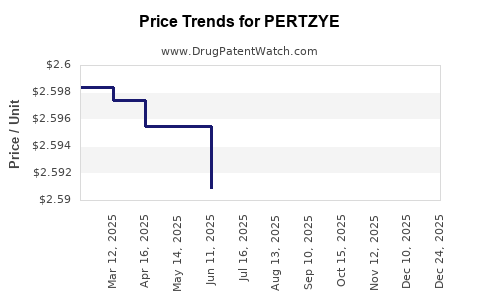
Pricing and Reimbursement

PERTZYE commands premium pricing due to its biological complexity and clinical necessity. Reimbursement policies in major markets like the U.S., EU, and Japan significantly influence market penetration. In the US, PERTZYE’s coverage under Medicare and private insurers remains robust, fostering predictable revenue streams. However, price pressures from payers and the introduction of biosimilars may influence future pricing strategies.

Clinical and Technological Innovations

Innovations in formulation—such as microencapsulation to improve enzyme stability and targeting—could enhance efficacy and patient adherence, expanding use cases. Additionally, personalized dosing based on genotypic or phenotypic patient profiles is under exploration, potentially improving clinical outcomes and demand.

Market Challenges

Key challenges include:

  • Patent expirations: Leading to generic biosimilar competition from 2025 onward.
  • Pricing pressures: Driven by healthcare systems seeking cost reductions.
  • Limited awareness: Among primary care providers regarding PEI diagnosis, potentially underdiagnosing the condition.
  • Manufacturing complexity: As a biologic, PERTZYE requires sophisticated production, affecting scalability and cost.

Financial Trajectory

Historical Revenue and Market Performance

Since its initial launch, PERTZYE revenues have demonstrated steady growth, reflecting its adoption for PEI management. In 2022, AbbVie reported PERTZYE revenues nearing $850 million, representing approximately 70% of its niche gastroenterology segment[2].

Forecasted Growth and Revenue Projections

Analysts project PERTZYE’s revenues to grow at a CAGR of 6-8% through 2030, driven by expanding indications and geographic markets[3]. Post-2025, patent cliffs may cause revenue declines unless offset by biosimilar competition or formulation innovations.

Impact of Biosimilars and Market Entry

The anticipated expiration of key patents between 2025 and 2027 presents both threats and opportunities. While biosimilar entrants could reduce prices and margins, they also could expand overall market volume by improving affordability and access. Strategic partnerships, licensing, and innovation could sustain revenue streams.

Cost and Investment Considerations

Continued R&D investment in formulation improvements and personalized therapies is expected. Manufacturing costs, influenced by strict biological production standards, will shape profit margins, emphasizing efficiency and automation.

Potential Growth Areas

  • Emerging markets: Increasing healthcare infrastructure investment accelerates access.
  • Pediatric applications: Growing awareness promotes adoption.
  • Extended indications: Barring new approvals, off-label use may sustain growth temporarily.
  • Technological enhancements: Novel delivery platforms promise improved patient adherence.

Strategic Outlook

Market Expansion

Global expansion, especially in Asia-Pacific and Latin America, is critical. Local regulatory approvals and pricing negotiations will determine market penetration speed. Additionally, educational initiatives targeting primary care enhancements support earlier diagnosis and treatment initiation.

Pipeline and Innovation

Investment in next-generation enzyme formulations, possibly combining biologics with adjunct therapies like microbiome modulation, could differentiate offerings and offset biosimilar competition.

Partnerships and M&A

Collaborations with biotech firms focusing on personalized medicine or diagnostic tools may unlock new revenue streams. Acquisitions of biosimilar developers can also be strategic to maintain market share post-2025.

Key Takeaways

  • PERTZYE benefits from a growing, high-need patient population with consistent demand but faces imminent patent expiries that could lead to increased biosimilar competition.
  • The market growth remains robust, supported by rising PEI prevalence, expanded indications, and healthcare infrastructure improvements.
  • Price sensitivity and reimbursement policies will shape future revenues, necessitating proactive pricing and partnership strategies.
  • Innovation in formulation and personalized therapies offer avenues for differentiation and value enhancement.
  • Strategic diversification and investment in emerging markets will be pivotal for sustaining financial trajectory beyond patent expirations.

Conclusion

The future of PERTZYE hinges on balancing innovation, market expansion, and competitive adaptation. While patent cliffs and biosimilar entry pose risks, strategic actions—such as leveraging technological advances, expanding into new regions, and fostering collaborations—can sustain its market leadership and profitability.


FAQs

  1. When is PERTZYE expected to face biosimilar competition?
    Biosimilars are projected to enter the market around 2025-2026 following patent expirations, notably after key patents held by AbbVie expire.

  2. How does reimbursement influence PERTZYE’s market availability?
    Favorable reimbursement policies in key markets like the US and EU facilitate access and drive demand, whereas reimbursement restrictions could hinder growth.

  3. What innovative developments could impact PERTZYE’s market share?
    Advances such as targeted delivery systems, enzyme optimization, and personalized dosing could enhance efficacy, offsetting biosimilar pressure.

  4. Are there expanding indications for PERTZYE beyond PEI?
    Currently, its primary use remains PEI. Off-label use or new indications require regulatory approval, but ongoing research might broaden its therapeutic scope.

  5. What strategies can manufacturers adopt to mitigate the patent cliff impact?
    Investing in formulation innovations, developing biosimilars, entering emerging markets early, and diversifying therapeutic applications are vital strategies.


References

[1] MarketResearch.com. (2022). Pancreatic enzyme replacement therapy market analysis.

[2] AbbVie Annual Report 2022.

[3] GlobalData. (2023). PERTZYE Market Forecast Analysis.

More… ↓

⤷  Get Started Free

Make Better Decisions: Try a trial or see plans & pricing

Drugs may be covered by multiple patents or regulatory protections. All trademarks and applicant names are the property of their respective owners or licensors. Although great care is taken in the proper and correct provision of this service, thinkBiotech LLC does not accept any responsibility for possible consequences of errors or omissions in the provided data. The data presented herein is for information purposes only. There is no warranty that the data contained herein is error free. We do not provide individual investment advice. This service is not registered with any financial regulatory agency. The information we publish is educational only and based on our opinions plus our models. By using DrugPatentWatch you acknowledge that we do not provide personalized recommendations or advice. thinkBiotech performs no independent verification of facts as provided by public sources nor are attempts made to provide legal or investing advice. Any reliance on data provided herein is done solely at the discretion of the user. Users of this service are advised to seek professional advice and independent confirmation before considering acting on any of the provided information. thinkBiotech LLC reserves the right to amend, extend or withdraw any part or all of the offered service without notice.