Share This Page
LYUMJEV Drug Profile
✉ Email this page to a colleague
Summary for Tradename: LYUMJEV
| High Confidence Patents: | 0 |
| Applicants: | 1 |
| BLAs: | 1 |
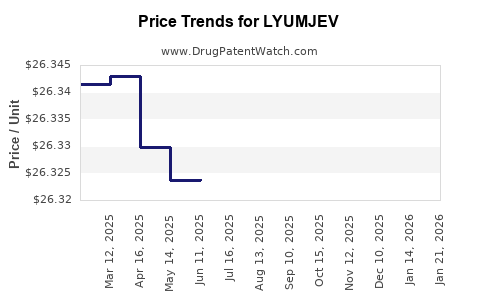
| Drug Prices: | Drug price information for LYUMJEV |
| Recent Clinical Trials: | See clinical trials for LYUMJEV |
Recent Clinical Trials for LYUMJEV
Identify potential brand extensions & biosimilar entrants
| Sponsor | Phase |
|---|---|
| Portal Diabetes, Inc. | PHASE1 |
| Stanford University | PHASE1 |
| St. Olavs Hospital | PHASE1 |
Pharmacology for LYUMJEV
| Ingredient-type | Insulin |
| Established Pharmacologic Class | Insulin Analog |
Note on Biologic Patents
Matching patents to biologic drugs is far more complicated than for small-molecule drugs.
DrugPatentWatch employs three methods to identify biologic patents:
- Brand-side disclosures in response to biosimilar applications
- DrugPatentWatch analysis and company disclosures
- Patents from broad patent text search
These patents were identified from disclosures by the brand-side company, in response to a potential biosimilar seeking to launch. They have a high certainty of blocking biosimilar entry. The expiration dates listed are not estimates — they're expiration dates as indicated by the brand-side company.
These patents were identified from searching various sources, including drug labels and other general disclosures from the brand-side company. This list may exclude some of the patents which block biosimilar launch, and some of these patents listed may not actually block biosimilar launch. The expiration dates listed for these patents are estimates, based on the grant date of the patent.
For completeness, these patents were identified by searching the patent literature for mentions of the branded or ingredient name of the drug. Some of these patents protect the original drug, whereas others may protect follow-on inventions or even inventions casually mentioning the drug. The expiration dates listed for these patents are estimates, based on the grant date of the patent.
1) High Certainty: US Patents for LYUMJEV Derived from Brand-Side Litigation
No patents found based on brand-side litigation
2) High Certainty: US Patents for LYUMJEV Derived from DrugPatentWatch Analysis and Company Disclosures
No patents found based on company disclosures
3) Low Certainty: US Patents for LYUMJEV Derived from Patent Text Search
No patents found based on company disclosures
LYUMJEV Market Dynamics, Financial Trajectory, Patent Position, and Competitive Outlook
LYUMJEV, insulin lispro-aabc, is Eli Lilly’s ultra-rapid-acting mealtime insulin. FDA approved it in June 2020 for adults with diabetes, and it competes primarily with Novo Nordisk’s Fiasp and established rapid-acting insulins such as Humalog, NovoLog and Apidra.[1] LYUMJEV has a differentiated pharmacokinetic profile, but its commercial expansion is constrained by insulin price pressure, formulary access, patient switching costs and Lilly’s own Humalog franchise.
Lilly does not separately disclose LYUMJEV revenue in its public financial statements. The product is reported within Lilly’s broader insulin and Humalog-related commercial portfolio, preventing a precise standalone revenue calculation. The available evidence supports a product with strategic value in ultra-rapid insulin and pump use, but with limited reported financial materiality relative to Mounjaro, Zepbound and Lilly’s larger diabetes franchises.[2]
What is LYUMJEV and how does it differ from Humalog?
LYUMJEV contains insulin lispro-aabc, a modified formulation of insulin lispro designed to accelerate absorption after subcutaneous injection. Its formulation includes excipients intended to improve the speed of insulin appearance in the bloodstream.[1]
| Attribute | LYUMJEV | Humalog | Fiasp |
|---|---|---|---|
| Active insulin | Insulin lispro-aabc | Insulin lispro | Insulin aspart |
| Manufacturer | Eli Lilly | Eli Lilly | Novo Nordisk |
| FDA approval | June 2020 | 1996 | 2017 |
| Primary use | Mealtime insulin | Mealtime insulin | Mealtime insulin |
| Delivery | Vials, prefilled pens, pumps | Vials, cartridges, pens, pumps | Vials, pens, pumps |
| Differentiation | Faster early absorption | Standard rapid-acting profile | Faster early absorption |
| U.S. regulatory route | NDA | NDA | NDA |
Clinical studies showed faster early absorption and an earlier glucose-lowering effect than standard insulin lispro. The clinical advantage is most relevant for patients needing dosing closer to meals, those with postprandial glucose excursions, and some insulin pump users.[3]
The benefit is incremental rather than transformational. LYUMJEV remains an injectable mealtime insulin requiring glucose monitoring and titration. It does not eliminate hypoglycemia risk, insulin resistance or the need for basal insulin in patients with type 1 diabetes.
How large is the LYUMJEV market?
LYUMJEV operates in the rapid-acting insulin market, which is mature and highly competitive. The addressable population includes insulin-treated patients with type 1 diabetes and a large subset of patients with advanced type 2 diabetes.
Market growth is driven by:
- Growth in diagnosed diabetes prevalence.
- Greater use of intensive insulin regimens.
- Adoption of insulin pumps and automated insulin-delivery systems.
- Demand for improved postprandial glucose control.
- Conversion from older human insulins to analog products.
Growth is limited by:
- Broad generic and follow-on insulin competition.
- Formulary rebates and mandatory step therapy.
- Insulin affordability policies.
- Patient resistance to changing established insulin regimens.
- Limited clinical differentiation among rapid-acting analogs.
- Increasing use of non-insulin therapies in type 2 diabetes.
The commercial opportunity is larger in type 1 diabetes, insulin pumps and technologically engaged patients than in the general type 2 diabetes population. Many type 2 patients remain on basal insulin, GLP-1 receptor agonists or fixed-ratio combinations rather than intensive basal-bolus therapy.
What is LYUMJEV’s financial trajectory?
Lilly does not report LYUMJEV net sales as a separate line item. Its revenue is embedded in broader insulin-related reporting, including the Humalog franchise and related diabetes products.[2]
That reporting structure has three implications:
- Standalone LYUMJEV growth cannot be verified from Lilly’s annual reports.
- Product-level revenue estimates from commercial databases may differ materially depending on gross-to-net assumptions.
- LYUMJEV’s strategic importance is greater than its likely direct contribution to Lilly’s consolidated revenue.
Lilly’s overall financial trajectory has been dominated by incretin products, particularly Trulicity, Mounjaro and Zepbound. That mix shift reduces the relative importance of insulin revenue, even while insulin remains strategically important to Lilly’s diabetes portfolio.[2]
Lilly revenue context
| Fiscal year | Eli Lilly total revenue | Major financial driver |
|---|---|---|
| 2020 | Approximately $24.5 billion | Established diabetes, oncology and immunology products |
| 2021 | Approximately $28.3 billion | Trulicity and established portfolio growth |
| 2022 | Approximately $28.5 billion | Trulicity and new-product launches |
| 2023 | Approximately $34.1 billion | Mounjaro, Trulicity and growth products |
| 2024 | Approximately $45 billion | Mounjaro, Zepbound and newer launch products |
The rapid growth of Mounjaro and Zepbound has changed Lilly’s revenue composition. LYUMJEV is therefore more likely to be evaluated as a portfolio-completion product than as a principal corporate growth driver.
How do insulin prices and rebates affect LYUMJEV?
LYUMJEV’s realized price depends heavily on payer contracts, rebates, channel mix and patient assistance programs. The U.S. insulin market has shifted from list-price competition toward net-price competition, with manufacturers using rebates to secure preferred formulary placement.
Lilly has introduced affordability programs, including a $35 monthly insulin cap for eligible patients and expanded access initiatives. These policies may improve patient access but can reduce realized revenue per unit and compress the commercial value of premium rapid-acting formulations.[4]
LYUMJEV also competes against lower-cost insulin lispro products. Lilly’s authorized generic insulin lispro, marketed through its insulin affordability strategy, can reduce the price gap between standard lispro and branded products. That creates a potential internal trade-off: LYUMJEV may gain volume through Lilly’s distribution platform while facing pressure to justify a premium over lower-cost lispro.
What competitive products challenge LYUMJEV?
Fiasp
Fiasp is LYUMJEV’s closest branded competitor. Both products target faster mealtime insulin action, and both compete for insulin pump, type 1 diabetes and postprandial-control patients.
Fiasp has an earlier U.S. launch and established presence in international markets. LYUMJEV benefits from Lilly’s broad U.S. insulin infrastructure and the existing Humalog prescriber base.
Humalog
Humalog is both a substitute and a commercial reference product. Physicians can switch between Humalog and LYUMJEV within Lilly’s portfolio, but the products have different pharmacokinetic profiles and may require dosing adjustments.
The availability of Humalog reduces the need for prescribers to move to a competitor when they want to remain within Lilly’s contracting structure. It also limits LYUMJEV’s ability to command a large premium.
NovoLog and generic insulin aspart
NovoLog and insulin aspart products remain important rapid-acting alternatives. Generic and follow-on versions increase payer leverage and reduce the probability that an ultra-rapid product will capture the entire rapid-acting insulin market.
Apidra
Sanofi’s Apidra has a smaller commercial position than Humalog or NovoLog but remains a recognized rapid-acting alternative in some formularies and geographies.
What FDA regulatory status does LYUMJEV have?
LYUMJEV was approved by FDA as an insulin lispro-aabc product under NDA 210605 in June 2020.[1] It is approved for adults with diabetes and is available in multiple delivery formats, including vials and prefilled pens. Its labeling includes use by subcutaneous injection and in insulin infusion pumps, subject to product-specific instructions.[1]
The product’s regulatory profile is different from that of a conventional small-molecule new chemical entity. Insulin products were transitioned into the biologics framework on March 23, 2020, but LYUMJEV was approved through an NDA framework. This creates a specialized regulatory environment for follow-on insulin products and does not map cleanly onto the traditional biosimilar model used for monoclonal antibodies.
When does LYUMJEV lose regulatory exclusivity?
LYUMJEV’s U.S. approval date was June 15, 2020. Any applicable three-year marketing exclusivity tied to new clinical investigations would have expired in June 2023, assuming the exclusivity was granted for the relevant approval.[1]
LYUMJEV does not receive the standard 12-year reference-product exclusivity associated with a licensed biologic reference product under the Public Health Service Act because its approval was submitted as an NDA product rather than a conventional BLA reference product.
Regulatory exclusivity does not determine the full generic-entry date. Follow-on manufacturers must still obtain approval, satisfy product-specific requirements and address any applicable patents or regulatory barriers.
What patents protect LYUMJEV?
LYUMJEV is protected by formulation, delivery and manufacturing-related intellectual property rather than by a new insulin molecule in the conventional composition-of-matter sense. The active insulin backbone, insulin lispro, has long been known.
The relevant patent categories include:
- Formulations that accelerate insulin absorption.
- Combinations of insulin lispro with absorption-enhancing excipients.
- Stable liquid formulations for vials and pens.
- Pump-compatible formulations.
- Manufacturing and purification processes.
- Device and cartridge configurations.
- Use patents directed to rapid mealtime dosing or specific delivery conditions.
A single, publicly determinable patent expiration date should not be treated as the end of LYUMJEV exclusivity. Patent protection depends on the specific formulation, dosage form, device and claim scope. Orange Book listings and patent certifications must be reviewed against the approved product and each proposed follow-on product.
Does LYUMJEV have Orange Book protection?
LYUMJEV was approved under an NDA, so any listed patents must be evaluated through the FDA Orange Book framework applicable to that approval. The presence or absence of an Orange Book listing does not resolve protection from formulation, manufacturing or device patents that may be asserted outside the central product listing.
The practical patent risk is therefore claim-specific. A follow-on manufacturer may challenge one formulation patent while designing around another. Patent term adjustment, patent term extension and pediatric exclusivity can also affect the operative end date.
Are there Paragraph IV challenges to LYUMJEV?
No broadly reported, commercially significant Paragraph IV litigation against LYUMJEV is established in the cited public FDA and Lilly materials through the latest available reporting period. This does not eliminate future challenge risk.
Potential challengers would likely focus on:
- Formulation patents.
- Stability and excipient combinations.
- Pen or cartridge configurations.
- Pump-use claims.
- Manufacturing claims.
A generic or follow-on insulin manufacturer may also pursue a non-infringement or invalidity strategy without creating a direct commercial dispute over every LYUMJEV-related patent.
What generic and biosimilar entry risks exist?
The primary risk is follow-on insulin competition rather than classic biosimilar substitution. Insulin products may be submitted through pathways designed for highly similar insulin products, but the regulatory and substitution analysis depends on the reference product, dosage form and state pharmacy-substitution rules.
Potential entrants face several barriers:
- Demonstrating comparable quality and pharmacology.
- Reproducing a complex excipient system.
- Establishing stability across vials, pens and pump reservoirs.
- Securing payer coverage.
- Meeting manufacturing and device requirements.
- Avoiding valid formulation and process patents.
These barriers are meaningful but lower than those associated with complex monoclonal antibodies. If a lower-cost ultra-rapid insulin reaches the market, payer adoption could be rapid because insulin formularies already use aggressive contracting.
How strong is the LYUMJEV patent estate?
The patent estate is likely moderate rather than dominant.
Its strengths are:
- Differentiated formulation technology.
- Potential protection across several presentations.
- Integration with Lilly’s insulin devices and manufacturing network.
- Commercial leverage from Lilly’s payer relationships.
Its weaknesses are:
- Insulin lispro is an established active ingredient.
- Rapid-acting insulin has multiple clinically acceptable substitutes.
- Formulation claims can face enablement, written-description and obviousness challenges.
- Competitors may design around specific excipient combinations.
- Product value is highly dependent on formulary access rather than exclusivity alone.
The strongest protection is likely concentrated in specific formulation and delivery claims. The estate is less likely to prevent all rapid-acting insulin competition after regulatory exclusivity ends.
What licensing deals affect LYUMJEV?
No major third-party licensing transaction is central to LYUMJEV’s commercial identity in Lilly’s public filings. Lilly controls the principal development, manufacturing and commercialization rights.
The most relevant commercial relationships are payer contracts, specialty pharmacy arrangements, diabetes technology integrations and insulin pump compatibility. These agreements can influence market access without creating publicly disclosed intellectual-property licensing revenue.
What patent litigation affects LYUMJEV?
No major publicly disclosed patent litigation has materially altered LYUMJEV’s commercial trajectory in the cited sources. The absence of major litigation does not mean the product is free of patent risk. It indicates that litigation has not been a visible driver of the product’s reported financial performance.
The more immediate commercial risks are price erosion, formulary exclusion and competition from established rapid-acting insulin products.
How does LYUMJEV compare with Fiasp?
| Factor | LYUMJEV | Fiasp |
|---|---|---|
| Developer | Eli Lilly | Novo Nordisk |
| Insulin base | Lispro | Aspart |
| U.S. launch | 2020 | 2017 |
| Primary differentiation | Faster absorption | Faster absorption |
| Main commercial advantage | Lilly’s Humalog and U.S. insulin infrastructure | Earlier market entry and Novo Nordisk insulin platform |
| Main risk | Cannibalization by Humalog and price pressure | Competition from LYUMJEV and lower-cost aspart |
| Revenue disclosure | Not separately disclosed | Novo Nordisk reports broader insulin categories, not always product-level detail |
Neither product has established a monopoly position in ultra-rapid mealtime insulin. Clinical differentiation is useful, but payer access and patient experience determine most commercial outcomes.
What are the likely LYUMJEV launch scenarios?
Base case
LYUMJEV remains a niche-to-midsized rapid-acting insulin brand with stable use in patients seeking faster mealtime action or pump compatibility. Revenue grows modestly or remains flat as Lilly prioritizes incretin products and manages insulin affordability pressure.
Upside case
Growth accelerates if automated insulin-delivery systems, pump adoption and postprandial glucose management increase demand for ultra-rapid insulin. Favorable formulary placement and broader patient assistance could expand volume.
Downside case
Revenue declines if payers favor lower-cost lispro or aspart, if Lilly’s affordability programs reduce net price, or if follow-on ultra-rapid insulin products enter with interchangeable or preferred coverage.
What is the geographic coverage of LYUMJEV?
LYUMJEV has regulatory approvals in the United States and multiple international markets under Lilly’s global diabetes organization. Market access varies by jurisdiction.
The United States is the most commercially important market because it supports premium branded insulin pricing, although rebate pressure is substantial. European markets provide volume but generally impose tighter price controls and health-technology assessment requirements. Emerging markets may favor lower-cost human insulin or standard rapid-acting analogs over premium ultra-rapid products.
Key Takeaways
- LYUMJEV is Eli Lilly’s ultra-rapid insulin lispro-aabc product, approved in the United States in June 2020.
- Its clinical differentiation is faster early insulin absorption and improved flexibility around meals.
- Lilly does not separately disclose LYUMJEV revenue, so standalone financial performance cannot be verified from public company filings.
- The product competes mainly with Fiasp, Humalog, NovoLog, insulin aspart and Apidra.
- Regulatory exclusivity from the 2020 approval has largely expired, while formulation, device and manufacturing patents may continue to affect entry.
- The commercial threat is follow-on insulin and formulary price erosion rather than conventional monoclonal-antibody biosimilar competition.
- Lilly’s major growth products, Mounjaro and Zepbound, have reduced LYUMJEV’s relative importance in the company’s financial mix.
- LYUMJEV’s patent estate is strongest around formulation and delivery technology, not the underlying insulin lispro molecule.
- Future performance will depend more on formulary access, pump adoption and net pricing than on clinical differentiation alone.
FAQs About LYUMJEV Market and Patent Risk
Is LYUMJEV a biosimilar?
No. LYUMJEV is insulin lispro-aabc, an approved insulin product with a modified formulation. It is not a biosimilar to Humalog, although it uses the same insulin lispro foundation.
Can LYUMJEV be used in an insulin pump?
Yes. FDA labeling permits LYUMJEV use in continuous subcutaneous insulin infusion, subject to the approved product instructions and pump compatibility requirements.[1]
Is LYUMJEV more effective than Humalog?
LYUMJEV acts faster after administration, particularly during the early post-meal period. Overall effectiveness depends on dosing, meal timing, glucose monitoring and patient response.
Does Lilly disclose LYUMJEV sales?
No. Lilly reports its financial results by broader product categories and does not provide a consistently separate LYUMJEV revenue line in its annual filings.[2]
What is the main investment risk for LYUMJEV?
The primary risk is net-price and volume erosion from insulin formulary competition, lower-cost follow-on products and substitution by other rapid-acting insulins.
References
- U.S. Food and Drug Administration. (2020). LYUMJEV (insulin lispro-aabc) prescribing information.
- Eli Lilly and Company. (2025). 2024 annual report.
- Leohr, J., et al. (2020). Ultra-rapid insulin lispro formulation and pharmacokinetic performance in adults with diabetes. Diabetes Care.
- Eli Lilly and Company. (2023). Insulin affordability and patient access programs.
More… ↓
