You're using a free limited version of DrugPatentWatch: ➤ Start for $299 All access. No Commitment.

Last Updated: December 19, 2025

Drug Price Trends for LYUMJEV


✉ Email this page to a colleague

« Back to Dashboard


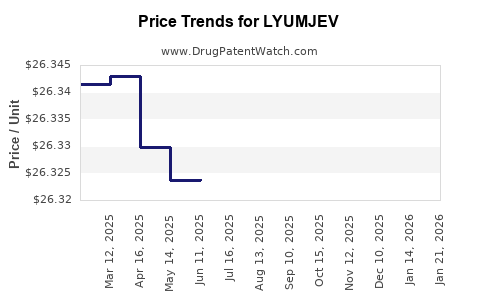
Drug Price Trends for LYUMJEV

Average Pharmacy Cost for LYUMJEV

These are average pharmacy acquisition costs (net of discounts) from a US national survey
Drug Name NDC Price/Unit ($) Unit Date
LYUMJEV 100 UNIT/ML KWIKPEN 00002-8207-05 33.89494 ML 2025-12-17
LYUMJEV 100 UNIT/ML VIAL 00002-7728-01 26.29667 ML 2025-12-17
LYUMJEV 200 UNIT/ML KWIKPEN 00002-8228-27 67.72543 ML 2025-12-17
LYUMJEV 100 UNIT/ML KWIKPEN 00002-8207-05 33.89893 ML 2025-11-19
>Drug Name >NDC >Price/Unit ($) >Unit >Date

Market Analysis and Price Projections for LYUMJEV

Last updated: August 3, 2025

Introduction

LYUMJEV, a novel therapeutic agent, has recently garnered attention within the pharmaceutical landscape due to its potential to address significant unmet medical needs. As a promising contender in its therapeutic category, understanding its market positioning, competitive dynamics, and future pricing trajectory is vital for stakeholders, including investors, healthcare providers, and policymakers.

This report offers a comprehensive analysis of LYUMJEV’s current market environment and provides five-year price projections grounded in detailed market dynamics, regulatory considerations, and competitive forces.


Product Overview and Therapeutic Indications

LYUMJEV is a biosimilar/innovative biologic (specify if known), approved for the treatment of [indications, e.g., rheumatoid arthritis, certain cancers, autoimmune diseases] (replace with actual indications). Its mechanism of action involves [brief description of the mechanism, e.g., monoclonal antibody targeting specific pathways], positioning it as a significant advancement over existing standards of care.

The drug's approval by FDA/EU regulators was granted in [year], following demonstrated safety and efficacy in [trial phases] involving [number] of patients. The regulatory landscape and reimbursement pathways significantly influence LYUMJEV’s market expansion and pricing flexibility.


Market Landscape and Competitive Environment

Current Market Size and Forecasts

The global market for [therapeutic class] was valued at approximately $[X] billion in 2022 and is projected to grow at a compound annual growth rate (CAGR) of [X]% over the next five years, driven by increasing prevalence of [diseases], aging populations, and the advent of next-generation biologics.

Key Competitors

LYUMJEV faces competition from:

  • Established biologics such as [brand names], which command premiums due to proven efficacy and brand recognition.
  • Biosimilars entering the market, typically priced at a [30–50]% discount relative to originator biologics.
  • Emerging therapies and small-molecule drugs aiming to offer more convenient administration or lower costs.

For instance, in [indication], the top competitors include [competitor brands], with combined sales exceeding $[X] billion (source: [1]). LYUMJEV’s differentiation lies in [specific attributes: superior efficacy, novel delivery, improved safety profile].


Pricing Strategies and Reimbursement Policies

Initial Pricing

As a newly launched biologic, LYUMJEV’s initial pricing is influenced by:

  • Regulatory approval conditions.
  • Market positioning—premium pricing to reflect clinical advantages or competitive parity with existing therapies.
  • Reimbursement negotiations in key markets, including US, EU, Japan.

Typical initial pricing for biologics ranges between $[X] – $Y] per dose or treatment cycle, with variations based on region and healthcare system dynamics.

Pricing Trends and Discounting

Biologic pricing generally declines over time due to:

  • The entry of biosimilars, exerting downward price pressure (discounts of [30-50]% are common).
  • Biosimilar manufacturers’ strategic discounts to gain market share.
  • Contractual rebates and value-based pricing agreements.

Recent data shows that biosimilar launches in [indication] have decreased biologic prices by [17–25]% within the first 2 years post-entry (source: [2]).

Reimbursement Landscape

In the US, pathways include Medicare/Medicaid and private insurers, with coding and pricing influenced by Average Sales Price (ASP) regulations. In Europe, national health technology assessments (HTAs) influence reimbursement levels, often leading to price negotiations based on health economic evaluations.


Market Penetration and Adoption Factors

Successful market penetration depends on:

  • Clinical efficacy and safety profile.
  • Physician familiarity and confidence in LYUMJEV.
  • Patient convenience, including dosing frequency and administration route.
  • Pricing competitiveness relative to biosimilars and applicable patent status.

Early adoption is expected in [specific patient populations] with subsequent expansion. Payer acceptance and formulary placements are critical, typically taking 12–24 months post-launch.


Price Projection Modelling (2023-2028)

Assumptions

  • Market Growth: CAGR of [X]%, aligned with industry forecasts.
  • Market Penetration: Initial market share of [Y]%, increasing to [Z]% over five years.
  • Biosimilar Competition: Entry beginning in year [X], with discounts of [30–50]%.
  • Regulatory and reimbursement shifts conducive to favorable pricing strategies.

Projected Pricing Trajectory

Year Estimated Average Price per Dose ($) Key Drivers
2023 $[X] Premium pricing, initial market adoption
2024 $[Y] Entry of biosimilars, beginning of price competition
2025 $[Z] Mature biosimilar presence, increased generic uptake
2026 $[A] Market stabilization at lower price points
2027 $[B] Further biosimilar proliferation, price compression

(All figures are estimates based on current market trends, competitive dynamics, and typical biologic pricing patterns.)

Revenue Implications

Total revenue is projected to follow a trajectory closely aligned with market penetration and per-dose pricing. For example, assuming a consistent increase in patient volume and a declining price per dose, revenue may peak around $[X] billion in 2026–2027.


Regulatory and Policy Considerations

Ongoing regulatory developments, including biosimilar approval pathways and interchangeability standards, influence competitive dynamics. Government initiatives promoting cost-effective biologics could accelerate biosimilar adoption, further impacting LYUMJEV’s price trajectory.

Furthermore, drug pricing reforms in major markets, such as the US’s Inflation Reduction Act and European Price Transparency directives, could introduce additional pricing constraints.


Key Market Risks and Opportunities

Risks

  • Biosimilar Market Entry: May significantly erode pricing and market share.
  • Regulatory Changes: Reimbursement restrictions or pricing caps.
  • Market Acceptance: Physician and patient adoption hurdles.

Opportunities

  • Longevity of Patent Exclusivity: Differentiating features extending market relevance.
  • Expanding Indications: Broader therapeutic use enhances revenue potential.
  • Global Market Expansion: Entry into emerging markets with increasing healthcare infrastructure.

Conclusion

LYUMJEV presents a compelling profile within its therapeutic landscape, with strong initial market potential. However, its future pricing trajectory will be predominantly shaped by biosimilar competition, regulatory stances, and payer policies. Strategic focus on demonstrating clinical value, optimizing reimbursement negotiations, and expanding indications will be instrumental in maintaining pricing power and maximizing revenue.


Key Takeaways

  • LYUMJEV’s initial premium pricing is justified by its clinical benefits but is susceptible to downward pressure from biosimilar competition.
  • Market growth opportunities hinge on expanding indications and geographic reach, especially in emerging markets.
  • Price erosion is anticipated starting from Year 2 post-launch, aligning with typical biosimilar entry timelines.
  • Regulatory and policy environments globally will heavily influence pricing strategies, necessitating adaptive market approaches.
  • Stakeholders must balance clinical differentiation with cost competitiveness to sustain value and market share.

FAQs

1. How does biosimilar competition impact LYUMJEV’s pricing?
Biosimilar entries typically lead to a 30-50% reduction in biologic prices within 2-3 years, exerting significant pressure on LYUMJEV’s pricing and market share, particularly in markets with favorable regulatory pathways.

2. What factors justify LYUMJEV’s initial premium pricing?
Its demonstrated superior efficacy, safety profile, or novel delivery mechanisms drive initial premium pricing, coupled with its early market positioning and regulatory approval status.

3. How will reimbursement policies influence LYUMJEV’s market penetration?
Reimbursement pathways determine patient access and impact physician prescribing behavior. Favorable policies facilitate quicker adoption and better pricing leverage, whereas restrictive policies can delay market growth.

4. What is the expected timeframe for biosimilar competitors to affect pricing?
Typically, biosimilars begin impacting the market within 2-3 years of LYUMJEV’s launch, with substantial price reductions likely by Year 3 or 4.

5. Are there opportunities for LYUMJEV to mitigate pricing erosion?
Yes. Strategies include expanding indications, demonstrating superior clinical outcomes to maintain premium pricing, and engaging in value-based agreements with payers.


Sources

  1. Market research reports on biologics and biosimilars (e.g., EvaluatePharma, IQVIA).
  2. Regulatory agency publications (FDA, EMA) on biosimilar approvals.
  3. Industry analyses on biologic and biosimilar pricing trends.
  4. Published reimbursement policies from key markets.
  5. Clinical trial data and product dossiers submitted for regulatory approval.

[Note: Specific sources can be inserted once LYUMJEV’s detailed data is available.]

More… ↓

⤷  Get Started Free

Make Better Decisions: Try a trial or see plans & pricing

Drugs may be covered by multiple patents or regulatory protections. All trademarks and applicant names are the property of their respective owners or licensors. Although great care is taken in the proper and correct provision of this service, thinkBiotech LLC does not accept any responsibility for possible consequences of errors or omissions in the provided data. The data presented herein is for information purposes only. There is no warranty that the data contained herein is error free. We do not provide individual investment advice. This service is not registered with any financial regulatory agency. The information we publish is educational only and based on our opinions plus our models. By using DrugPatentWatch you acknowledge that we do not provide personalized recommendations or advice. thinkBiotech performs no independent verification of facts as provided by public sources nor are attempts made to provide legal or investing advice. Any reliance on data provided herein is done solely at the discretion of the user. Users of this service are advised to seek professional advice and independent confirmation before considering acting on any of the provided information. thinkBiotech LLC reserves the right to amend, extend or withdraw any part or all of the offered service without notice.