Share This Page
INFLECTRA Drug Profile
✉ Email this page to a colleague
Summary for Tradename: INFLECTRA
| High Confidence Patents: | 0 |
| Applicants: | 1 |
| BLAs: | 1 |
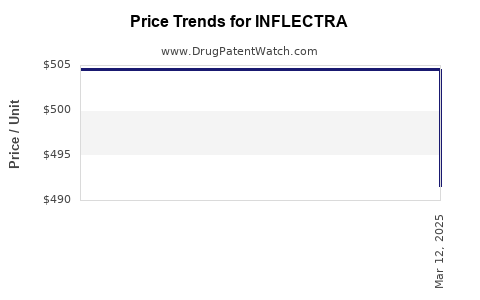
| Drug Prices: | Drug price information for INFLECTRA |
| Recent Clinical Trials: | See clinical trials for INFLECTRA |
Recent Clinical Trials for INFLECTRA
Identify potential brand extensions & biosimilar entrants
| Sponsor | Phase |
|---|---|
| Children's Hospital Medical Center, Cincinnati | Phase 2/Phase 3 |
| National Institute of Diabetes and Digestive and Kidney Diseases (NIDDK) | Phase 2/Phase 3 |
| University of California, San Diego | Phase 2/Phase 3 |
Pharmacology for INFLECTRA
| Mechanism of Action | Tumor Necrosis Factor Receptor Blocking Activity |
| Established Pharmacologic Class | Tumor Necrosis Factor Blocker |
Note on Biologic Patents
Matching patents to biologic drugs is far more complicated than for small-molecule drugs.
DrugPatentWatch employs three methods to identify biologic patents:
- Brand-side disclosures in response to biosimilar applications
- DrugPatentWatch analysis and company disclosures
- Patents from broad patent text search
These patents were identified from disclosures by the brand-side company, in response to a potential biosimilar seeking to launch. They have a high certainty of blocking biosimilar entry. The expiration dates listed are not estimates — they're expiration dates as indicated by the brand-side company.
These patents were identified from searching various sources, including drug labels and other general disclosures from the brand-side company. This list may exclude some of the patents which block biosimilar launch, and some of these patents listed may not actually block biosimilar launch. The expiration dates listed for these patents are estimates, based on the grant date of the patent.
For completeness, these patents were identified by searching the patent literature for mentions of the branded or ingredient name of the drug. Some of these patents protect the original drug, whereas others may protect follow-on inventions or even inventions casually mentioning the drug. The expiration dates listed for these patents are estimates, based on the grant date of the patent.
1) High Certainty: US Patents for INFLECTRA Derived from Brand-Side Litigation
No patents found based on brand-side litigation
2) High Certainty: US Patents for INFLECTRA Derived from DrugPatentWatch Analysis and Company Disclosures
No patents found based on company disclosures
3) Low Certainty: US Patents for INFLECTRA Derived from Patent Text Search
No patents found based on company disclosures
Inflectra Market Dynamics, Financial Trajectory, Patent Position and Competitive Outlook
Inflectra is the U.S. brand for infliximab-dyyb, a biosimilar to Johnson & Johnson and Merck’s Remicade. Pfizer commercializes Inflectra in the United States after acquiring Hospira, while Celltrion developed the product and supplies the underlying biosimilar technology. The product has durable regulatory demand but faces persistent price erosion from Remicade biosimilars, payer steering, hospital purchasing pressure and physician-administered drug reimbursement changes.
Pfizer does not report Inflectra revenue as a separate line item in its current public financial statements. Its financial trajectory must therefore be assessed through biosimilar portfolio disclosures, market-share indicators, reimbursement trends and competitive pricing rather than a verified standalone sales series.
What is Inflectra and how is it regulated?
Inflectra is infliximab-dyyb, a tumor necrosis factor-alpha inhibitor administered by intravenous infusion. The FDA approved it in April 2016 under the abbreviated biologics license application pathway in Section 351(k) of the Public Health Service Act. It was the first U.S.-approved biosimilar monoclonal antibody referencing Remicade.[1]
Inflectra is approved for the same principal indications as Remicade, including:
- Rheumatoid arthritis in combination with methotrexate
- Crohn’s disease
- Pediatric Crohn’s disease
- Ulcerative colitis
- Pediatric ulcerative colitis
- Ankylosing spondylitis
- Psoriatic arthritis
- Plaque psoriasis
The product is administered intravenously, generally in hospital outpatient departments, physician offices and infusion centers. That setting distinguishes Inflectra from self-administered biosimilars such as adalimumab products and creates a reimbursement-driven purchasing model.
Is Inflectra interchangeable with Remicade?
Inflectra is biosimilar to Remicade but does not have an FDA interchangeable designation. The FDA’s original approval established biosimilarity, not automatic pharmacy-level substitution.
Because Inflectra is infused by a healthcare professional, substitution typically occurs through prescribing decisions, hospital formulary policy, payer protocols or infusion-provider purchasing. Pharmacy substitution laws that apply to self-administered products have less practical importance for Inflectra.
What is the financial trajectory of Inflectra?
Pfizer does not provide a separately audited annual revenue series for Inflectra in its recent Form 10-K product tables. The company reports broader business segments and selected major brands, while Inflectra is generally included within established products or biosimilar-related revenue categories.[2]
| Financial indicator | Publicly observable position |
|---|---|
| Standalone Inflectra revenue | Not separately reported by Pfizer in recent annual filings |
| Primary commercial market | United States, with additional international commercialization depending on territory |
| Revenue model | Physician-administered biologic, mainly buy-and-bill and institutional purchasing |
| Volume trend | Supported by conversion from Remicade and continued use of infliximab |
| Price trend | Downward because of multiple biosimilars and payer negotiation |
| Margin trend | Exposed to manufacturing scale, contracting discounts and reimbursement pressure |
| Key commercial risk | Loss of preferred status to lower-priced infliximab competitors |
Inflectra’s financial trajectory has two opposing elements. The addressable market remains large because infliximab is used across gastroenterology, rheumatology, dermatology and other immune-mediated diseases. At the same time, the product’s net price is under pressure as competing infliximab biosimilars expand.
Pfizer’s biosimilar business has strategic value because it generates established-product revenue after reference-product exclusivity expires. The business is less attractive on a unit-price basis than an innovative biologic because payers and providers can use contracting to force rapid price reductions. Inflectra’s financial performance therefore depends more on volume retention, formulary access and infusion-channel contracts than on list-price growth.
Which factors drive Inflectra revenue?
The main revenue drivers are:
- Conversion of Remicade patients to Inflectra.
- New-start patients placed on infliximab therapy.
- Hospital and integrated-delivery-network contracts.
- Medicare Part B reimbursement and average sales price dynamics.
- Payer preference among Inflectra, Renflexis, Avsola and Remicade.
- Physician confidence in switching stable patients.
- Supply reliability and infusion-center inventory decisions.
The main negative factor is the spread between reimbursement and acquisition cost. Infusion providers may favor the product with the best combination of acquisition discount, reimbursement economics, contract support and supply continuity.
How large is the U.S. market for infliximab biosimilars?
The U.S. infliximab market has shifted from a single-brand model to a multi-product market. Remicade remains the reference product, while Inflectra competes with Samsung Bioepis’ Renflexis and Amgen’s Avsola.
| Product | Active ingredient | Company or commercial sponsor | U.S. regulatory position |
|---|---|---|---|
| Remicade | Infliximab | Janssen Biotech, Merck co-commercialization history | Reference biologic |
| Inflectra | Infliximab-dyyb | Pfizer; developed by Celltrion/Hospira relationship | Biosimilar |
| Renflexis | Infliximab-abda | Samsung Bioepis / Organon | Biosimilar |
| Avsola | Infliximab-axxq | Amgen | Biosimilar |
The competitive market has several characteristics:
- All products rely on intravenous administration.
- Prescribing decisions are concentrated among specialists and health systems.
- Payers can negotiate directly with providers and specialty practices.
- Biosimilars compete through net price, contracting and operational reliability.
- The reference product can retain share through established physician familiarity and rebates.
- A biosimilar does not need to capture the entire reference-product market to remain commercially viable.
Market growth is therefore measured by biosimilar share and net price realization rather than by total infliximab prescription growth alone.
What patents protect Inflectra and when does Remicade lose exclusivity?
Inflectra does not depend on a conventional small-molecule patent expiry timeline. The key legal event was the expiration of Remicade’s reference-product exclusivity and the resolution of patent disputes surrounding biosimilar entry.
Remicade received FDA approval in 1998. The BPCIA’s 12-year reference-product exclusivity framework did not permit FDA approval of a biosimilar until the applicable exclusivity period had expired. FDA approval of Inflectra in 2016 occurred after the reference-product exclusivity barrier had been addressed, although commercial launch timing was also affected by patent litigation and settlement arrangements.[1]
Remicade’s U.S. patent estate included composition, formulation, dosing and manufacturing-related claims. The central commercial barrier was the ’471 patent, U.S. Patent No. 6,284,471, which Janssen asserted in litigation against biosimilar applicants. The relevant disputes were resolved through settlements that allowed biosimilar launches before the full end of the asserted patent term.[3]
Does Inflectra have Orange Book-listed patents?
No. Inflectra is a biologic, so its relevant FDA patent and exclusivity records are not maintained in the small-molecule Orange Book framework. Biologic reference-product and biosimilar information is associated with FDA’s Purple Book and the applicable biologics license records.
Inflectra’s commercial protection is therefore based on:
- Regulatory approval
- Manufacturing know-how
- Cell-line and process control
- Supply agreements
- Contracting relationships
- Physician and health-system adoption
- Any applicable proprietary process or formulation rights
The absence of an Orange Book listing does not mean the product lacks intellectual-property protection. It means the primary patent-analysis framework differs from that used for drugs approved under Section 505 of the Federal Food, Drug, and Cosmetic Act.
What Paragraph IV challenges and litigation affect Inflectra?
Paragraph IV certification is a Hatch-Waxman mechanism for small-molecule drugs. It is not the primary legal mechanism for biosimilar approval. Biosimilar applicants proceed under the BPCIA and may participate in the statutory patent-exchange process commonly called the “patent dance.”
The principal litigation risk for Inflectra was tied to Remicade’s patent estate and the launch strategy of the biosimilar applicant. Hospira and Celltrion faced patent-related disputes involving Janssen. Settlement terms ultimately enabled U.S. commercialization of Inflectra.[3]
Current Inflectra litigation risk is more likely to involve:
- Manufacturing-process patents
- Cell-culture or purification claims
- Contracting disputes
- Product-liability claims
- Reimbursement disputes
- Antitrust allegations concerning biologic market access
- Patent disputes involving later-generation infliximab products
There is no equivalent of a continuing, high-value Orange Book patent cliff for Inflectra itself. Its commercial risk is primarily competitive price erosion rather than an imminent loss of exclusivity.
How strong is the Inflectra patent estate?
Inflectra’s patent position is moderate from a commercial perspective but not comparable to the patent position of an originator biologic.
| Patent-strength factor | Assessment |
|---|---|
| Reference-product protection | Remicade’s principal exclusivity barriers have largely expired or been bypassed through settlements |
| Product-specific composition protection | Limited relevance for a biosimilar using a known reference molecule |
| Manufacturing protection | Potentially meaningful if process claims are difficult to design around |
| Formulation protection | Relevant but unlikely to prevent all competing infliximab products |
| Regulatory protection | Biosimilar approval creates market access but not long-term exclusivity |
| Switching advantage | Based on clinical familiarity, contracting and supply rather than patent rights |
| Litigation leverage | Lower than for an originator with broad composition claims |
The strongest barriers are operational. Cell-line development, comparability testing, large-scale sterile manufacturing and regulatory quality systems are difficult to reproduce quickly. These barriers can protect market share even when patent protection is limited.
What formulation and method-of-use protections apply to Inflectra?
Inflectra uses an intravenous formulation of infliximab. The commercial value of formulation patents is lower than the value of the active biologic’s regulatory approval because competing infliximab biosimilars can enter with their own formulations after satisfying FDA comparability requirements.
Method-of-use patents may cover dosing schedules or specific patient populations. Their ability to block Inflectra use is constrained by the approved biosimilar indication set, physician prescribing practices and the legal treatment of label carve-outs. A biosimilar sponsor may avoid certain patented indications through labeling strategy, but physicians can still prescribe biologics off-label where legally permitted.
For Inflectra, formulation and method-of-use patents are secondary defenses. They do not provide the same market control as composition-of-matter patents for small molecules.
Which companies are challenging Inflectra commercially?
Inflectra faces direct competition from:
- Samsung Bioepis and Organon through Renflexis
- Amgen through Avsola
- Janssen and Merck through Remicade
- Hospital systems and specialty pharmacies that negotiate product-specific discounts
- Payers that establish preferred infliximab products
Competition is not limited to list price. Providers evaluate net acquisition cost, wastage, vial size, inventory requirements, reimbursement spread, patient assistance and contract duration.
The product also faces indirect competition from other biologic classes, including adalimumab, ustekinumab, vedolizumab and newer therapies for inflammatory bowel disease. These products can reduce the number of patients who start or remain on infliximab treatment, even when Inflectra gains share within the infliximab category.
What is the FDA and reimbursement status of Inflectra?
Inflectra is FDA-approved and marketed in the United States as a biosimilar to Remicade. It is reimbursed primarily through medical-benefit channels because it is administered by infusion.
The reimbursement environment creates several commercial constraints:
- Medicare Part B reimbursement is linked to average sales price methodology.
- Provider economics depend on the relationship between reimbursement and acquisition cost.
- Commercial insurers can impose preferred-product requirements.
- Health systems may use centralized purchasing to standardize on one infliximab product.
- Biosimilar adoption can increase when payers share savings with providers or patients.
- Lack of interchangeability designation limits automatic pharmacy substitution.
Biosimilar reimbursement policy remains a major determinant of market share. FDA approval alone does not guarantee rapid conversion from Remicade.
What generic or biosimilar launch risks exist?
Inflectra does not face conventional generic entry because it is itself a biosimilar. Its principal risk is further biosimilar competition.
Near-term risks
- Payers may move contracts to Renflexis or Avsola.
- New entrants may offer deeper net discounts.
- Remicade may defend share through rebates.
- Providers may consolidate purchasing around a single preferred product.
- Switching stable patients may remain slower than new-start conversion.
- Infusion centers may reduce inventory variety.
Longer-term risks
- Improved interchangeability policies could increase automatic substitution for future products.
- Additional infliximab biosimilars could accelerate net-price compression.
- Subcutaneous and oral therapies could reduce infusion demand.
- Clinical preference could shift toward newer mechanisms in inflammatory bowel disease.
Inflectra’s downside is therefore gradual erosion rather than a single loss-of-exclusivity event.
How does Inflectra compare with Remicade, Renflexis and Avsola?
| Factor | Inflectra | Remicade | Renflexis | Avsola |
|---|---|---|---|---|
| Role | Biosimilar | Reference product | Biosimilar | Biosimilar |
| Active ingredient | Infliximab-dyyb | Infliximab | Infliximab-abda | Infliximab-axxq |
| Approval pathway | 351(k) | Original biologics license | 351(k) | 351(k) |
| Interchangeable designation | No | Not applicable | Product-specific FDA status should be checked | Product-specific FDA status should be checked |
| Administration | Intravenous infusion | Intravenous infusion | Intravenous infusion | Intravenous infusion |
| Main advantage | Pfizer commercial infrastructure and early market entry | Physician familiarity and reference-product position | Competitive contracting | Amgen scale and contracting capability |
| Main weakness | Price pressure and no automatic substitution | Higher net-price exposure | Competes in crowded category | Late-entry and contracting dependence |
Inflectra’s early approval and Pfizer’s commercial infrastructure provide useful scale. Those advantages do not eliminate the need for aggressive contracting because all major products compete in the same infusion channel.
What licensing deals support Inflectra?
Inflectra originated from the Celltrion-Hospira collaboration. Celltrion developed the biosimilar, while Hospira held commercialization rights in key markets. Pfizer acquired Hospira in 2015, transferring Hospira’s commercialization infrastructure and rights into Pfizer’s portfolio.[4]
The arrangement gives Pfizer access to a product without bearing the full cost of originating the reference biologic. It also creates dependence on external development and manufacturing relationships. Commercial economics therefore reflect the allocation of revenue and costs among the relevant parties, not only Pfizer’s reported product revenue.
What is the outlook for Inflectra revenue?
Inflectra should remain a meaningful established-product asset while infliximab demand persists. Revenue growth is unlikely to come primarily from higher prices. The more realistic trajectory is:
- Initial growth from Remicade conversion and biosimilar adoption.
- Expansion through payer and provider contracts.
- Maturing sales as competing biosimilars increase.
- Net-price compression as suppliers compete for preferred access.
- Stabilization at a lower price level if Inflectra retains volume and supply reliability.
The product’s financial resilience depends on volume, not exclusivity. Pfizer can protect economics through manufacturing efficiency, contracting discipline and specialty-provider relationships. It cannot rely on a long remaining patent term or automatic substitution.
Key Takeaways
- Inflectra is Pfizer’s U.S. brand for infliximab-dyyb, developed through the Celltrion-Hospira relationship.
- FDA approved Inflectra in 2016 as a biosimilar to Remicade.
- Pfizer does not separately disclose a current audited Inflectra revenue series.
- The product operates in a mature, price-competitive infusion market.
- Renflexis and Avsola are the principal U.S. biosimilar competitors.
- Inflectra is not an Orange Book product and does not use a conventional Paragraph IV exclusivity framework.
- Its strongest commercial protections are manufacturing capability, supply reliability, contracting and physician adoption.
- Revenue risk is driven by price erosion and payer switching rather than a single future patent cliff.
- Inflectra is not FDA-designated interchangeable with Remicade.
- Long-term value depends on retaining infliximab volume as providers compare net cost across multiple biosimilars.
FAQs
Is Inflectra still commercially viable after Remicade patent expiry?
Yes. Biosimilar viability depends on infliximab volume, payer access and provider contracting rather than continued reference-product patent protection.
Does Pfizer disclose Inflectra sales separately?
No. Pfizer’s recent public reporting does not provide a consistently separate, audited Inflectra revenue line.
Can a pharmacist automatically substitute Inflectra for Remicade?
Generally no. Inflectra is biosimilar to Remicade but lacks an FDA interchangeable designation, and its infused administration limits ordinary pharmacy-level substitution.
Does Inflectra compete with adalimumab biosimilars?
Yes, indirectly. Adalimumab biosimilars compete for patients and payer budgets in overlapping immune-mediated disease indications, although the products differ in mechanism, administration and clinical positioning.
What is the largest long-term threat to Inflectra?
The largest threat is cumulative net-price compression from Renflexis, Avsola and future infliximab competitors, combined with migration to newer biologic mechanisms and non-infusion therapies.
References
- U.S. Food and Drug Administration. (2016). FDA approves Inflectra, a biosimilar to Remicade. https://www.fda.gov
- Pfizer Inc. (2024). 2023 annual report. https://www.pfizer.com/investor/financial-reports
- Janssen Biotech, Inc. v. Celltrion Healthcare Co., Ltd., patent litigation records, U.S. District Court for the District of Massachusetts.
- Pfizer Inc. (2015). Pfizer completes acquisition of Hospira. https://www.pfizer.com/news/press-release/press-release-detail/pfizer_completes_acquisition_of_hospira
More… ↓
