Share This Page
HUMULIN N Drug Profile
✉ Email this page to a colleague
Summary for Tradename: HUMULIN N
| High Confidence Patents: | 0 |
| Applicants: | 1 |
| BLAs: | 2 |
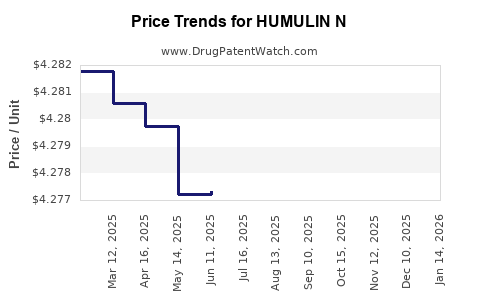
| Drug Prices: | Drug price information for HUMULIN N |
| Recent Clinical Trials: | See clinical trials for HUMULIN N |
Recent Clinical Trials for HUMULIN N
Identify potential brand extensions & biosimilar entrants
| Sponsor | Phase |
|---|---|
| Portal Diabetes, Inc. | PHASE1 |
| Stanford University | PHASE1 |
| Laboratorios Pisa S.A. de C.V. | PHASE1 |
Note on Biologic Patents
Matching patents to biologic drugs is far more complicated than for small-molecule drugs.
DrugPatentWatch employs three methods to identify biologic patents:
- Brand-side disclosures in response to biosimilar applications
- DrugPatentWatch analysis and company disclosures
- Patents from broad patent text search
These patents were identified from disclosures by the brand-side company, in response to a potential biosimilar seeking to launch. They have a high certainty of blocking biosimilar entry. The expiration dates listed are not estimates — they're expiration dates as indicated by the brand-side company.
These patents were identified from searching various sources, including drug labels and other general disclosures from the brand-side company. This list may exclude some of the patents which block biosimilar launch, and some of these patents listed may not actually block biosimilar launch. The expiration dates listed for these patents are estimates, based on the grant date of the patent.
For completeness, these patents were identified by searching the patent literature for mentions of the branded or ingredient name of the drug. Some of these patents protect the original drug, whereas others may protect follow-on inventions or even inventions casually mentioning the drug. The expiration dates listed for these patents are estimates, based on the grant date of the patent.
1) High Certainty: US Patents for HUMULIN N Derived from Brand-Side Litigation
No patents found based on brand-side litigation
2) High Certainty: US Patents for HUMULIN N Derived from DrugPatentWatch Analysis and Company Disclosures
No patents found based on company disclosures
3) Low Certainty: US Patents for HUMULIN N Derived from Patent Text Search
| Applicant | Tradename | Biologic Ingredient | Dosage Form | BLA | Patent No. | Estimated Patent Expiration | Source |
|---|---|---|---|---|---|---|---|
| Eli Lilly And Company | HUMULIN N | insulin isophane human | Injectable Suspension | 018781 | 10,660,941 | 2037-02-17 | Patent claims search |
| >Applicant | >Tradename | >Biologic Ingredient | >Dosage Form | >BLA | >Patent No. | >Estimated Patent Expiration | >Source |
HUMULIN N Market Dynamics, Patent Status, Competition, and Financial Trajectory
Humulin N is Lilly’s recombinant human insulin isophane, or NPH insulin, used for basal glycemic control in diabetes. It is a mature biologic with no meaningful remaining U.S. patent barrier, no current Humulin N-specific exclusivity period, and declining commercial momentum. Its market position depends on low price, established clinical use, broad distribution, and insulin access programs rather than product innovation.
Lilly does not separately report Humulin N revenue. It reports Humulin franchise sales, which include multiple presentations and may include Humulin R and other Humulin products. The franchise generated approximately $1 billion annually in recent years, down materially from earlier periods. The principal risks are lower realized prices, conversion to newer basal insulins, competition from Novo Nordisk’s Novolin N, and broader use of insulin analogs.
What is Humulin N and how is it used?
Humulin N contains human insulin formulated with protamine and zinc to produce an intermediate-acting suspension. It is administered subcutaneously and is available in vial and prefilled pen presentations, subject to market-specific availability.
| Attribute | Humulin N |
|---|---|
| Active ingredient | Human insulin isophane, NPH insulin |
| Manufacturer | Eli Lilly and Company |
| Therapeutic class | Intermediate-acting insulin |
| Regulatory category | Biologic insulin |
| U.S. dosage forms | Vial and KwikPen presentations |
| Primary use | Glycemic control in patients with diabetes mellitus |
| Typical role | Basal or intermediate-duration insulin coverage |
| Main U.S. competitor | Novolin N from Novo Nordisk |
| Key alternatives | Insulin glargine, insulin detemir, insulin degludec, premixed insulins, rapid-acting insulin regimens |
| Current patent barrier | No material active U.S. patent barrier identified in FDA product listings |
| Current regulatory exclusivity | None relevant to a newly approved product |
Humulin N is pharmacologically different from newer basal analogs. NPH insulin has a less predictable absorption profile and a higher risk of nocturnal hypoglycemia than several long-acting insulin analogs. Its commercial advantage is cost, not dosing convenience or pharmacokinetic consistency.
How large is the Humulin N market?
The U.S. NPH insulin market is a mature, price-sensitive segment. Use persists among patients who require lower-cost insulin, patients treated under established protocols, and health systems seeking lower acquisition costs.
The principal demand drivers are:
- Insulin dependence among patients with type 1 and type 2 diabetes.
- Cash-pay and underinsured demand.
- Medicaid and government purchasing.
- Cost-driven prescribing in lower-income populations.
- Use in institutional, hospital, and safety-net settings.
- Continued clinical familiarity with NPH insulin.
The principal demand constraints are:
- Conversion to long-acting insulin analogs.
- Greater use of basal-bolus regimens using analog insulins.
- Higher hypoglycemia risk relative to some analogs.
- Pen and dosing convenience advantages offered by newer products.
- Formulary substitution and managed-care negotiations.
- Expanded availability of lower-priced insulin alternatives.
NPH insulin remains clinically relevant, but its share of the basal insulin market has generally contracted as analog insulins gained formulary access and physician adoption.
What is the financial trajectory for Humulin?
Lilly does not disclose Humulin N as an independent reporting unit. Public revenue figures therefore represent the Humulin franchise rather than Humulin N alone.
| Period | Humulin franchise trend | Commercial interpretation |
|---|---|---|
| 2018-2020 | Approximately $1.3 billion to $1.7 billion annually across the period | Large legacy franchise with substantial U.S. pricing exposure |
| 2021 | Approximately $1.2 billion | Continued erosion from mature-product pricing and competition |
| 2022 | Approximately $1.1 billion | Lower realized prices and reduced volume |
| 2023 | Approximately $1.0 billion | Further decline in a mature insulin franchise |
| 2024 onward | Downward or pressured trajectory expected | Price caps, access programs, analog substitution, and mature-market competition |
Lilly’s annual reports identify lower realized prices and competitive pressure as recurring factors affecting insulin sales. The company’s growth is concentrated in newer medicines, including incretin-based therapies, while Humulin is managed as a mature product line rather than a growth asset (Eli Lilly and Company, 2024).
Humulin N’s contribution is a subset of the reported Humulin figure. Its standalone sales are likely lower than the total franchise figure because the Humulin portfolio also includes other human insulin presentations. A precise Humulin N revenue series is not available from Lilly’s public segment reporting.
How do insulin price caps affect Humulin N revenue?
Lilly announced a $35 monthly out-of-pocket cap for all Lilly insulin products for eligible commercially insured and uninsured patients, effective in 2023. The company also reduced the list price of Humalog and Humulin products and expanded access programs (Eli Lilly and Company, 2023).
These initiatives improve affordability but reduce price realization. The effect on Humulin N is commercially important because the product is already positioned as a lower-cost insulin. Price reductions can support volume retention while compressing revenue per prescription.
Medicare Part D and Part B insulin cost-sharing limits also reduce patient out-of-pocket exposure for eligible beneficiaries. The Inflation Reduction Act established a $35 monthly insulin cost-sharing limit for covered Medicare insulin products beginning in 2023 and 2024, depending on the benefit and insulin category (Centers for Medicare & Medicaid Services, 2024).
When does Humulin N lose exclusivity?
Humulin N has already lost market exclusivity. It was approved in the 1980s, and any original composition, manufacturing, or formulation patents associated with the product have expired.
| Exclusivity category | Humulin N status |
|---|---|
| New chemical entity exclusivity | Expired |
| Biologic reference-product exclusivity | Not applicable to the original approval in the modern BPCIA framework |
| Orphan exclusivity | None |
| Pediatric exclusivity | None currently relevant |
| Active U.S. patent protection | No material protection identified |
| Market exclusivity end date | Already expired |
The relevant commercial question is therefore not when Humulin N loses exclusivity. It is whether competitors can obtain sufficient manufacturing scale, regulatory approval, interchangeability designation, and distribution access to displace Lilly.
What is the Orange Book status of Humulin N?
Humulin N is not protected by a meaningful current Orange Book patent estate. FDA’s Orange Book is principally designed for approved drug products submitted under the Federal Food, Drug, and Cosmetic Act. Insulin products transitioned to the Public Health Service Act framework in 2020, and biologic reference-product and biosimilar information is generally evaluated through FDA’s Purple Book rather than through conventional Orange Book patent listings (U.S. Food and Drug Administration, 2020).
Humulin N’s commercial position does not depend on an active patent listing that would support a conventional Paragraph IV litigation strategy.
Are there Paragraph IV challenges to Humulin N?
No significant current Paragraph IV challenge to Humulin N is identified as a principal market event. Paragraph IV litigation is generally associated with abbreviated new drug applications and Orange Book-listed patents. Humulin N is a legacy biologic insulin, and its competitive pathway is more likely to involve a biologic application, a biosimilar application, or a separately approved insulin product than a classic Hatch-Waxman challenge to an active Humulin N patent.
A competitor could still challenge product-related patents if any were listed or assert manufacturing and formulation patents in litigation. No active, high-impact Humulin N patent dispute is a central feature of the current market.
What biosimilar and follow-on risks affect Humulin N?
Humulin N faces follow-on competition risk, but the risk is different from the risk facing a recently approved monoclonal antibody.
Regulatory pathway
FDA regulates insulin products as biologics under the Public Health Service Act following the March 2020 transition of insulin applications from the drug pathway to the biologic pathway. A competitor can pursue:
- A biosimilar application under section 351(k).
- A standalone biologic application under section 351(a).
- A product based on a different insulin formulation or delivery system.
- A human insulin product approved through the post-transition regulatory framework.
As of the end of 2024, there was no widely established U.S. biosimilar market specifically for Humulin N. The more immediate competitive threat is from existing human insulin products, especially Novolin N, and from lower-cost insulin access programs.
Manufacturing barriers
Insulin manufacturing creates practical barriers even without patent protection. Competitors must establish:
- Recombinant insulin production capacity.
- Consistent purification and refolding processes.
- Protamine and zinc formulation controls.
- Sterility and particulate controls.
- Device compatibility for pens and cartridges.
- Cold-chain distribution.
- Batch-to-batch comparability.
- Commercial scale and reliable supply.
For NPH insulin, the formulation and suspension characteristics are commercially important. A competitor must match concentration, resuspension behavior, dose delivery, stability, and device performance. Those requirements create manufacturing and regulatory friction, although they do not provide the same legal protection as an unexpired patent.
What formulations are protected by Humulin N intellectual property?
No current formulation patent is known to provide a significant U.S. exclusivity barrier for Humulin N. The product’s formulation uses established NPH technology involving insulin, protamine, and zinc.
Potentially protectable technical areas include:
- Suspension stability.
- Particle-size distribution.
- Resuspension performance.
- Preservative systems.
- Pen-device integration.
- Container closure systems.
- Manufacturing controls.
- Specific dosing or administration methods.
These areas can support product quality, regulatory approval, or operational advantage. They do not appear to create a broad, active patent monopoly over NPH insulin in the United States.
Which companies are challenging Humulin N?
The principal competitive company is Novo Nordisk, whose Novolin N product is also an NPH insulin.
| Company | Product | Competitive position |
|---|---|---|
| Eli Lilly | Humulin N | Incumbent human NPH insulin |
| Novo Nordisk | Novolin N | Direct branded NPH competitor |
| Walmart and insulin suppliers | ReliOn-branded insulin access channels | Price and distribution pressure, often involving established human insulin products |
| Sanofi | Long-acting insulin analogs | Indirect competition through basal-insulin substitution |
| Biocon Biologics and other insulin manufacturers | Insulin analog and biologic products | Potential long-term follow-on and price competition |
Novolin N is the closest product comparison because it uses the same broad NPH insulin concept. Insulin glargine, insulin degludec, and other analogs compete for the same basal-insulin treatment decision but have different pharmacology and dosing profiles.
How does Humulin N compare with Novolin N?
| Factor | Humulin N | Novolin N |
|---|---|---|
| Manufacturer | Eli Lilly | Novo Nordisk |
| Insulin type | Human NPH | Human NPH |
| Patent position | Mature, no meaningful current barrier | Mature, no meaningful current barrier |
| Primary advantage | Lilly brand, established supply and access programs | Strong Novo Nordisk insulin franchise and distribution |
| Main weakness | Revenue erosion and analog substitution | Similar NPH limitations |
| Clinical differentiation | Limited | Limited |
| Commercial battleground | Price, formulary access, supply, devices | Price, formulary access, supply, devices |
The two products are more substitutable than NPH insulin is with long-acting analogs. Competition is therefore determined heavily by net price, payer contracts, pharmacy availability, and supply reliability.
What patent litigation affects Humulin N?
No material active U.S. patent litigation centered on Humulin N is identified as of the end of 2024. The product’s litigation exposure is lower than that of newer insulin products with active device, formulation, or manufacturing patents.
Potential future disputes would more likely involve:
- Delivery devices.
- Pen mechanisms.
- Cartridge and container systems.
- Manufacturing processes.
- Biosimilar interchangeability.
- Product labeling and substitution.
- Trade secrets involving biologic manufacturing.
The absence of a current Humulin N patent dispute does not eliminate commercial competition. It shifts the battleground from exclusionary rights to manufacturing economics, payer access, and distribution.
What generic launch risks exist for Humulin N?
A conventional generic launch risk is low because Humulin N is a biologic rather than a small-molecule drug. A follow-on biologic or alternative human insulin launch risk is more relevant.
Low-risk scenario
Lilly retains stable supply and payer access while NPH use continues in price-sensitive patients. Humulin N revenue declines gradually as the overall NPH segment contracts.
Base-case scenario
Lilly maintains the product but accepts lower net pricing. Novolin N and lower-cost access channels remain available, while basal analogs continue to replace NPH in commercially insured patients.
High-pressure scenario
A scalable follow-on human NPH product enters with aggressive pricing, or payers expand mandatory substitution. Humulin N volume and net price decline faster, particularly in institutional and government channels.
The most credible erosion mechanism is not a sudden patent-enabled generic launch. It is cumulative substitution and price compression.
What licensing deals affect Humulin N?
No major recent licensing transaction is publicly associated specifically with Humulin N. Lilly historically controlled the product’s development, manufacturing, and commercialization. The product is part of Lilly’s internal insulin portfolio rather than a recently partnered asset.
Industry licensing activity has focused more heavily on insulin analogs, biosimilar platforms, delivery devices, and manufacturing technologies. Those transactions can affect the broader insulin market but do not create a direct Humulin N licensing catalyst.
What is the geographic coverage of Humulin N?
Humulin products have historically been commercialized in multiple countries, subject to local regulatory approvals, labeling, reimbursement, and presentation differences. The strongest commercial exposure is in the United States, where insulin pricing, affordability programs, and payer negotiations have a direct effect on revenue.
Outside the United States, NPH insulin remains relevant in markets where health-system budgets favor human insulin over analogs. Local manufacturers and government procurement can produce greater price pressure. Geographic revenue is not separately disclosed for Humulin N.
How strong is the Humulin N patent estate?
The patent estate is weak as an exclusivity asset and stronger as an operational asset.
| Dimension | Assessment |
|---|---|
| Composition-of-matter protection | Expired |
| Formulation exclusivity | No material current barrier identified |
| Method-of-use protection | No major current barrier identified |
| Device protection | Potentially relevant to presentations, but not a broad Humulin N monopoly |
| Manufacturing know-how | Potentially meaningful but difficult to quantify |
| Regulatory moat | Moderate due to biologic manufacturing and approval requirements |
| Brand and distribution | More important than patents |
| Overall patent strength | Low |
Humulin N’s residual value comes from manufacturing know-how, established quality systems, regulatory history, physician familiarity, supply relationships, and Lilly’s ability to manage price and access.
Key Takeaways
- Humulin N is a mature recombinant human NPH insulin marketed by Eli Lilly.
- Lilly does not separately disclose Humulin N revenue; the broader Humulin franchise is approximately a $1 billion annual business in recent reporting.
- Revenue has declined from earlier levels because of lower insulin prices, analog substitution, and mature-market competition.
- Humulin N has no meaningful current U.S. patent or exclusivity barrier.
- No major current Paragraph IV challenge or Humulin N-specific patent litigation is identified.
- Novo Nordisk’s Novolin N is the principal direct competitor.
- The largest commercial risks are price compression, payer substitution, lower-cost insulin programs, and gradual migration to basal insulin analogs.
- Biosimilar risk exists but is less immediate than competition from established human insulin products.
- Manufacturing scale, quality control, suspension performance, and distribution are more important barriers than patents.
- Humulin N is likely to remain commercially viable as a low-cost insulin while continuing to experience long-term revenue erosion.
FAQs
Is Humulin N still commercially available?
Yes. Humulin N remains an established Lilly insulin product, although availability can vary by presentation, pharmacy, country, and supply conditions.
Is Humulin N a biosimilar?
No. Humulin N is an original Lilly recombinant human insulin product, not a biosimilar version of another reference insulin.
Can a generic company launch Humulin N without a patent challenge?
A competitor would generally need an appropriate biologic regulatory pathway rather than relying solely on a traditional small-molecule ANDA. The absence of an active patent barrier does not remove manufacturing, approval, and interchangeability requirements.
Which is cheaper, Humulin N or Novolin N?
Relative pricing varies by pharmacy, insurance plan, discount program, vial or pen presentation, and geography. Both are positioned as lower-cost human NPH options, and net price rather than list price determines competitive share.
Will Humulin N be discontinued?
No broad discontinuation announcement is identified for Humulin N through the end of 2024. Lilly’s commercial strategy is more likely to involve lower pricing and portfolio management than immediate withdrawal of a product with continuing low-cost insulin demand.
References
-
Centers for Medicare & Medicaid Services. (2024). Insulin affordability and Medicare coverage provisions under the Inflation Reduction Act. U.S. Department of Health and Human Services.
-
Eli Lilly and Company. (2023). Lilly expands insulin affordability options and caps monthly insulin costs for eligible patients. Eli Lilly and Company.
-
Eli Lilly and Company. (2024). 2023 annual report. Eli Lilly and Company.
-
U.S. Food and Drug Administration. (2020). Regulation of insulin products and transition of insulin products to the biologics license application pathway. U.S. Department of Health and Human Services.
-
U.S. Food and Drug Administration. (2024). Purple Book: Database of licensed biological products. U.S. Department of Health and Human Services.
More… ↓
