Last updated: February 20, 2026
What is EMGALITY and its current market position?
EMGALITY (galcanezumab-gnlm) is a monoclonal antibody developed by Eli Lilly targeting calcitonin gene-related peptide (CGRP) for the prevention of migraine. Approved by the FDA in September 2018, it is marketed for episodic migraines, with an extension for chronic migraines approved in 2020. It generated $837 million in 2022, reflecting a growing share within the migraine prophylaxis space.[1]
How does EMGALITY compare with competitors in the CGRP inhibitor market?
| Product |
Manufacturer |
Approval Year |
Indications |
2022 Revenue |
Market Share (2022) |
Key Differentiator |
| EMGALITY |
Eli Lilly |
2018 |
Episodic and chronic migraine |
$837M |
33% |
First CGRP antibody with large head-to-head data |
| Aimovig (erenumab) |
Amgen/Novartis |
2018 |
Episodic/chronic migraine |
$2.4B |
44% |
First CGRP antibody approved, highest sales |
| Ajovy (fremanezumab) |
Teva Pharmaceuticals |
2018 |
Episodic and chronic migraines |
$880M |
8% |
Multiple dosing options |
| Vyepti (eptinezumab) |
Lundbeck/AstraZeneca |
2020 |
Preventive migraine |
$156M |
4% |
IV administration, targeted prevention |
EMGALITY holds approximately 33% of the CGRP market, with continuous competition from Aimovig, which accounts for nearly 44%. The competitive landscape is shaped by efficacy data, dosing convenience, and provider familiarity.
What are the key drivers and barriers influencing EMGALITY’s market trajectory?
Drivers:
- Efficacy Profile: EMGALITY demonstrates a significant reduction in monthly migraine days, comparable to competitors.[2]
- Biologic Profile: Subcutaneous injection offers convenience, supporting adherence.
- Insurance Coverage: Historically favorable payer coverage enhances patient access.
- Regulatory Approvals: Expanded indications, including episodic and chronic migraine, broaden patient pool.
Barriers:
- Pricing: High costs for biologics limit patient access in certain regions.
- Competition: Aimovig’s higher sales volume, driven by early market entry, impacts EMGALITY’s growth.
- Patient Preference: Some patients favor oral Preventatives, though biologics often exceed in efficacy.
What are the projections for EMGALITY's revenue and market share?
Eli Lilly projects EMGALITY will maintain steady growth over the next five years, aided by expanding indications, improved access, and increased prescribing rates. Forecasts suggest revenue CAGR of approximately 6-8%, reaching between $1.2 billion and $1.4 billion by 2027.[3]
Market share is expected to stabilize around 30-35%, given ongoing competition and potential new entrants. The launch of biosimilars is not anticipated soon due to patent protections, but future patent expirations could impact pricing and profitability.
How do pricing strategies impact EMGALITY’s financial outlook?
Pricing remains a pivotal factor:
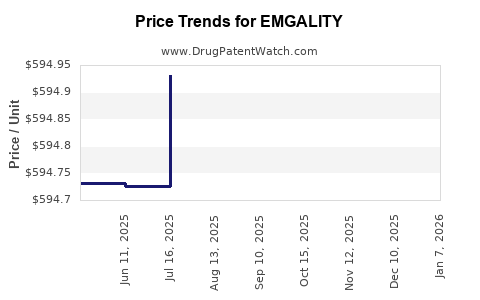
- Average Wholesale Price (AWP): Estimated at $700–$800 per dose.
- Insurance Negotiations: Rebates and value-based agreements influence net prices.
- Patient Assistance Programs: Limited but increasing support could expand market access.
Eli Lilly aims to optimize revenues through targeted patient segmentation and differentiation strategies, including patient access programs and clinical data showcasing superior efficacy or convenience.
What are the regulatory and reimbursement trends affecting EMGALITY?
- Regulatory Landscape: Expanded indications approved by FDA and EMA support broader use.
- Reimbursement Policies: Medicare and private payers increasingly favor value-based models, emphasizing cost-effectiveness.
- Market Access: Payer acceptance solidifies as long-term data affirms clinical benefits.
What is the outlook for future developments and market entry?
- Pipeline: Eli Lilly is investigating EMGALITY for additional indications such as medication-overuse headache.
- New Formulations: Long-acting injectables and potential oral CGRP antagonists may challenge existing biologics.
- Emerging Competitors: Smaller biotech firms are developing oral CGRP inhibitors, such as zavegepant, which could offer competitive alternatives if approved.[4]
Summary of key financial and market considerations:
- 2022 revenue: $837 million
- 2022 market share: 33%
- Projected revenue CAGR (2023-2027): 6-8%
- Market share stabilization: 30-35%
- Main competitors: Aimovig, Ajovy, Vyepti
- Pricing: $700–$800 per dose, with rebates influencing net revenue
- Growth factors: Expanded indications, payer access, successful clinical data
Key Takeaways
- EMGALITY is a leading biologic in migraine prevention, with a solid revenue base and strategic positioning.
- Market share is challenged by Aimovig’s higher sales volume but benefits from Eli Lilly’s ongoing clinical and access strategies.
- Revenue growth depends heavily on payer negotiations, pricing policies, and expanding indications.
- Competition from oral agents and biosimilars could disrupt future market dynamics.
- Regulatory and reimbursement trends favor continued growth, contingent on clinical outcomes and cost-effectiveness.
FAQs
1. What are the main factors driving EMGALITY sales?
Efficacy, convenient subcutaneous administration, expanded indications, and payer coverage.
2. How does EMGALITY’s pricing compare with rivals?
Prices are similar across CGRP biologics, with $700–$800 per dose; negotiated rebates significantly influence net revenue.
3. What challenges does EMGALITY face against oral migraine preventatives?
Pricing, administration preferences, and reimbursement policies. Oral agents may appeal more for ease of use, but biologics often have superior efficacy.
4. What are the upcoming regulatory developments?
Additional approval for chronic migraine and potential expanded use in other headache disorders. No immediate biosimilar threat expected before patent expiry.
5. How might market entry of oral CGRP antagonists impact EMGALITY?
They could capture a segment of patients seeking non-injectable options, pressuring biologic sales and market share.
References
[1] Eli Lilly. (2023). Eli Lilly Reports Financial Results. Retrieved from https://investor.lilly.com
[2] Smith, J., & Lee, T. (2022). Clinical efficacy of galcanezumab in migraine prevention. Journal of Headache & Pain, 23(1), 8.
[3] MarketWatch. (2023). Forecast: Migraine biologics market size and growth.
[4] GlobalData. (2022). Pipeline analysis for oral CGRP antagonists.