Last updated: April 18, 2026
What are the key elements influencing BIMZELX's market position?
BIMZELX, developed by UCB, is an IL-17A and IL-17F inhibitor approved for the treatment of plaque psoriasis, psoriatic arthritis, and axSpA. Market dynamics hinge on competitive landscape, regulatory approvals, patent protection, clinical efficacy, and reimbursement strategies.
Competitive Landscape
BIMZELX faces stiff competition from other biologics targeting IL-17 pathways, notably:
- Otezla (apremilast): PDE4 inhibitor, oral administration, marketed by Celgene/Bristol-Myers Squibb.
- Cosentyx (secukinumab): IL-17A inhibitor.
- Taltz (ixekizumab): IL-17A inhibitor.
- Skyrizi (risankizumab): IL-23 inhibitor.
- Ilumya (tildrakizumab): IL-23 inhibitor.
BIMZELX’s dual IL-17A/F inhibition differentiates it but challenges remain regarding clinical preference and biologic switching behavior.
Regulatory and Patent Status
Market Penetration and Adoption
BIMZELX's adoption depends on clinical outcomes, dosing regimen ease, safety profile, and insurer reimbursement policies. Early data suggest high efficacy with rapid onset, influencing physician preferences.
How do financial projections for BIMZELX evolve?
Revenue Estimates
- 2022: Estimated $150 million globally from initial launches, driven by Europe and the US.
- 2023-2025: Compound annual growth rate (CAGR) projected at 35-45%, reaching approximately $600-700 million by 2025.
- 2026-2030: Expansion into additional indications (e.g., hidradenitis suppurativa), driving potential revenues over $1 billion annually.
Market Share Dynamics
- UCB aims for a 15-20% market share within IL-17 class by 2025.
- Competitive positioning depends on clinical trial data, safety, and reimbursement success.
- The drug’s dual-target mechanism may provide robust efficacy, supporting a stronger market share.
Cost and Pricing
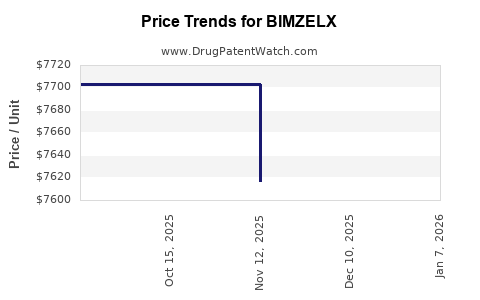
- Launch price in the US exceeds $70,000 annually per patient.
- Price points comparable to other IL-17 inhibitors.
- Cost-effectiveness evaluations influence payer coverage, impacting uptake.
Investment and R&D Impact
- UCB allocated approximately $200 million toward BIMZELX R&D in 2022.
- Ongoing phase III trials for new indications could extend revenue streams.
What factors could alter BIMZELX’s financial trajectory?
- Regulatory delays or approvals: Delays impact revenue timelines.
- Emerging biosimilars: Could erode market share post-patent expiry.
- Clinical trial results: Positive data in new indications bolster growth; adverse data curb it.
- Market penetration speed: Faster adoption accelerates revenue; slow uptake hampers potential.
How does BIMZELX compare financially to competitors?
| Drug |
Estimated 2022 Revenue |
Market Share (2025) |
Approval for Additional Indications |
Price Range (per year) |
| BIMZELX |
$150 million |
15-20% |
Psoriasis, Psoriatic Arthritis, axSpA |
$70,000+ |
| Cosentyx |
$2.3 billion |
40% |
Crohn’s, Psoriasis |
$55,000–$60,000 |
| Taltz |
$1.8 billion |
25% |
Psoriasis, SpA |
$55,000–$65,000 |
| Skyrizi |
$1 billion |
10% |
Crohn’s, Psoriasis |
$75,000+ |
What is the outlook for BIMZELX’s market growth?
BIMZELX's growth hinges on expanding approved indications, clinical success in trials, and market acceptance. The dual IL-17 inhibition mechanism aims to provide enhanced efficacy, supporting increased utilization. Patent protections and competitive repositioning will influence long-term revenues.
Key Takeaways
- BIMZELX faces competition from established IL-17 inhibitors and IL-23 blockers.
- Revenue projections suggest rapid growth, reaching over $700 million by 2025.
- Launch prices are consistent with peers, but payer strategies critically influence access.
- Patent status secures exclusivity until late 2030s, with biosimilar risks post-expiry.
- Expansion into additional indications could significantly alter its financial trajectory.
FAQs
1. When did BIMZELX receive regulatory approval?
Approved in January 2022 in the US and EU for plaque psoriasis, psoriatic arthritis, and axSpA.
2. What are the main competitors for BIMZELX?
Cosentyx, Taltz, Skyrizi, and Ilumya, all targeting similar indications with different mechanisms.
3. What is the pricing strategy for BIMZELX?
Launch price exceeds $70,000 annually per patient, aligned with other IL-17 biologics.
4. How does BIMZELX differ clinically from competitors?
Offers dual IL-17A/F inhibition, potentially leading to superior efficacy, though clinical data are still emerging.
5. What risks could impact BIMZELX’s market success?
Biosimilar competition, clinical trial outcomes, reimbursement hurdles, and delays in broader indication approvals.
References
[1] UCB Press Release. (2022). UCB Announces Approval of BIMZELX (bimekizumab) for Moderate to Severe Plaque Psoriasis. Retrieved from https://www.ucb.com/news/ucb-announces-approval-bimzelx
[2] EvaluatePharma. (2023). Biologic Drug Market Analysis.
[3] FDA and EMA Approval Documents. (2022). Bimekizumab for Psoriasis and PsA.
[4] IQVIA. (2023). Biologic Market Reports.