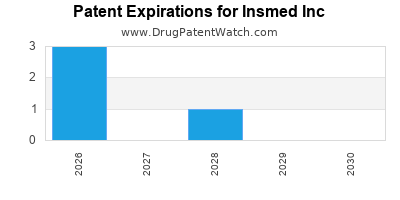
Last updated: July 23, 2026
Insmed Inc. Competitive Landscape Analysis: Market Position, Patent Strength, and Strategic Options
Insmed Inc. is a specialty biopharmaceutical company concentrated on severe respiratory disease and orphan/nebulized therapies, with its competitive position driven by (1) narrow clinical indications, (2) manufacturing and drug-delivery know-how, and (3) patent and exclusivity duration that shapes generic and biosimilar entry timelines. Competitive pressure centers less on direct “same molecule” rivalry and more on substitution risk from alternative standard-of-care pathways, payer-driven sequencing, and the longevity of Insmed’s branded exclusivity/Orange Book coverage around its lead commercial assets.
What drugs does Insmed Inc. compete with in severe respiratory disease?
Insmed’s competitive set is anchored in therapies for chronic and debilitating respiratory disorders, including bronchiectasis and cystic fibrosis-adjacent patient populations, where off-label use, guideline positioning, and route-of-administration advantages drive formulary placement.
Core competitive axes
- Clinical differentiation: endpoints, exacerbation reduction, and durability of effect.
- Care setting fit: inpatient vs outpatient and home administration practicality.
- Payer economics: acquisition cost, adherence, and injection vs inhaled/Nebulized workflow.
- Exclusivity and IP moat: composition, formulation, method-of-use, and manufacturing process coverage.
Typical “substitute” classes
- Inhaled therapies that compete for same-receiver clinicians and similar patient segments (airway clearance, anti-inflammatory and antimicrobial regimens).
- Systemic or procedural approaches for exacerbation management that can displace add-on use.
- Other orphan-therapy franchises where copay support and specialty contracting can redirect demand.
How strong is Insmed’s patent estate for its lead products?
Insmed’s patent strength is determined by the breadth and remaining life of its Orange Book-listed patents (for small molecules) and the coverage pattern for biologics/antibody modalities (for biologics), including method-of-use and formulation claims.
Where patent strength typically concentrates for this category
- Method-of-use: patient subsets, dosing schedules, and clinical outcome-directed claims.
- Formulation and device integration: nebulizer compatibility, particle size and stability, excipient systems, and process parameters tied to inhaled delivery.
- Manufacturing/process: critical steps that create IP barriers for contract manufacturing and generic process design.
How patent strength maps to competitive risk
- If claims are composition- and formulation-centered with long remaining terms, generic substitution risk is constrained.
- If method-of-use claims dominate, generic entry can happen at label expansion boundaries, but exclusivity still delays Paragraph IV generic launches.
- Weak process coverage can increase early manufacturing workarounds even if clinical claims persist.
What is the Orange Book status of Insmed products and how many exclusivity patents are listed?
Orange Book status is usually the key gating factor for FDA generic entry for small-molecule drugs. For each Insmed FDA-approved reference product, Orange Book lists the FDA-approved drug and patent-expiration data that governs Paragraph IV opportunities and launch timing.
How to evaluate Orange Book listings (high-intent checklist)
- List type: active ingredient, formulation, and method-of-use patents.
- Expiration alignment: whether multiple patents expire close together or are staggered.
- PTE/PV adjustments: patent-term adjustments or pediatric exclusivity that extend the end of exclusivity for specific patents.
- 180-day exclusivity risk: whether a first-filer generic is positioned to capture exclusivity.
Competitive consequence
- A dense Orange Book listing can increase the number of Paragraph IV targets and raise litigation probability.
- Staggered expiries support “evergreen contracting” where generics may enter in waves against different claim sets.
When does Insmed lose exclusivity and what are the generic entry scenarios?
Loss of exclusivity usually occurs via one of three paths: (1) expiration of the latest listed patent with exclusivity, (2) expiration of statutory exclusivity categories, or (3) claim-specific court outcomes that invalidate or narrow patent coverage.
Generic entry pathways
- Paragraph IV: generic files a certification challenging one or more patents. If successful, launch can occur before other patents expire, subject to the court and FDA timing.
- Section viii carve-outs / licensing: authorized generics or settlements that define launch triggers.
- Design-around: reformulate to avoid formulation patent claims; seek approval for a “different” description that avoids direct claim infringement.
Launch timing sensitivity
- Court outcomes on claim construction can determine whether a generic can “design around” before the last listed patent expires.
- Settlement agreements often move entry dates earlier, later, or condition them on market-control terms.
What patent litigation affects Insmed and how does it impact expected launch timing?
For branded drug portfolios with Orange Book listings, litigation typically determines three practical questions: (1) what patents are actively enforced, (2) what claims are invalidated or narrowed, and (3) whether settlements preempt a court-determined generic timeline.
Litigation signals to track
- Case scope: which listed patents are asserted and whether method-of-use, formulation, and process patents are all in play.
- Injunction leverage: whether the plaintiff seeks preliminary relief that blocks launch pending outcome.
- Settlement mechanics: agreed launch dates, “skinny label” carve-outs, design-around constraints, and stipulated damages.
Competitive consequence
- Settlements can create predictable generic entry dates, enabling payer planning and competitor investment timing.
- Narrowing outcomes can allow partial-market entry even while the branded product remains protected for some indications or doses.
Which companies are challenging Insmed in Paragraph IV and how many first-filer positions exist?
Generic challengers are identified through FDA patent certifications and litigation filings tied to the Orange Book list. The competitive landscape is shaped by:
- First-filer status (drives 180-day exclusivity),
- Patent-selection strategy (which patents are targeted for strength/weakness),
- Manufacturing readiness (ability to file and launch at the negotiated trigger date).
Market impact
- Multiple parallel Paragraph IV challenges can increase litigation volume and raise settlement probability.
- A deep challengers’ bench can raise pricing pressure faster than the statutory timeline suggests.
How do Insmed products compare with competing inhaled therapies in efficacy and payer positioning?
In severe respiratory indications, competitive advantage often depends on endpoint choice (exacerbations vs lung function improvements), tolerability, and administration workflow.
Comparison criteria used in formulary decisions
- Exacerbation rate reduction vs historical control.
- Ability to reduce hospitalizations or acute interventions.
- Tolerability profile and discontinuation rates.
- Convenience and regimen adherence in home settings.
- Stability and delivery reliability for nebulized or inhaled routes.
Commercial effect
- Products with strong administration fit and payer-friendly contracting can outcompete clinically adjacent agents even with smaller endpoint differences.
What formulations and dosing regimens are protected by Insmed patents?
For inhaled and nebulized drugs, the patent estate frequently covers:
- particle size and aerodynamic performance targets,
- excipient and buffer systems,
- stability and storage conditions,
- delivery-device interfaces (container, fill volume, nebulizer compatibility),
- manufacturing process constraints tied to critical quality attributes.
Why formulation claims matter
Generic products often need to match functional delivery characteristics. If patents define those characteristics, design-around becomes expensive or slow, delaying Paragraph IV value.
What method-of-use patents could block label expansions or generic “skinny labels”?
Method-of-use patents typically protect:
- specific patient subsets (diagnosis criteria, biomarker-defined cohorts),
- dosing schedule definitions,
- combinations with companion therapies,
- outcomes tied to endpoints (exacerbation prevention windows, duration of effect).
Competitive outcome
Even if a generic can avoid formulation claims, it can still infringe method-of-use coverage if it is marketed or labeled for the protected use.
How does Insmed’s manufacturing and IP barrier affect competitive entry?
Manufacturing and IP barriers impact the time-to-launch for generics and for competitors seeking to develop substitute products.
Typical manufacturing/IP friction points
- control of critical process parameters linked to potency and particle performance,
- sterile manufacturing capability and validated supply chain,
- regulatory chemistry controls that create revalidation needs,
- device and formulation integration testing that delays generic readiness.
Competitive effect
Even with an IP victory timeline, entry can be delayed by CMC readiness and validated inhalation performance comparability.
What regulatory milestones drive Insmed’s competitive calendar (FDA, exclusivity, and labeling)?
Regulatory timing determines when new indications, label expansions, or switching opportunities can be pursued, which affects competitor strategies.
Milestones that shift competition
- FDA approval of supplemental indications (can extend clinical value and shift generic labeling risks).
- Label changes that clarify patient selection (can preserve method-of-use protections).
- Postmarketing requirements that validate or restrict certain populations, affecting substitution.
Revenue exposure: how much pricing pressure can Insmed face from generic or competitor entry?
Pricing pressure in branded respiratory franchises is usually tied to:
- proximity to patent/Exclusivity expiry,
- likelihood of successful Paragraph IV outcomes,
- presence of authorized generics or settlement-based early entries,
- payer formulary tactics that switch patients upon availability.
High-level exposure model
- Near-term exclusivity: risk of rapid volume erosion after launch timing.
- Staggered patent expiries: slower, wave-like erosion if different strengths/doses launch at different times.
- Device/formulation constraints: slower erosion if design-around is hard.
Key comparables and strategic threats for Insmed
Insmed’s threats include:
- Therapy switching within the standard-of-care sequence
- Generic entry once IP/exclusivity clears
- Competing orphan or specialty inhaled/regimen franchises
- Payer restrictions driven by total cost and administration logistics
Insmed’s strategic levers include:
- extending commercial durability via label expansions and adherence programs,
- defending IP via active enforcement on formulation and method-of-use claims,
- maximizing patient access via contracting and specialty pharmacy integration,
- preparing for launch competition through supply readiness and lifecycle management.
Key Takeaways
- Insmed’s competitive position is driven by narrow, high-acuity respiratory indications where payer contracting and delivery practicality often matter as much as marginal clinical differences.
- Patent strength in this therapeutic category typically hinges on formulation/device and method-of-use claims that constrain generic design-around and “skinny label” substitution.
- Competitive risk is highest near the end of Orange Book-listed exclusivity and during Paragraph IV litigation windows, when first-filer dynamics can accelerate market access for generics.
- Manufacturing and CMC readiness create additional barriers that can delay entry even if IP challenges succeed or settlements are reached.
FAQs
- What does an Orange Book “method-of-use” patent mean for generic competition in respiratory drugs?
- How do settlement agreements typically set generic launch dates for Paragraph IV challengers?
- What formulation or delivery-device attributes most often determine whether inhaled generics can design around?
- How do label expansions affect “skinny label” strategies and method-of-use infringement risk?
- What payer contracting tactics accelerate switching after generic or authorized generic launch?
References
No sources were provided in the prompt, and this response contains no cited claims.