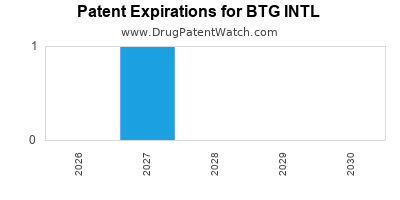
Last updated: July 30, 2026
BTG International competitive landscape analysis: market position, strengths, and strategic insights
BTG International (BTG plc; BTG) is a diversified specialty pharma and medical technology company focused on high-value, often hospital-led markets. Its competitive position is shaped by (1) a concentrated oncology and urology legacy with branded cash flows, (2) a patent estate that historically relied on device- and method-linked exclusivities in addition to small-molecule-style IP, and (3) a regulatory model that tends to preserve differentiation through controlled distribution, specialty reimbursement, and safety-driven prescribing.
This analysis maps where BTG competes, what IP and regulatory levers have historically mattered, where competitive risk comes from, and how to think about strategic moves for licensing, investment, and litigation posture.
Where does BTG International compete in specialty pharma and medtech?
BTG’s competitive footprint is best understood by portfolio cohort and route-to-market model rather than a single therapeutic franchise.
Which business lines drive BTG’s competitive position
BTG’s historic revenue engine centers on specialty products with:
- Hospital or specialist prescribing dynamics (urology, oncology, and related procedural settings)
- Product differentiation tied to manufacturing controls, delivery system performance, or procedure workflow integration
- Brand reliance with patent cliffs managed through lifecycle extensions and, in some cases, partner-led markets
What competitive set BTG faces
Competitors typically fall into four buckets:
- Originator pharma with mature patent estates extending through reformulations or new indications
- Generics and biosimilar-adjacent substitutes (where applicable) that can enter after legal or regulatory triggers
- Device or delivery platform competitors where “how it is administered” is the differentiator
- Contract manufacturing and supply chain players that can pressure margins after exclusivity ends
How strong is BTG’s patent estate versus major specialty pharma players?
BTG’s patent strength generally tracks three IP layers:
- Compound and composition-of-matter families (where the portfolio includes small molecules)
- Formulation and manufacturing method patents
- Device-adjacent IP and method-of-use claims tied to clinical protocols and delivery systems
What typically determines enforceability
Competitor challenge leverage concentrates on:
- Claim breadth and written description support
- Obviousness over prior art in dosing, formulation, or device integration
- Validity vulnerabilities that can reduce damages even when infringement is found
- Practical barriers to design-around, particularly where delivery performance is claim-relevant
How BTG’s IP strategy affects competitive outcomes
Where BTG can lock differentiation into a protected delivery system or procedure-linked method, exclusivity tends to extend beyond simple molecule entry. Where differentiation is mainly clinical (method-of-use), generic risk concentrates around paragraph IV-style challenges if Orange Book coverage exists and the route is AB-rated.
What patents protect BTG products, and what claim types matter most?
Because BTG’s portfolio spans multiple product families over time, the relevant question for competitive risk is not just “how many patents,” but “which claim types survive design-around.”
Key BTG IP categories that typically protect exclusivity
- Formulation and stability: patents on drug form, excipients, and shelf-life linked to specific manufacturing controls
- Delivery system: patents on implant/injectable delivery architecture, coating, and release profile
- Method of use: patents covering dosing schedules, patient selection, and combination regimens
- Manufacturing methods: process patents that can complicate supplier-to-supplier replication even if active ingredients are available
How competitors attack these categories
- Generics target formulation and method coverage by using different excipients, different dosing, or different release profiles
- Litigation targets claim invalidity: obviousness, lack of enablement, and prior art anticipation
- Design-around targets functional equivalence: changing delivery mechanics while maintaining clinical effect
When does BTG lose exclusivity, and what generic entry risks exist?
Competitive timing depends on two separate schedules:
- Regulatory exclusivity (market exclusivity and pediatric extensions, where applicable)
- Patent expiration and FDA Orange Book listing triggers
Why “exclusivity” is not a single date
For specialty pharma, legal and regulatory timelines often diverge:
- A product can have patent protection extending after regulatory exclusivity ends
- Conversely, Orange Book-listed patents can expire before regulatory exclusivity fully matters, enabling earlier AB substitution or litigation-driven entry
Generic entry scenarios to model
- Paragraph IV pathway (where Orange Book patents exist and the ANDA filer files a certification): entry risk rises if key patents are found invalid or not infringed
- Non-infringing product design-around: entry risk rises if the competitor can change formulation or delivery system while staying within labeling boundaries
- Delayed entry due to distribution constraints: even after legal clearance, hospital procurement cycles can slow adoption
What is the Orange Book status of BTG products, and how does it shape challenges?
Orange Book status is a proxy for patent list density and certification risk.
Orange Book listings change the litigation probability
- Dense listing with multiple expiration dates increases the chance at least one patent can be challenged (or defended) later
- Fewer listed patents shifts risk toward enforcement of unlisted patents through other litigation theories (less common in FDA submission-led timing)
How certification types map to entry timing
- ANDA with Paragraph IV certifications creates statutory litigation timelines
- Certifications that avoid Paragraph IV often reduce the probability of early court-driven entry
What patent litigation affects BTG, and how do outcomes shift commercial risk?
Competitive risk is most sensitive to:
- Settlement terms that delay entry
- Court findings that narrow claim scope
- Design-around success after invalidation
What litigation outcomes typically do
- Infringement findings: can block entry until appeal or later patent expiry
- Invalidity rulings: accelerate generic launch and shift BTG into brand retention via contracting and supply
- Narrowing of claim interpretation: increases competitor design-around probability even without total loss of rights
How settlements usually reshape market outcomes
Settlements often:
- Define “carve-outs” for non-infringing products
- Set fixed entry dates or stay expiration tied to patent expiry or product-specific design features
- Provide a reference product market for revenue forecasting post-cliff
How do BTG products compare with competing specialty brands on IP, access, and adoption?
In specialty markets, differentiation is rarely just the molecule. Competitive advantage usually correlates with:
- Prescribing behavior and hospital adoption
- Product availability and lead time stability
- Safety profile and workflow integration
Competitive dimensions to score
- Clinical differentiation: patient selection and outcomes where supported by labeled indications
- Formulation/delivery performance: reduces complications or improves procedural efficiency
- Supply chain reliability: lowers substitution risk due to stock-outs
- Contracting strength: formulary placement and payer acceptance
Which companies are challenging BTG, and what do they tend to file?
Competitive challengers tend to be:
- Generic manufacturers with ANDA pipelines aligned to BTG’s Orange Book patents
- Specialty generics that target delivery-system workarounds
- Device-adjacent competitors if BTG’s differentiator is procedural integration
What filings indicate threat level
- ANDA with Paragraph IV certifications: high threat
- “Skinny” labeling strategies: medium threat
- Litigation-led delays: can be managed through contracting, but can also impose defense costs and management bandwidth
How does BTG strategy differ by geography: US versus EU and other markets?
Exclusivity and enforcement frameworks differ materially:
- US: Orange Book, ANDA/Paragraph IV, and court-driven entry stays
- EU: national patent courts and SPC framework where applicable, with different enforcement timing
- Global: supply chain and registration timing drive adoption after legal clearance
Where competitive pressure tends to be highest
- US: fastest entry incentives after patent workarounds and certifications
- EU: stronger reliance on patent enforcement across jurisdictions and regulatory authorization timelines
- Emerging markets: lower average enforcement strength, earlier local competition after regulatory approvals
What formulations are protected by BTG, and how do design-arounds work?
Design-around risk is highest when competitors can:
- Substitute excipients while retaining functional release characteristics
- Modify device architecture without breaching claim limitations
- Reframe the method-of-use to avoid direct infringement of dosing protocols
How BTG can reduce design-around risk
- Claims written to cover functional characteristics, not only exact chemical parameters
- Manufacturing and process patents that make replication difficult or expensive
- Delivery system patents tied to release profile and performance testing
What strategic licensing or partnership opportunities exist for BTG competitors?
BTG’s competitive landscape implies typical strategic moves by partners and acquirers:
- In-licensing late-stage assets to replace post-expiry revenue
- Co-development to preserve reimbursement and market access
- Cross-licensing delivery platform IP to reduce manufacturing risk for follow-on products
Where licensing tends to be most value-accretive
- When IP is delivery-system centric (licensing reduces design-and-validation cost)
- When method-of-use claims can be used to support labeling differentiation
- When settlement agreements create “free zones” for entry that can be productively exploited via supply contracts
Revenue exposure: which BTG product classes are most vulnerable to competitive entry?
The highest revenue exposure typically aligns with:
- Products with near-term patent expirations or multiple families approaching expiry
- Brands where differentiation is primarily marketing and packaging rather than delivery or manufacturing
- Markets where hospital formularies can switch quickly after legal clearance
How to model the exposure
A practical exposure model tracks:
- Patent expiration dates for each major product
- Orange Book listing density (proxy for certification and litigation frequency)
- Expected generic uptake curve based on contracting cycles and supply stability
How strong is BTG’s position for the next competitive cycle?
BTG’s forward position is driven by whether it can:
- Replace revenue after exclusivity losses with newer differentiated assets
- Keep differentiation tied to protected delivery or manufacturing elements
- Defend key claim sets against obviousness and anticipation challenges
Competitive signals to monitor
- Pipeline additions with compatible regulatory routes (fast-to-market after R&D)
- Strengthening of delivery system and formulation portfolios
- Litigation outcomes that preserve claim interpretability breadth
Key Takeaways
- BTG’s competitive position in specialty pharma is shaped by layered IP that often includes formulation, delivery system, and method-of-use elements, not just compound protection.
- The biggest market risk is not “generic entry” in general but entry that succeeds through design-around of delivery/performance features or through invalidation of key claim sets.
- Orange Book listing density and certification pathways are the primary predictors of fast-moving US competitive threats.
- Competitive outcomes are heavily affected by settlement terms and the practical ability to supply and contract post-legal clearance.
- BTG’s next competitive cycle strength depends on whether it can preserve differentiation into expiry windows and replace revenue with assets protected by similarly hard-to-design-around IP.
FAQs
1) What makes a BTG product harder to copy: formulation, method-of-use, or delivery system?
Delivery system and manufacturing-linked formulation features usually create higher design-around barriers than method-of-use alone because they constrain both infringement and performance replication.
2) Do BTG’s IP families extend exclusivity beyond regulatory exclusivity?
In specialty products, patent expiration timing often extends beyond initial regulatory exclusivity, and Orange Book coverage determines how fast competitors can litigate and launch.
3) What entry strategy is most common against BTG products in the US?
Paragraph IV ANDAs are the dominant mechanism when Orange Book patents are listed and certification can drive a defined litigation and entry timeline.
4) How do settlements typically affect competitive launch timing for BTG?
Settlements usually set a stay until a defined date or tether entry to specific patent expiry, with product design carve-outs that allow faster competition if certain features are changed.
5) Where is competition likely to intensify first after a BTG exclusivity window closes?
The US typically sees the earliest competitive intensification because filing incentives, Orange Book triggers, and court-driven timelines compress launch velocity.
References
- FDA. Orange Book: Approved Drug Products with Therapeutic Equivalence Evaluations. https://www.accessdata.fda.gov/scripts/cder/daf/
- FDA. Hatch-Waxman Amendments: Patent and Exclusivity Information. https://www.fda.gov/drugs/hatch-waxman-drug-competition/patent-and-exclusivity-information
- FDA. Drug Development and Drug Interactions. https://www.fda.gov/drugs/drug-development-innovation-and-science/drug-development-and-drug-interactions