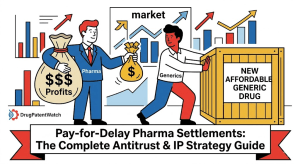
Pharmaceutical pay-for-delay agreements, the precise term is reverse payment patent settlements, sit at the intersection of Hatch-Waxman exclusivity mechanics, branded IP valuation, and federal antitrust law. Since the Supreme Court’s 2013 ruling in FTC v. Actavis, the legal risk calculus for these deals has inverted: what was once a reliable settlement tool is now a documented liability with nine-figure enforcement outcomes. This guide covers the full arc, from the regulatory architecture that created the incentive through the post-Actavis enforcement environment and the emerging settlement structures that agencies are already scrutinizing.
The audience here is pharma IP teams, portfolio managers, R&D leads, and institutional investors tracking branded drug asset lifecycles. Every section is structured to deliver actionable intelligence, not legal boilerplate.
The Hatch-Waxman Architecture and How It Created Pay-for-Delay
What the 1984 Act Actually Did
The Drug Price Competition and Patent Term Restoration Act of 1984, the Hatch-Waxman Act, solved two problems simultaneously. Branded manufacturers needed relief from the patent time lost during FDA clinical review, because a drug approved in year ten of a twenty-year patent term only captures ten years of market exclusivity. Generic manufacturers needed a faster path to market that did not require expensive duplicative clinical trials for drugs whose safety and efficacy had already been established.
The Act addressed the first problem with patent term extensions of up to five years, calculated from the NDA filing date through approval. It addressed the second problem by creating the Abbreviated New Drug Application (ANDA) pathway, which lets a generic manufacturer reference the innovator’s clinical data rather than generate its own. The Act also created the artificial infringement provision at 35 U.S.C. 271(e)(2), which lets a generic filer challenge a patent before launching a product, triggering Hatch-Waxman litigation without any actual market entry.
The 180-Day Exclusivity Provision: Intent vs. Reality
The provision that most directly enabled reverse payment settlements is the 180-day market exclusivity awarded to the first generic manufacturer to file an ANDA containing a Paragraph IV certification, meaning a certification that the listed patent is invalid, unenforceable, or would not be infringed by the generic product. The intent was to reward the litigation risk that first-to-file generics accept when challenging potentially valid patents.
The mechanism worked as designed in one respect: generics started filing Paragraph IV certifications aggressively, and contested Hatch-Waxman litigation expanded through the 1990s and 2000s. The unintended consequence was structural. The 180-day exclusivity clock begins only when the first-to-file generic either wins its litigation or enters the market. If that first filer agrees to delay entry, the clock never starts, and all subsequent generic filers remain blocked regardless of their own patent positions. That blockage created a negotiating asset worth tens to hundreds of millions of dollars in avoided competition for the branded manufacturer, and an equivalent amount in risk-free guaranteed income for the first-to-file generic. The convergence of those two interests is what produced the reverse payment as a settlement format.
The IP Valuation Mechanics Behind Every Settlement
Understanding why a branded company would pay a generic to stay off the market requires thinking through how that company values its patent estate. A blockbuster small molecule in year eight of brand exclusivity, generating $2 billion annually, with six years remaining on the Orange Book-listed compound patent, carries a forward-looking net present value on that exclusivity of roughly $8 to $10 billion at a standard pharma discount rate, before haircut for generic entry probability.
If internal or litigation counsel rates the Paragraph IV challenge as having a forty percent probability of success, the expected value of defending the patent through trial is roughly $4.8 to $6 billion. The expected value of losing is total erosion: day-one generic entry, six-plus manufacturers entering within eighteen months, and brand revenue collapsing by 70 to 95 percent. A settlement paying the first-to-file generic $200 million to delay three years preserves roughly $6 billion in NPV. That is not legal strategy, it is capital allocation.
For the first-to-file generic, the 180-day exclusivity during a period of no other generic competition is worth substantial money. The generic captures premium pricing, typically 20 to 30 percent below brand rather than the 70 to 85 percent below brand that results from full market saturation, against a revenue base the brand has already built. A settlement guaranteeing that exclusivity window without bearing litigation cost is frequently superior to the uncertain outcome of winning at trial.
Key Takeaways: The Hatch-Waxman Act’s 180-day exclusivity provision, while designed to incentivize patent challenges, created the conditions for branded and generic manufacturers to collude implicitly on market timing. The economic logic of reverse payments is straightforward IP valuation math. Every settlement should be stress-tested against the brand’s patent NPV and the generic’s exclusivity window value before any terms are discussed.
Investment Strategy: For portfolio managers tracking branded pharma assets, the existence of Paragraph IV filings against a product’s Orange Book-listed patents is a material IP valuation event. A settlement resolving that litigation requires careful analysis: a long delay period secured by a large cash payment to the generic is a classic pay-for-delay structure and carries regulatory risk that can crater deal value. A settlement with a near-term entry date and modest litigation cost reimbursement is far more defensible.
The ‘Scope of the Patent’ Era: Why Courts Got It Wrong for Two Decades
The Second, Eleventh, and Federal Circuit Consensus
Through the 1990s and into the 2000s, most federal circuits reviewing reverse payment settlements applied what became known as the scope of the patent (SOP) test. The SOP test held that a settlement agreement was per se lawful under antitrust law provided its restrictions on generic entry did not exceed the potential exclusionary scope of the challenged patent. If the patent could theoretically exclude generic competition through its expiration date, then any settlement that kept the generic off the market until expiration or earlier was within bounds.
The Federal Circuit, the Second Circuit, and the Eleventh Circuit all applied variations of this framework. The Eleventh Circuit’s 2003 decision in Schering-Plough Corp. v. FTC is illustrative. The court reviewed a settlement between Schering-Plough and Upsher-Smith Laboratories over K-Dur 20, a potassium chloride supplement, and affirmed the settlement under the SOP test despite the FTC’s challenge. The court reasoned that because the patent, if valid, could have excluded Upsher-Smith from the market, the agreement to delay entry was within the patent’s competitive reach.
The flaw in this reasoning is significant. The SOP test treats patent validity as an established fact rather than a probabilistic outcome determined by litigation. A patent with a fifty percent chance of invalidation has half the exclusionary value of a certain patent. When a branded company pays a substantial sum to a generic not to litigate that validity question, the payment itself is evidence that the brand believed the patent might not hold. Paying to suppress that inquiry is precisely what antitrust law should address, but the SOP test made it invisible.
The Third Circuit Breaks Ranks: In re K-Dur (2012)
The Third Circuit’s 2012 decision in In re K-Dur Antitrust Litigation rejected the SOP test explicitly. The court applied a different standard: reverse payment settlements are presumptively anticompetitive, and the settling parties bear the burden of demonstrating procompetitive justification. The Third Circuit’s analysis focused on the economic reality of the payment. A brand paying a generic to drop a patent challenge is, at minimum, sharing monopoly profits. That sharing, the court held, requires a rigorous antitrust justification, not deference to the theoretical scope of the patent.
The K-Dur ruling created a genuine circuit split. In jurisdictions following the Eleventh or Federal Circuits, reverse payment settlements were effectively immune from antitrust challenge if they did not exceed the patent’s term. In the Third Circuit, they were presumptively unlawful. The FTC, which had been challenging these settlements administratively and in court for years, pushed for Supreme Court review.
FTC v. Actavis: The Supreme Court Resets the Framework
AndroGel, Solvay, and the Deal That Reached the Court
The case the Supreme Court agreed to hear involved AndroGel, Solvay Pharmaceuticals’ testosterone replacement gel, approved under NDA 21-434. Solvay listed a single compound patent covering testosterone gel formulation technology. Watson Pharmaceuticals (later Actavis) and Paddock Laboratories each filed Paragraph IV ANDAs certifying that the Solvay patent was invalid or would not be infringed. Solvay sued both for infringement under 35 U.S.C. 271(e)(2).
Before trial, the parties settled. Watson and Paddock agreed to delay their generic launches, Watson by approximately five years, in exchange for payments from Solvay that the FTC estimated at $19 to $30 million annually to Watson and smaller amounts to Paddock. The payments were nominally structured as compensation for Watson co-promoting AndroGel and for Paddock manufacturing the brand product, but the FTC characterized the services agreements as pretext for what were effectively delay payments.
The Rule of Reason Standard: What the Court Actually Held
The Supreme Court’s 5-3 decision in June 2013 established several points that continue to structure reverse payment litigation. The Court held that reverse payment settlements are not immune from antitrust scrutiny because they fall within the potential exclusionary scope of a patent. The patent grant does not insulate the patent holder’s conduct from antitrust review, particularly when that conduct involves a large cash payment to a competitor to stop competing.
The Court declined to adopt either the SOP test or the Third Circuit’s presumptive illegality standard. Instead, it directed lower courts to apply the rule of reason, balancing the settlement’s anticompetitive effects against its procompetitive justifications in the specific market context. The Court identified the size of the reverse payment as particularly probative evidence. A large, unexplained payment from the patentee to the challenger is a signal that the patentee expected to lose the underlying patent litigation, and that the payment is compensation for suppressing that competitive outcome.
The Court also made a practical point about judicial administration. Antitrust courts cannot reliably relitigate patent validity questions to determine what would have happened absent the settlement. The payment size, if substantially larger than the brand’s avoided litigation costs, provides a workable proxy for anticompetitive harm without requiring that underlying inquiry.
What ‘Large and Unexplained’ Actually Means in Practice
The ‘large, unexplained payment’ concept requires unpacking. Litigation cost savings from settling Hatch-Waxman disputes, which typically run $5 to $15 million per case through trial, can legitimately be transferred to the generic as part of a settlement. What cannot be justified is payment substantially in excess of those savings, unless the generic is providing demonstrable services of genuinely equivalent value.
The court in Actavis did not set a numerical threshold. Post-Actavis litigation has developed a rough operational standard: courts examine whether the payment exceeds the brand’s expected litigation costs by a margin that implies its primary function is purchasing delay rather than compensating for services. A $200 million payment in a case where litigation costs would have been $10 million requires genuine explanation, and that explanation cannot be a marketing services agreement that gives the generic 8 percent co-promotion fees on a drug it has every incentive to want replaced by its own generic.
Key Takeaways: The Actavis decision did not make reverse payments illegal. It made large, unjustified ones presumptively harmful under the rule of reason. The ‘large, unexplained payment’ standard redirected antitrust inquiry from patent validity to payment economics. Every value transfer in a settlement, whether cash, service compensation, supply agreements, or authorized generic restrictions, now carries antitrust exposure if its magnitude exceeds what traditional settlement considerations justify.
Investment Strategy: The Actavis decision created a quantifiable legal risk premium for any branded asset whose Orange Book litigation resolves via a settlement with a material reverse payment. Analysts covering these assets should model three scenarios: generic entry at the settlement’s agreed date, generic entry accelerated by FTC challenge, and generic entry accelerated by class action litigation. The second and third scenarios require haircuts on any settlement-secured exclusivity period.
Post-Actavis Enforcement: Courts Building the Rule of Reason Framework
Step Zero: The Threshold Conduct Requirement
Lower courts applying the Actavis rule of reason have developed an analytical sequence. The first step, sometimes called ‘Step Zero’ in academic literature, requires the plaintiff to identify and demonstrate the existence of the specific conduct at issue: a large, unjustified reverse payment. Without establishing that a payment of the relevant size and character actually occurred, the rule of reason balancing exercise has no proper foundation.
The Step Zero requirement is not trivial. Courts have used it to filter complaints where the alleged ‘payment’ is merely a settlement allowing generic entry before patent expiration, which is a standard outcome of Hatch-Waxman litigation, rather than a payment from brand to generic. The distinction matters: early generic entry dates with no accompanying value transfer are not reverse payments. The conduct that triggers antitrust concern is the unexplained value flowing from the patent holder to the alleged infringer.
Rule of Reason Balancing: Anticompetitive Effects vs. Procompetitive Justification
Once Step Zero is cleared, the balancing analysis requires the plaintiff to demonstrate that the payment’s anticompetitive effect, typically delayed generic entry and prolonged supracompetitive pricing, outweighs the procompetitive benefits the settling parties assert. Courts have consistently accepted avoided litigation costs as a legitimate procompetitive justification. They have been skeptical of service agreements that emerged during settlement negotiations rather than predating them, royalty structures that coincidentally match the economic value of the delay, and no-authorized-generic (No-AG) commitments offered as ‘consideration’ for a deal.
The ‘less restrictive alternative’ doctrine has emerged as a particularly powerful analytical tool. If the brand and generic could have achieved the same legitimate benefits, for example, resolving uncertainty and reducing litigation costs, through a settlement that allowed earlier generic entry without the large payment, then the original agreement fails the rule of reason. The less restrictive alternative need not be perfect or costless; it simply needs to be feasible and substantially less harmful to competition.
The Impax/Opana ER Decision: The Fifth Circuit Validates the FTC
The most consequential post-Actavis appellate ruling is the Fifth Circuit’s 2021 decision affirming the FTC’s order in Impax Laboratories, Inc. v. FTC, which arose from a settlement between Impax and Endo Pharmaceuticals over Opana ER, an extended-release oxymorphone formulation. Endo had sued Impax for patent infringement over its ANDA. The parties settled, with Impax agreeing to delay its generic launch for approximately six months beyond the ANDA approval date in exchange for a package of payments that the FTC valued at over $100 million, structured primarily as credits against Impax’s future royalty obligations on another product.
The Fifth Circuit affirmed the FTC’s finding that this constituted an unlawful reverse payment despite the non-cash structure. The court accepted that a large, unjustified value transfer is anticompetitive regardless of whether it takes the form of cash, credits, supply agreements, or other instruments. It also accepted the less restrictive alternative analysis: Endo and Impax could have settled by agreeing to a specific entry date without the large credit package, and that alternative would have achieved Endo’s legitimate interest in litigation certainty at far less cost to competition.
The Opana ER context adds a dimension the FTC emphasized in its briefing: Endo itself later withdrew the original Opana ER formulation from the market and reformulated the product to resist abuse, a move the FDA later concluded had no public health benefit. The reformulation is a textbook evergreening tactic. The reverse payment settlement bought Endo time during which it executed that reformulation, suggesting the settlement was part of a broader lifecycle management strategy rather than a good-faith resolution of patent uncertainty.
The Bayer Cipro Case: IP Valuation, Settlement Magnitude, and Long-Term Exposure
The Original Agreement and Its Patent Foundation
The Bayer/Barr Cipro settlement is the historical reference case for understanding how large reverse payments are structured and what their downstream exposure looks like. Bayer AG’s ciprofloxacin compound patent, U.S. Patent 4,670,444, covered the fluoroquinolone antibiotic Cipro and carried an expiration date in December 2003. Barr Pharmaceuticals filed a Paragraph IV ANDA certification in 1991, contending the patent was invalid.
Barr’s invalidity theory was not frivolous. The German compound patent underlying the U.S. application had been challenged in European proceedings, and Bayer faced documented prior art issues in certain markets. On the eve of trial in 1997, Bayer settled: it paid Barr $398.1 million in total compensation, structured as quarterly payments, to delay generic entry until patent expiration. Bayer also extended No-AG commitments for a specified period. The agreement kept every other generic filer blocked for the remaining six years of the patent term.
Patent IP Valuation: What the Cipro Patent Was Worth
To understand why Bayer paid that amount, consider the patent’s value as a financial asset at the time of settlement. Cipro’s U.S. annual revenues in the late 1990s were approximately $1.5 billion, growing toward $2 billion by the early 2000s before generic entry. With six years remaining on exclusivity, the compound patent carried an NPV of roughly $7 to $8 billion at a 10 percent discount rate, before probability adjustment for litigation outcome.
Bayer’s payment of $398.1 million represented approximately 5 to 6 percent of that protected revenue stream. For a patent whose validity was genuinely uncertain, that payment ratio was arguably rational from a pure capital allocation standpoint. The FTC and plaintiffs’ bar took a different view: if the patent were strong, Bayer would have won at trial and owed Barr nothing. The size of the payment implied Bayer knew its patent was weak. That implicit admission of patent weakness, embedded in the settlement economics, became the foundation for the class action litigation that followed years later.
The Class Action: California Supreme Court and Structured Rule of Reason
California consumers and insurance payors filed antitrust class actions under California’s Cartwright Act and Unfair Competition Law, arguing the settlement forced them to pay brand prices for Cipro over an eight-year period they would not have paid had generic competition entered earlier. The litigation ran for nearly two decades.
In 2015, the California Supreme Court adopted a ‘structured rule of reason’ for reverse payment cases under California law, effectively following the federal Actavis framework at the state level. The case then proceeded to settlement: Bayer settled with the consumer class for $74 million in 2013, a separate settlement with other generic defendants yielded $100 million in 2016, and Barr’s settlement added $225 million in 2017, bringing the total class recovery to approximately $399 million, a figure that essentially matched the original payment Bayer made to Barr.
The symmetry is striking. Bayer paid Barr $398 million to delay competition. The class action extracted $399 million in settlements from the defendants decades later. The net economic outcome for Bayer was that it purchased six years of exclusivity for free, in the sense that the litigation losses ultimately came from its co-defendants and from Barr. But the reputational cost, regulatory scrutiny, and the two decades of litigation exposure were not free, and the Cipro case accelerated congressional and FTC action that ultimately led to Actavis.
Key Takeaways: The Cipro case illustrates the full lifecycle of a reverse payment: the IP valuation logic at the time of settlement, the regulatory and litigation exposure that accrues over years, and the eventual financial reckoning that can match or exceed the original payment in total class damages. Branded manufacturers assessing settlement terms today should model not just the immediate regulatory risk but the long-tail class action exposure that reverse payment structures reliably generate.
Investment Strategy: For investors in branded pharma, the Cipro pattern should inform due diligence. Settlements that include large unexplained payments create contingent liabilities that may not materialize for years but carry predictable magnitude when they do. Any target company with Hatch-Waxman settlements executed before 2013 should be scrutinized for payment structures that would fail the Actavis standard retroactively, particularly if class action statutes of limitations have not yet run in all relevant jurisdictions.
Teva’s Exposure: Provigil and the $1.2 Billion FTC Settlement
Modafinil’s Patent Architecture
Provigil (modafinil) is a wakefulness agent approved by the FDA for narcolepsy and later for shift work sleep disorder and obstructive sleep apnea. Cephalon, acquired by Teva in 2011, held a cluster of patents covering modafinil including compound patents, formulation patents covering particle size, and method-of-use patents for specific indications. The compound patent expired in 2001, but the particle size patent, covering a specific micronized formulation, remained listed in the Orange Book and did not expire until 2006.
Four generic manufacturers, Barr, Mylan, Ranbaxy, and Watson, each filed Paragraph IV ANDAs against the particle size patent between 2002 and 2003, initiating four separate infringement actions under Hatch-Waxman. Cephalon settled all four cases between 2005 and 2006, paying the generic challengers a combined total of approximately $300 million in exchange for agreements to delay generic Provigil entry until 2012.
FTC Enforcement and the $1.2 Billion Outcome
The FTC sued Cephalon in 2008, alleging the four settlements constituted an illegal reverse payment scheme that extended Cephalon’s Provigil monopoly by six years beyond what the particle size patent could legitimately support. The agency’s theory was that Cephalon knew the particle size patent was weak, its validity was uncertain given prior art involving modafinil formulations, and that the settlements were effectively paying four potential market entrants to validate a monopoly they could have broken.
Teva, which inherited this litigation when it acquired Cephalon, ultimately settled with the FTC in 2015 for $1.2 billion, one of the largest antitrust settlements in FTC history. A separate California class action settlement brought additional exposure. The FTC settlement fund compensated consumers and third-party payors who had paid brand Provigil prices during the six years of delayed generic competition.
The Provigil case is instructive for IP teams thinking through settlement structure. Cephalon’s particle size patent was a secondary patent, not the compound patent. Its expected litigation outcome was considerably more uncertain than a compound patent in its original term. Paying $300 million across four generics to avoid litigating a secondary patent was a signal, visible to the FTC and eventually to the courts, that Cephalon assigned low probability to actually prevailing. The settlement terms looked like market allocation rather than patent resolution.
Evergreening, Product-Hopping, and the Relationship to Pay-for-Delay
How Lifecycle Management Creates the Settlement Incentive
Pay-for-delay settlements rarely exist in isolation. They are typically one instrument in a broader lifecycle management strategy that includes evergreening, the practice of obtaining new patents on modifications to an existing drug to extend effective market exclusivity beyond the original compound patent. Common evergreening tactics include new formulation patents covering extended-release or fixed-dose combination presentations, polymorph patents covering alternative crystal forms, enantiomer patents covering pure active isomers of racemic mixtures, and method-of-use patents covering new indications discovered during the drug’s commercial life.
None of these tactics are inherently anticompetitive. A genuinely improved formulation that reduces dosing frequency or improves tolerability represents legitimate innovation. The problem arises when reformulations are pursued primarily to maintain exclusivity rather than to provide clinical benefit, and when reverse payment settlements are used to buy time while the reformulation moves through FDA review.
The Opana ER case demonstrates this interaction. Endo’s reverse payment settlement with Impax bought delay during which Endo reformulated Opana ER into an abuse-deterrent version. Endo then voluntarily withdrew the original Opana ER formulation, attempting to shift the market to the reformulated product, which had new patent coverage extending well beyond the original formulation’s exclusivity. The FDA ultimately determined the reformulation offered no abuse-deterrent benefit in real-world use. The FTC characterized the entire sequence, settlement, reformulation, and withdrawal, as a coordinated market manipulation.
Technology Roadmap for Evergreening Tactics
A comprehensive evergreening technology roadmap for a small molecule drug typically follows this sequence. The compound patent covering the active moiety is the foundational asset, usually filed during Phase II or III development with a twenty-year term from filing date, extended up to five years under Hatch-Waxman restoration to account for FDA review time.
Approximately three to five years before compound patent expiration, branded manufacturers typically execute three to four secondary patent strategies in parallel. The first is formulation development targeting specific release profiles, particle size specifications, or co-crystal forms that are clinically distinguishable from the original and patentable under 35 U.S.C. 102 and 103 novelty and non-obviousness standards. The second is method-of-use development, pursuing new indications through supplemental NDA filings that generate both new use patents and potentially new exclusivity periods if the indication qualifies for orphan drug designation or pediatric exclusivity under BPCA.
The third strategy is combination product development, pairing the original active with a complementary molecule, often a drug in the same therapeutic class but with a complementary mechanism, to create a fixed-dose combination with fresh patent coverage. The fourth, and most aggressive, is patent thicket construction: filing overlapping patents on every distinguishable aspect of the product, including manufacturing processes, packaging specifications, and specific polymorphic forms, creating a portfolio that generic challengers must clear in its entirety before a court would find non-infringement.
When that thicket faces coordinated Paragraph IV challenges, the reverse payment settlement becomes one potential response. Paying the first-to-file generic provides time to transition the market to a reformulated product, accumulate new regulatory exclusivities, and position against biosimilar competition if the product is a biologic. The settlement is a time-buying instrument embedded in a longer IP extension strategy.
Key Takeaways: Pay-for-delay and evergreening are frequently complementary strategies rather than independent ones. IP teams should model both simultaneously when assessing product lifecycle value. Reverse payment settlements that buy time during which a product-hop or reformulation is executed face heightened regulatory scrutiny because they can reveal that the settlement’s primary function was protecting a market transition strategy, not resolving genuine patent uncertainty.
Investment Strategy: When evaluating branded pharma assets with active Paragraph IV litigation, analysts should map the full patent portfolio, not just the compound patent. A product with seven secondary patents filed in the five years before compound patent expiration, combined with a Hatch-Waxman settlement carrying a large payment, is a clear signal of an aggressive lifecycle management program. That program carries both upside, extended effective exclusivity if secondary patents hold, and downside, multi-front antitrust exposure if the FTC or class plaintiffs characterize the entire strategy as coordinated market allocation.
FTC Enforcement Mechanics: Mandatory Filing, Surveillance, and the Non-Cash Payment Shift
The Medicare Modernization Act Reporting Requirement
The Medicare Prescription Drug, Improvement, and Modernization Act of 2003 (MMA) requires that any final settlement between an NDA holder and an ANDA filer that resolves or settles a patent infringement action must be filed with the FTC and DOJ within ten business days of execution. The filing must include the complete settlement agreement and any ancillary agreements, including co-promotion, supply, and licensing arrangements entered into contemporaneously with the settlement.
This mandatory reporting regime is the foundation of the FTC’s surveillance capacity. Before the MMA, the agency relied on public court filings, market entry data, and third-party complaints to identify potentially problematic settlements. The reporting requirement shifted the surveillance model: the FTC receives every qualifying settlement and can prioritize review based on payment size, delay duration, and whether the settling parties are also parties to contemporaneous commercial agreements that may constitute disguised payments.
The FTC’s Bureau of Competition published an annual analysis of these filings for many years, with the most recent comprehensive analysis covering 2004 through 2009. That analysis identified 66 settlements over the period that contained an explicit reverse payment from brand to generic, averaging approximately 16 settlements per year at peak.
The Post-Actavis Shift to Non-Cash Compensation
Explicit cash reverse payments have declined significantly since Actavis. The FTC’s January 2025 enforcement update documented the shift. Companies have moved toward four categories of non-cash compensation that achieve similar economic effects.
The first is quantity restrictions, which cap the volume of generic product the settling filer can sell during a defined period. A generic manufacturer with a quantity cap cannot compete aggressively on price because it cannot supply the full market demand. This allows the brand to maintain near-monopoly pricing even after nominal generic entry. The FTC has characterized sufficiently restrictive quantity caps as functional equivalents of full market exclusivity.
The second is No-AG commitments, in which the brand agrees not to launch an authorized generic during the first-to-file generic’s 180-day exclusivity period. Without an authorized generic competing against it, the first-to-file generic earns considerably higher margins during its exclusivity window, pricing at 20 to 30 percent below brand rather than the 40 to 60 percent discount that authorized generic competition typically forces. The economic value of the No-AG commitment can be quantified precisely: it equals the incremental revenue the generic earns from higher exclusivity-period pricing multiplied by the exclusivity duration.
The third is favorable supply arrangements, where the brand supplies active pharmaceutical ingredient or finished product to the generic at prices, terms, or volumes that effectively subsidize the generic’s operations during the delay period. The fourth is declining royalty structures in license agreements, where the royalty rate paid by the generic declines substantially at a specified date that coincides with the agreed market entry date, effectively creating a built-in revenue transfer that increases as entry approaches.
Each of these structures is a value transfer from the patent holder to the patent challenger that cannot be explained solely by avoided litigation costs or legitimate commercial services. The FTC’s 2025 update made clear the agency treats all four as potential reverse payments subject to the Actavis rule of reason.
Key Takeaways: The MMA reporting requirement gives the FTC near-complete visibility into Hatch-Waxman settlements. Post-Actavis, the agency has shifted its analysis from explicit cash transfers to the full economic value of settlement packages. Legal and IP teams structuring settlements need to quantify every element of the compensation package and verify that the total package value does not exceed what legitimate settlement considerations justify. That analysis should be documented contemporaneously, not constructed after an FTC inquiry.
The DOJ’s Role: Criminal Exposure and the Generic Drug Pricing Investigation
Civil Versus Criminal Jurisdiction
The FTC holds primary civil enforcement authority for reverse payment cases under Section 5 of the FTC Act, which prohibits unfair methods of competition. The DOJ Antitrust Division holds concurrent civil authority under Sections 1 and 2 of the Sherman Act and is the sole authority for criminal antitrust prosecution.
Reverse payment settlements, in their post-Actavis form, are not typically the subject of criminal prosecution because the rule of reason standard requires extensive economic analysis before liability attaches, and criminal antitrust requires per se violations or conduct approaching per se illegality. However, the DOJ has demonstrated willingness to pursue criminal charges against pharmaceutical companies for adjacent conduct, particularly generic drug price-fixing and market allocation agreements.
The Generic Drug Pricing Investigation
Beginning in 2016, the DOJ’s Antitrust Division launched a criminal investigation into the generic pharmaceutical industry focused on price-fixing and market allocation among competing generic manufacturers. By 2024, the investigation had produced guilty pleas from multiple generic drug companies and executives, including a $25 million False Claims Act settlement from one company whose price-fixing inflated costs to Medicare and Medicaid.
The generic drug investigation is conceptually adjacent to reverse payment enforcement because both involve generic manufacturers agreeing to limit competition in exchange for value. The reverse payment case involves value flowing from the brand to the generic; the price-fixing cases involve generic manufacturers collectively agreeing to maintain elevated prices without competing on price. Both represent market allocation rather than competition.
The alignment of FTC and DOJ enforcement priorities under the Biden Administration, and their stated continuity into 2025, means that pharmaceutical companies face a coordinated enforcement environment. The DOJ investigates horizontal generic pricing cartels; the FTC investigates vertical brand-to-generic settlement payments. Together, the two agencies cover the full spectrum of anticompetitive arrangements in the pharmaceutical supply chain.
International Enforcement: EU, Canada, and the Case for Harmonization
Article 102 TFEU and European Commission Enforcement
The European Commission takes a structurally more aggressive approach to reverse payment settlements than U.S. federal law under Actavis. Under Article 101 TFEU, which prohibits agreements that restrict competition, and Article 102 TFEU, which prohibits abuse of dominant position, the Commission has pursued settlements that U.S. courts might analyze under the rule of reason and potentially excuse.
The Commission’s 2013 Lundbeck decision is the reference case. The Commission fined Lundbeck and four generic manufacturers a combined 146 million euros for settlements in which Lundbeck paid generic manufacturers to delay entry of generic citalopram. The Commission characterized the settlements as pay-for-delay agreements that restricted competition by object, meaning they were presumptively anticompetitive without requiring proof of actual market effects. The General Court and Court of Justice affirmed this characterization in subsequent appeals.
The ‘restriction by object’ standard in EU law is considerably stricter than the U.S. rule of reason. Under EU law, once the Commission demonstrates that an agreement is likely to restrict competition by its nature, the burden shifts entirely to the parties to demonstrate that the agreement qualifies for a block exemption or individual exemption under Article 101(3). That exemption requires demonstrating objective efficiency gains, fair consumer benefit, necessity, and absence of market elimination. Pay-for-delay agreements almost never clear this four-part test.
Canada: Competition Bureau Position
The Canadian Competition Bureau has published guidance indicating that reverse payment patent settlements may violate Section 90.1 of the Competition Act, which prohibits agreements between competitors that prevent or lessen competition substantially. The Bureau’s analytical framework closely tracks the U.S. rule of reason, but its enforcement record is less developed than either the FTC or European Commission.
Canada’s Patented Medicine Prices Review Board adds a regulatory layer that the U.S. lacks: it monitors brand-name drug prices and can order price reductions if prices are found excessive. A reverse payment settlement that extends a brand’s monopoly and maintains elevated pricing in Canada faces potential regulatory response from two independent agencies.
The Case for International Harmonization
The divergence between EU ‘restriction by object’ enforcement and U.S. rule of reason analysis creates genuine compliance complexity for multinational pharmaceutical companies. A settlement that survives FTC scrutiny under Actavis may still violate EU competition law if the Commission treats it as a presumptive restriction. Companies operating in both markets need to structure settlements against the stricter EU standard even when the immediate litigation is in U.S. courts, because the settlement terms, once executed, create exposure in every jurisdiction where the parties operate.
International harmonization around the stricter EU standard is probably the long-run equilibrium. The economic harms from delayed generic entry are not jurisdiction-specific, and the political pressure to lower drug prices is intensifying in most developed markets simultaneously. Multinational branded manufacturers should expect the enforcement standard to converge upward over the next decade, making today’s borderline settlements tomorrow’s enforcement targets.
The Economics of Delay: Quantifying What Consumers and Taxpayers Actually Pay
Consumer Out-of-Pocket Costs
When a generic drug enters the market, the first generic competitor produces an average price reduction of 39 percent against brand pricing. The entry of a second generic pushes average prices 54 percent below brand. With six or more generic manufacturers in the market, the average discount exceeds 95 percent. The magnitude of this price compression is why generic competition matters economically and why branded companies have such strong incentives to delay it.
The aggregate consumer cost of delayed generic entry is substantial and well-documented. A 2025 research brief covering the period 2014 through 2023 estimated total consumer out-of-pocket expenditure increases attributable to pay-for-delay agreements at $4.4 billion, with projected costs over the following decade reaching $5.3 billion. These figures represent the premium consumers paid over what they would have paid had generic competition entered on the date the first-to-file generic would have launched absent the settlement.
Federal Healthcare Program Exposure
Medicare and Medicaid absorb a disproportionate share of drug cost increases from delayed generic entry because they cover older and lower-income populations who are disproportionately affected by high drug costs and less likely to pay out of pocket for brand drugs when generic alternatives exist. The same 2025 research brief estimated Medicare’s exposure at $9.9 billion over 2014 through 2023, with Medicaid absorbing $3.5 billion over the same period. Projected forward to 2033, the combined federal exposure exceeds $27 billion.
These numbers create legislative pressure. Congressional attention to pharmaceutical pricing consistently references pay-for-delay as a quantifiable policy target. The Preserving Access to Cost Effective Drugs (PACED) Act and similar legislative proposals have periodically advanced in Congress, though none had passed as of mid-2025. The projected $27 billion federal exposure gives future legislative efforts a concrete savings figure, which tends to accelerate legislative action particularly when budget reconciliation creates mechanisms to capture those savings for deficit reduction.
Category
2014-2023 Historical (USD Billions)
2024-2033 Projected (USD Billions)
Total Federal
16.1
27.4
Medicare
9.9
18.5
Medicaid/CHIP
3.5
4.9
ACA Marketplace
0.5
0.9
Employer-Sponsored Insurance
2.2
3.1
Consumer Out-of-Pocket
4.4
5.3
Source: Pay for Delay: Historic and Future Costs of Delayed Generic Entry, Applied Research (2025)
Patent NPV vs. Antitrust Risk: The Correct Framing for IP Teams
The correct way to evaluate a proposed reverse payment settlement is not to ask whether the deal is economically rational relative to the patent’s NPV, but to subtract the full probability-weighted cost of antitrust enforcement from the NPV benefit of the settlement before comparing it to the expected value of litigating to judgment.
That probability-weighted enforcement cost includes FTC investigation and litigation costs, which typically run $50 to $150 million for a major Hatch-Waxman product; class action settlement exposure, which in major cases has matched or exceeded the original reverse payment; potential disgorgement of profits from the delay period; and the reputational and regulatory cost of being publicly identified as a pay-for-delay offender in an environment of intense political scrutiny of drug pricing. When those costs are properly incorporated into the settlement decision model, many reverse payment structures that appear financially attractive on their face become negative net present value propositions.
Key Takeaways: The consumer and federal payer cost of pay-for-delay runs to tens of billions of dollars over observable time periods. Those costs generate political pressure that translates into enforcement resources and eventually legislative action. For IP teams and portfolio managers, the relevant calculation is not whether a reverse payment settlement maximizes short-term exclusivity value, but whether it maximizes expected enterprise value after probability-weighting all enforcement scenarios.
Investment Strategy: Institutional investors with positions in branded pharma should require detailed disclosure of Hatch-Waxman settlement terms in due diligence and portfolio monitoring. Settlements executed after Actavis with large value transfers, whether cash or non-cash, represent contingent liabilities whose magnitude is estimable using the empirical framework developed in Cipro, Provigil, and Impax. Analysts should model enforcement probability at 15 to 25 percent for settlements with total package values exceeding ten times estimated litigation costs, and escalate that probability for products where the FTC has already issued civil investigative demands.
Strategic Compliance: What Sound Hatch-Waxman Settlement Practice Looks Like Post-Actavis
Contemporaneous Documentation of Settlement Value
The single most important compliance practice for branded manufacturers settling Hatch-Waxman litigation is contemporaneous documentation demonstrating that every element of the settlement package is justified by the specific facts of the case. That documentation should begin before settlement negotiations start, with an independent assessment of the challenged patent’s litigation strength, prepared by counsel without settlement in mind.
If the litigation assessment assigns the patent a 70 percent probability of validity, a settlement payment equivalent to the present value of the litigation risk reduction is defensible. If the assessment assigns 40 percent probability and the settlement payment equals three years of the product’s revenue, no contemporaneous documentation will make that defensible, because the math reveals that the payment is purchasing delay rather than resolving legal uncertainty.
Service Agreement Architecture
When settlements include co-promotion, supply, or manufacturing services from the generic manufacturer, those arrangements should have three characteristics. The service agreement should predate the settlement or arise from a genuine commercial opportunity independent of the patent litigation. The compensation should be established by reference to market-rate benchmarking for equivalent services, not negotiated as part of the overall settlement economics. The services should actually be performed, with verifiable performance metrics, not merely described in agreement language.
The FTC’s review of co-promotion agreements in the Actavis case itself demonstrated that the agency will look behind the label. Watson’s $19 to $30 million annual co-promotion fees for AndroGel were scrutinized against actual market conditions for testosterone replacement co-promotion, and the agency found the fees inconsistent with market rates. Any service agreement that fails market-rate validation will be characterized as a reverse payment regardless of its legal label.
Biosimilar Settlement Considerations
The reverse payment framework developed under Hatch-Waxman for small molecules is now being applied to biosimilar litigation under the Biologics Price Competition and Innovation Act (BPCA). BPCA’s patent dance process, which governs the exchange of patent information between reference product sponsors and biosimilar applicants, produces litigation that can settle in ways structurally similar to Hatch-Waxman settlements.
The FTC has not yet brought a major enforcement action against a biosimilar reverse payment settlement as of mid-2025, but the agency’s 2025 enforcement update noted biosimilar settlements as an area of active monitoring. Given the much larger revenue base of biological drugs, typically multiple billions of dollars annually versus hundreds of millions for small molecules, the potential value of a reverse payment settlement in the biosimilar context is substantially larger, which means the expected antitrust exposure is correspondingly larger as well.
IP teams managing biologic portfolios should apply the same analytical framework developed in the small molecule context: document patent strength independently, verify that any settlement value transfer can be justified by avoided litigation costs or market-rate services, and avoid No-AG equivalents in the biosimilar context, including commitments not to launch interchangeable biosimilars or reference product-sponsored authorized biosimilars.
Using Patent Intelligence to Position Around Generic Entry Windows
Orange Book Monitoring as a Core IP Practice
The FDA’s Orange Book lists every patent that the NDA holder has certified as covering the approved drug product, along with expiration dates. For a compound with multiple listed patents, the Orange Book creates a structured chronology of potential generic entry windows. The compound patent expiration date establishes the outer boundary of brand exclusivity absent successful secondary patent challenges. Paragraph IV certifications against each listed patent identify which patents are under active challenge and therefore which exclusivity windows may be accelerated.
Monitoring Paragraph IV certifications against a product’s Orange Book listings is the starting point for any IP team managing that product’s lifecycle. A first Paragraph IV filing against a compound patent triggers the 45-day window in which the brand must file an infringement suit to invoke the automatic 30-month stay of ANDA approval. Missing that window, or choosing not to sue, starts the ANDA approval clock without a stay.
Paragraph IV Litigation as a Signal of Generic Intent
The filing of a Paragraph IV certification is a public event: the FDA publishes ANDA approvals and the existence of Paragraph IV certifications in its database. For competitive intelligence purposes, a Paragraph IV filing against a secondary patent, particularly one filed two to three years before the compound patent expires, signals that a generic manufacturer has done prior art analysis on that secondary patent and found it vulnerable. That signal should trigger an internal validity assessment before litigation strategy is fixed.
Platforms that track Paragraph IV filing dates, litigation outcomes, and settlement terms against the full Orange Book patent landscape give IP teams the data framework to make that assessment systematically rather than reactively. The key data points for each active litigation are: the number of ANDA filers with Paragraph IV certifications, the strength assessment of each challenged patent based on prior art searches and prosecution history analysis, the litigation stage and expected trial date, and any public information about settlement negotiations.
Generic Entry Probability Modeling
Quantitative IP teams increasingly build probabilistic models of generic entry for key products, combining patent validity assessments with ANDA pipeline data and litigation timing to estimate the probability distribution of actual generic entry dates. That probability distribution feeds directly into the product’s financial model, replacing deterministic assumptions about exclusivity duration with expected value calculations that incorporate litigation risk.
For a product facing two Paragraph IV challengers, where one patent has a 70 percent probability of validity and the other has a 40 percent probability, the combined probability that neither patent is invalidated before its expiration date is approximately 0.70 times 0.40, or 28 percent. The expected value calculation assigns 72 percent probability to early generic entry. A reverse payment settlement that extends effective exclusivity by three years at a cost of $150 million must be evaluated against that 72 percent scenario, which means the settlement’s NPV contribution is negative in most probability-weighted scenarios unless the patent strength assessment changes materially as a result of the litigation discovery.
Frequently Asked Questions
What distinguishes a reverse payment settlement from a standard patent license?
A standard patent license involves the alleged infringer paying the patent holder for the right to use the patented technology, typically in exchange for market entry at defined royalty rates. A reverse payment settlement inverts this: the patent holder pays the alleged infringer to stay out of the market. The payment direction is the operative distinction. A license that also includes a supply agreement, a co-promotion arrangement, or a royalty structure at commercially reasonable terms may be evaluated differently than a pure cash payment to delay, but the substance of the economic transfer, rather than its legal label, determines how regulators and courts characterize it.
How does the FTC calculate whether a payment is ‘large and unexplained’?
The FTC’s methodology starts with an estimate of the brand’s avoided litigation costs, typically $5 to $15 million per case through trial for a standard Hatch-Waxman matter. Any value transfer from brand to generic that substantially exceeds that amount requires explanation. The agency then examines whether commercial arrangements in the settlement reflect market-rate terms: Is the co-promotion fee consistent with what an arms-length co-promoter would charge? Is the supply arrangement priced at cost plus a reasonable margin? Arrangements that fail market-rate validation contribute to the ‘unexplained’ portion of the payment.
Can a No-AG commitment alone constitute an illegal reverse payment?
Yes. The FTC has taken the position, affirmed in subsequent enforcement actions, that a No-AG commitment has quantifiable economic value equal to the incremental revenue the first-to-file generic earns from operating without authorized generic competition during its 180-day exclusivity period. That value can be substantial: during a period where the generic holds the only non-brand alternative, it can price at 20 to 30 percent below brand rather than the steeper discounts forced by authorized generic competition. If the No-AG commitment’s value exceeds what avoided litigation costs justify, it functions as a reverse payment.
How do biosimilar settlements differ from small molecule Hatch-Waxman settlements for antitrust purposes?
The structural difference is the patent dance process under BPCA, which governs information exchange between reference product sponsors and biosimilar applicants differently from the Orange Book listing process under Hatch-Waxman. The antitrust analysis is similar in principle: large, unexplained value transfers from a reference product sponsor to a biosimilar applicant in exchange for delayed market entry face scrutiny under Actavis. The larger revenue bases of biological products mean the economic stakes are higher, and the FTC’s monitoring of biosimilar settlement terms is active and documented.
What should an IP team do when patent strength assessment changes during litigation?
If litigation discovery reveals prior art or claim interpretation arguments that materially reduce the brand’s probability of prevailing, the IP team should immediately update its litigation NPV model and reassess any proposed settlement terms. A settlement structured when the patent was assessed at 70 percent probability of validity is potentially defensible at a certain payment level. The same settlement structure becomes less defensible if post-discovery assessment drops to 30 percent, because the implied ‘large, unexplained’ portion of any payment increases as patent strength decreases. Contemporaneous documentation of the updated assessment is essential for demonstrating that settlement terms were calibrated to litigation risk, not to purchasing delay.
Key Takeaways: What Every IP Team and Portfolio Manager Must Know
The Hatch-Waxman Act’s 180-day exclusivity provision created the economic conditions for reverse payment settlements by giving branded manufacturers a mechanism to block all generic competition by paying the first-to-file filer to stay off the market. The provision that was designed to accelerate generic entry became the instrument that delayed it.
The Supreme Court’s Actavis decision in 2013 ended the ‘scope of the patent’ safe harbor that had protected reverse payments in most circuits. The rule of reason standard it substituted subjects every significant value transfer from brand to generic in a settlement to antitrust scrutiny, with the size of the transfer relative to avoided litigation costs serving as the primary signal of illegality.
Post-Actavis enforcement has tracked the industry’s shift from explicit cash payments to non-cash instruments including quantity restrictions, No-AG commitments, favorable supply arrangements, and structured royalty declines. The FTC has demonstrated, through the Impax case and its 2025 enforcement update, that the economic substance of these arrangements, not their legal labels, determines whether they constitute reverse payments.
The combined consumer and federal payer cost of delayed generic entry runs to tens of billions of dollars over observable periods. That economic harm generates enforcement resources and legislative pressure that make the current enforcement environment durable rather than cyclical.
For IP teams, the core discipline is contemporaneous documentation demonstrating that every settlement element is independently justified by patent strength, avoided litigation costs, and market-rate commercial terms. For portfolio managers, the discipline is probability-weighting generic entry scenarios against the full expected cost of antitrust enforcement rather than assuming that a settlement secures the exclusivity it promises on paper.
The regulatory environment is not returning to the pre-Actavis era of judicial deference to patent settlements. The direction of enforcement, in the United States, in the European Union, and in major pharmaceutical markets globally, is toward stricter scrutiny, broader definitions of compensable value transfers, and larger financial consequences for violations. Settlement strategy must be calibrated accordingly.
Data sources: FTC annual pharmaceutical patent settlement reports; applied research brief ‘Pay for Delay: Historic and Future Costs of Delayed Generic Entry’ (2025); U.S. Supreme Court, FTC v. Actavis, Inc., 570 U.S. 136 (2013); Fifth Circuit, Impax Laboratories, Inc. v. FTC (2021); European Commission Lundbeck decision (2013); FDA Orange Book and ANDA database.