The Economic Logic of Pharmaceutical IP: Why Every Dollar Spent on Patents Is a Bet on Survival
Biopharma runs on a straightforward but brutal arithmetic. A company spends roughly $2.6 billion and ten to fifteen years developing a single approved drug. The failure rate across that development arc is above 90%. When a molecule finally clears FDA review, the clock on the composition of matter patent has often been ticking for eight to twelve years already. That leaves, in many cases, fewer than ten years of commercial exclusivity to recover a decade of sunk capital, fund the next pipeline, and generate a return for investors.
Patents are not a footnote to this model. They are the model. The USPTO data makes this concrete: biopharmaceutical companies invest more than $12 million for every patent issued, a ratio that exceeds every other industrial sector. That figure captures the density of the economic bet being placed each time a patent application is filed. It also explains why sophisticated IP teams treat every approved drug as an IP engineering project, not just a scientific achievement.
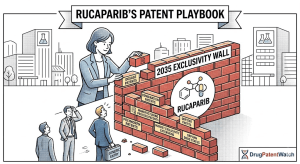
Rucaparib (Rubraca), a poly(ADP-ribose) polymerase (PARP) inhibitor first discovered at Newcastle University in collaboration with Agouron Pharmaceuticals, is one of the cleaner case studies available for dissecting exactly how that engineering works. Its patent portfolio spans composition of matter, crystalline polymorph, high-dosage formulation, method of use, and manufacturing process claims across U.S. and European jurisdictions. The core composition patent has already expired, yet the earliest realistic date of generic entry sits at August 17, 2035, anchored by formulation patent US9,987,285. That is the entire argument for layered IP strategy, expressed in a single data point.
The story is also an instructive autopsy. Clovis Oncology, the company that commercialized rucaparib, filed for Chapter 11 bankruptcy in December 2022. In April 2023, the Rubraca asset sold at a Section 363 auction to pharma& Schweiz GmbH for $70 million upfront, with up to $65 million in regulatory and sales milestones. A drug protected by patents running to 2035 sold for $70 million at bankruptcy. That gap between legal exclusivity and commercial value is the second lesson this case teaches, and it is at least as important as the first.
Key Takeaways
The pharmaceutical IP system is built on a calculated social contract: temporary monopoly rights in exchange for public disclosure of the invention and the assumption of massive development risk. Composition of matter patents provide the broadest protection but lose a significant portion of their 20-year statutory term to development and regulatory review, which compresses effective commercial exclusivity to 7-10 years post-launch in most cases. The rucaparib portfolio demonstrates that formulation, polymorph, and method-of-use patents, filed at different points in the asset’s lifecycle, can extend the exclusivity wall by years or decades beyond composition patent expiry. But exclusivity without a commercially viable product generates no value, a distinction every IP team and portfolio manager must hold simultaneously.
Rucaparib’s IP Valuation as a Core Asset: What the Numbers Actually Say
Before examining how the patent portfolio was constructed, it is worth establishing what that portfolio was worth, and why the gap between legal and commercial value became so dramatic.
Estimating IP Value at Peak
At its commercial peak in 2019, Rubraca generated approximately $147 million in annual net product revenue for Clovis. Using a standard royalty-relief methodology, where IP value equals the present value of royalty payments that would be required to license the asset from a third party, and applying a royalty rate typical for oncology small molecules (8-12% of net sales), the royalty stream from peak revenue would approximate $12-18 million annually. Discounted at a 10% rate across a remaining exclusivity window extending to 2035, the implied fair-market IP value of the Rubraca portfolio, at peak revenue, could range from $100 million to $180 million. This aligns with the $70 million realized in a distressed bankruptcy sale, which incorporated a significant discount for clinical risk (the ARIEL4 overall survival data had turned negative), commercial erosion, and regulatory uncertainty around label expansion.
For IP teams and portfolio managers, this exercise illustrates the standard three-factor valuation framework applied to pharma patent assets: remaining patent term adjusted for estimated litigation risk, probability of generic entry before the nominal expiry date, and the underlying commercial revenue trajectory. Each factor compounds the others. A formulation patent expiring in 2035 with a strong presumption of validity (as demonstrated by Clovis’s successful European opposition defense) is worth considerably more than an equivalently dated patent that would fail a Paragraph IV invalidity challenge.
The Pfizer Royalty Dimension
An underappreciated element of rucaparib’s IP economics is Pfizer’s role as a royalty counterparty. Agouron Pharmaceuticals, the company that co-discovered rucaparib at Newcastle University, was acquired by Warner-Lambert in 2000, which was then acquired by Pfizer in 2000. Pfizer therefore retained royalty rights on rucaparib commercialization. By late 2022, Clovis was actively negotiating with Pfizer to defer those royalty payments as part of its liquidity management. The existence of a royalty encumbrance on a patent-protected asset is a standard IP valuation adjustment that reduces the net present value of the patent portfolio to the holder. Any acquirer of the Rubraca asset in the Section 363 sale would have modeled these royalty obligations as a direct offset to the IP’s economic benefit.
This dimension of rucaparib’s history is instructive for IP teams conducting due diligence on acquisition targets: the patent portfolio is not the complete picture of economic exclusivity. Upstream royalty obligations, sublicensing restrictions, and co-development agreements sit beneath the patent layer and can materially alter the asset’s value to a specific acquirer.
Investment Strategy Note
For institutional investors, the rucaparib case argues for a specific analytical discipline: patent expiry dates reported in FDA Orange Book or equivalent databases are necessary but insufficient inputs for generic entry timing. The correct model requires mapping each listed patent by claim type, assessing polymorph and formulation patent validity under current obviousness standards, and discounting for the probability of a successful Paragraph IV challenge. The gap between the nominal expiry date of 2035 and the realistic probability-weighted first date of generic entry may be substantially narrower than the raw expiry date suggests.
The Scientific Foundation: PARP Inhibition, Synthetic Lethality, and the IP Implications of a New Mechanism
From NAD+ Biology to First-in-Class Drug: The 30-Year Research Arc
The biochemical path to rucaparib began with observations about NAD+ metabolism in 1956 and the identification of poly(ADP-ribose) in 1963. By 1975, researchers had established PARP’s role in DNA single-strand break repair. The 1980 publication demonstrating that PARP inhibition blocked DNA repair and increased cellular cytotoxicity in combination with alkylating agents established the conceptual basis for the entire class. Newcastle University researchers, working with Agouron in the 1990s, translated that biochemistry into small molecule PARP inhibitors, with rucaparib (then designated AG014699) as the lead compound.
This 30-year lead time from basic mechanism to approved drug is standard for first-in-class therapies built on genuinely novel biology. It also has direct IP implications. The foundational biochemistry of PARP inhibition was published in the open literature decades before rucaparib’s composition of matter patent was filed. That publication history defined the prior art landscape and shaped the scope of claims available to rucaparib’s inventors. Broad claims covering ‘any PARP inhibitor for cancer treatment’ were foreclosed by prior art; what remained patentable was the specific chemical structure, its particular therapeutic applications, and its optimized physical forms. Understanding this prior art boundary is essential context for interpreting why rucaparib’s composition patent (US6,495,541) expired in November 2023 without immediately opening the generic market.
Synthetic Lethality: The Mechanism That Generates Method-of-Use Patent Runway
Synthetic lethality refers to the phenomenon where two individually non-lethal genetic or pharmacological perturbations combine to cause cell death. In the PARP inhibitor context, PARP inhibition is pharmacologically introduced in a cancer cell that already carries a homologous recombination deficiency (HRD) due to germline or somatic BRCA1/2 mutation. Either defect alone is compatible with cell survival; together they create irreparable DNA double-strand breaks and trigger cell death. Normal cells, which retain functional BRCA-mediated homologous recombination, tolerate PARP inhibition and survive.
The clinical significance of this selectivity for rucaparib’s IP strategy is that it enabled a biomarker-defined patient population: individuals with BRCA-mutated tumors, and more broadly those with HRD. Each new biomarker-defined subpopulation, or each new tumor type in which BRCA mutation prevalence was established, represented a candidate for a distinct method-of-use patent claim. This is the mechanistic basis for rucaparib’s method-of-use patents covering not just ovarian cancer but fallopian tube cancer, peritoneal cancer, and metastatic castration-resistant prostate cancer (mCRPC). The PARP inhibitor mechanism, because it exploits a defined genetic defect rather than acting on a general tumor target, generates a more expansive and defensible method-of-use patent surface than most oncology mechanisms.
PARP Inhibitor Competitive Landscape: Where Rucaparib Sits in 2026
The global PARP inhibitor market was valued at approximately $7.4 billion in 2026 and is projected to reach $17.1 billion by 2036 at an 8.7% CAGR. Olaparib (Lynparza, AstraZeneca/Merck) holds an 86.2% market share in 2026, reflecting its earlier approval (2014), broader label, and partnership between two large commercial organizations. Niraparib (Zejula, GSK) and talazoparib (Talzenna, Pfizer) hold secondary positions. Rucaparib, under its new owner pharma& Schweiz, has a much smaller commercial footprint.
The competitive IP picture matters for analysts because it illustrates how composition of matter patent strategy differs between the PARP inhibitor entrants. AstraZeneca’s olaparib composition patent expires in 2023 in most jurisdictions, but the drug benefits from separate method-of-use and formulation patents, BRCA companion diagnostic protection, and Merck’s commercial infrastructure. GSK’s niraparib carries its own polymorph and formulation patent wall. The patent estates of all three drugs expire on different timelines, and the downstream generic entry dates are staggered accordingly, creating a multi-year window of competitive dynamics that is material for oncology payer formulary modeling.
Regulatory Pathway as IP Infrastructure: How FDA Approvals Built Rucaparib’s Exclusivity Stack
The Accelerated Approval of December 2016 and Its Exclusivity Mechanics
The FDA granted rucaparib accelerated approval on December 19, 2016, for adults with deleterious BRCA mutation-associated advanced ovarian cancer who had received two or more prior chemotherapy regimens. The approval was based on objective response rate data from 106 patients showing a 54% ORR and a 9.2-month median response duration. It came with a companion diagnostic, the FoundationFocus CDxBRCA assay (Foundation Medicine), approved simultaneously to identify patients with BRCA1/2 mutations in tumor tissue.
The regulatory mechanics here are directly relevant to IP valuation. Accelerated approval under 21 CFR 601.41 or 314.500 does not itself confer additional statutory market exclusivity beyond what the NDA generates. But it does accomplish two things with IP implications: it establishes an earlier revenue start date, improving the net present value of the patent portfolio by pulling forward commercial cash flows, and it positions the drug as a first-mover in a biomarker-defined indication, creating clinical and prescriber inertia that functions as a de facto commercial barrier independent of legal IP.
New Chemical Entity (NCE) exclusivity, which the December 2016 approval triggered, gave Clovis a five-year period during which no ANDA could be filed, regardless of patent status. The NCE-1 date, marking the first opportunity for a Paragraph IV ANDA filing, was therefore December 19, 2020. Any generic manufacturer filing on that date and surviving patent litigation would still face the Orange Book-listed formulation patents extending to 2035.
The companion diagnostic dimension adds a further layer. If the FoundationFocus CDxBRCA test remains the FDA-approved companion diagnostic for rucaparib and there is no generic-compatible companion diagnostic on the market at the time of generic entry, a generic rucaparib product may face practical prescribing barriers even with cleared legal patents. Companion diagnostic IP is an underappreciated element of total exclusivity architecture that appears nowhere in an Orange Book patent listing.
Maintenance Approval (April 2018) and the ARIEL3 Data
The FDA’s April 2018 supplemental approval for rucaparib as maintenance treatment for recurrent platinum-sensitive ovarian, fallopian tube, or peritoneal cancer, regardless of BRCA status, was the single most commercially significant regulatory event in the drug’s lifecycle. It dramatically expanded the eligible patient population beyond the narrow BRCA-mutated subset approved in 2016. The ARIEL3 trial data, which supported this approval, showed progression-free survival improvements of 5.4 to 11.2 months across patient subgroups stratified by HRD and BRCA status.
From an IP architecture standpoint, this approval created new Orange Book-listable method-of-use patent claims covering the maintenance treatment of patients regardless of BRCA mutation status (within the HRD-defined subgroup). The ARIEL3 data was patentable because it demonstrated clinical benefit in a population defined by a new biomarker (HRD/LOH high status), not merely BRCA mutation status. This is the operational definition of method-of-use evergreening in the oncology context: new clinical trial data, when it defines a new patient population or new indication, generates new patentable subject matter.
The mCRPC Label and Prostate Cancer’s IP Contribution
The May 2020 FDA approval for rucaparib in BRCA1/2-mutated metastatic castration-resistant prostate cancer (mCRPC) was based on TRITON2 data showing a 44% confirmed ORR in patients with BRCA alterations. This approval expanded the drug’s Orange Book-listable method-of-use patents into a second tumor type with a distinct patent runway. Patents covering the use of rucaparib in BRCA-mutated mCRPC (including US8,859,562, expiring August 4, 2031) provide exclusivity in this indication that runs seven years beyond the expiration of the foundational composition patent.
For generics manufacturers modeling first-date-of-entry strategy, this means that even after the composition patent and earlier method-of-use patents expire, a skinny-label ANDA that carves out the mCRPC indication would still face litigation risk under induced infringement theories if off-label prescribing of rucaparib in mCRPC patients is common. The practical enforceability of such a claim depends on prescribing patterns and the proximity of carve-out label language to the patented method, but the risk is real and must be modeled.
The ARIEL4 Signal: When Clinical Data Damages IP Value
The ARIEL4 overall survival interim analysis presented in 2022 showed a hazard ratio of 1.55 in favor of chemotherapy (OS of 19.6 months for rucaparib versus 27.1 months for chemotherapy, p=0.0161). This result led to the voluntary withdrawal of rucaparib’s FDA approval for the treatment setting in June 2022, leaving only the maintenance indication intact in the U.S. This is the clearest available demonstration that negative clinical data can be as consequential to IP asset valuation as a patent challenge. The legal exclusivity did not change. The revenue generating capacity collapsed.
IP teams and portfolio managers must model clinical lifecycle risk alongside patent term risk. A patent wall extending to 2035 is worthless if the drug’s approved label has been stripped of its highest-revenue indication. Rucaparib’s trajectory from $147 million peak revenue to bankruptcy within three years of that peak is a data point that belongs in every pharmaceutical asset valuation model as a benchmark for clinical risk discount rates in the maintenance oncology segment.
Architecting the Patent Fortress: Rucaparib’s Layered IP Portfolio in Technical Detail
Composition of Matter: US6,495,541 and Its Lifecycle Implications
US6,495,541, covering ‘Tricyclic inhibitors of poly(ADP-ribose) polymerases,’ was the foundational composition of matter patent for rucaparib. It protected the core chemical scaffold, the indole-fused azepinone ring system that defines the molecule’s interaction with the PARP active site. This patent expired in November 2023.
Composition of matter patents are the most commercially powerful pharmaceutical patents precisely because their claims are molecule-specific and mechanism-agnostic: any use of the compound in any formulation infringes. But their practical vulnerability is structural. Because IND filing typically occurs six to eight years into a patent’s 20-year term, and because Phase I through Phase III development and NDA review consume another six to eight years, the remaining patent life at the time of first approval is often eight to twelve years. For rucaparib, approved in December 2016 on a patent filed in the mid-1990s, the effective post-approval term of the composition patent was less than seven years before its November 2023 expiration.
This compression is the fundamental driver of secondary patent strategy across the pharmaceutical industry. It is not a defect in IP planning; it is an inherent feature of the innovation economics. A company that files only a composition patent is accepting that its legal exclusivity will largely coincide with the period of lowest commercial revenue (early in the product lifecycle) and will expire just as peak revenue is being generated or has recently been achieved. The entire discipline of pharmaceutical lifecycle management exists to address this structural mismatch.
Salt and Polymorph Patents: The Camsylate Strategy and Its Valuation
Rucaparib is not sold as the free base. It is formulated as the camphorsulfonate (camsylate) salt, specifically as the (S)-camphorsulfonate enantiomer (S-camsylate). The choice of salt form is an active pharmaceutical ingredient decision with direct IP consequences. Different salts and different polymorphic forms of the same salt can have substantially different physical properties: solubility, hygroscopicity, melting point, crystalline stability, and manufacturability. When those property differences are substantial and non-obvious, they are patentable.
For rucaparib, multiple patents protect the camsylate salt and its specific crystalline forms. US8,754,072, US9,045,487, and US9,861,638 protect salts and polymorphs of rucaparib with expiration dates of February 10, 2031. The commercially critical asset in this cluster is the European polymorph patent, EP2534153, covering the S-camsylate Form A (the commercial form used in Rubraca tablets). This patent was challenged in opposition proceedings at the European Patent Office. In a decision that went in Clovis’s favor, the Opposition Division upheld the claims in amended form, confirming European protection until at least 2031, with potential for a Supplementary Protection Certificate (SPC) extension to 2033. The Division’s reasoning turned on the unexpected combination of properties exhibited by Form A: good physical stability, non-hygroscopicity, resistance to hydrate formation, and a high melting point suitable for tablet compression. These properties were deemed non-obvious from the prior art base, which is the operative standard for polymorph patent validity.
A subsequent EPO Technical Board of Appeal decision (T 0243/22, February 2025) involving a related rucaparib maleate salt patent provides further doctrinal context. The Board’s reasoning on unexpected properties and the inventive step analysis for pharmaceutical polymorphs defines the legal test that any generics manufacturer must clear when challenging European polymorph patents. The standard is demanding: the challenger must establish that the superior properties of the patented form were either predictable from the prior art or that the inventor merely identified an obvious form among a predictable range of candidates.
The commercial significance of this patent cluster for IP valuation purposes is that it protects not the molecule in the abstract but the specific commercial product. A generic manufacturer must use a different salt form or a different polymorph to avoid infringement, and if that alternative form has inferior properties (lower stability, higher hygroscopicity, different bioavailability profile), the generic product may face regulatory equivalence challenges even if it clears the patent barrier. This creates a practical moat that reinforces the legal exclusivity.
IP Valuation Sub-Assessment: Polymorph Patents
For discount-rate modeling purposes, the polymorph patent cluster at 2031 should be valued at a higher confidence interval than the base composition patent was worth at any comparable point in its life, because the post-opposition European uphold provides a strong presumption of validity. The expected cost of a successful Paragraph IV challenge against a polymorph patent that has survived EPO opposition is substantially higher than the cost of challenging an unlitigated patent. Generic manufacturers will model this and factor the litigation cost premium into their go/no-go calculus for first-to-file ANDA strategies.
High-Dosage Formulation Patents: The 2035 Anchor
US9,987,285 and US10,130,636, covering ‘High dosage strength tablets of rucaparib camsylate salt,’ expire on August 17, 2035. These are the patents that set the earliest generic entry date in the DrugPatentWatch analysis. They protect the specific 200mg, 250mg, and 300mg tablet formulations of rucaparib camsylate used in clinical practice. The formulation patents are not merely packaging claims; they cover the specific combination of drug load, excipient ratios, and tablet architecture that achieves the required dissolution profile and chemical stability for a high-potency oral oncology tablet.
Formulation patents at this dosage range require meaningful pharmaceutical development work. High drug loading in solid oral dosage forms creates challenges: particle size distribution, content uniformity, compressibility, and chemical compatibility with excipients all become engineering problems at 200-300mg dose strengths in a single tablet. The patent claims reflect solutions to those problems. From a patentability standpoint, a skilled formulation scientist without the inventors’ data would not necessarily arrive at the same excipient combination and tablet architecture, which supports the non-obviousness argument if challenged.
The litigation risk profile for these formulation patents is more complex than for the polymorph cluster. Formulation patents are the most commonly challenged category of pharmaceutical secondary patents in Paragraph IV proceedings. Generic manufacturers and their patent challenge law firms (Paragraph IV specialists at firms such as Hatch-Waxman practices at large generic companies) routinely challenge formulation patents on obviousness grounds, arguing that the claimed formulation represents routine pharmaceutical development. The 2012 Supreme Court decision in Mayo Collaborative Services v. Prometheus tightened Section 101 standards for method claims but left composition and formulation claims on stronger ground. Rucaparib’s formulation patents, as composition claims on a specific physical dosage form, sit on the more defensible side of that doctrinal line.
Technology Roadmap: Evergreening Tactics Available at Each Stage
For IP teams managing a small molecule oncology asset, the standard lifecycle technology roadmap, applied to the rucaparib model, proceeds as follows:
At IND filing, identify the optimal salt form and file polymorph patents on all commercially viable crystalline forms. Simultaneously draft method-of-use claims tied to the specific patient population (here, BRCA-mutated tumors) with claims narrow enough to clear prior art but broad enough to cover all biomarker-defined subgroups. File process patents on any non-obvious synthesis route that achieves superior yield or purity.
At Phase II, file formulation patents as the commercial tablet or capsule specification is confirmed. If clinical data suggests activity in a second tumor type, initiate additional IND applications to generate data for new method-of-use patents covering that indication.
At NDA filing, file all remaining Orange Book-eligible patents simultaneously with the NDA submission to maximize the 30-month stay triggered by any Paragraph IV challenge filed within 45 days of ANDA notification.
At post-approval, continue generating new method-of-use patents as label expansions are approved. Evaluate Pediatric Written Request qualification for 6-month pediatric exclusivity, which attaches to all listed patents regardless of which specific patent was studied. Pursue Patent Term Extension under 35 U.S.C. 156 for the single patent that will benefit most from the extension (typically the longest remaining Orange Book patent, subject to the 14-year post-approval cap).
Rucaparib’s portfolio executed this roadmap through the method-of-use stage (with patents covering ovarian, fallopian tube, peritoneal, and mCRPC indications) and the formulation stage (with the 2035-dated tablet patents). Clovis reported seeking a 1,412-day Patent Term Extension for rucaparib, which, if granted in full, would have been among the longer PTEs on record, reflecting the extended FDA review period for the accelerated approval pathway.
Method-of-Use Patents: The Indication Expansion Map
The method-of-use patent cluster for rucaparib covers treatment of specific cancer types in biomarker-defined patient populations. US8,071,579 and US8,143,241 expire August 12, 2027, covering the use of DNA damage repair inhibitors for treating cancer. US8,859,562 expires August 4, 2031, covering the specific mCRPC indication in BRCA-mutated patients. These patents work in conjunction with the Orange Book listing requirements under the Hatch-Waxman Act: any method-of-use patent for which the NDA holder has obtained approval must be listed, and a generic ANDA filer must certify to each listed patent.
The critical IP strategy point here is label carve-out, also called skinny labeling. A generic manufacturer may file an ANDA with a Section viii statement (rather than a Paragraph IV certification) for a method-of-use patent, carving out the patented indication from the generic product’s label. This avoids patent litigation for that indication but does not prevent off-label prescribing. The legal risk from induced infringement (where the generic manufacturer’s marketing materials or product labeling are alleged to encourage prescribers to use the product for the patented indication) is a significant and evolving area of Hatch-Waxman litigation. GlaxoSmithKline LLC v. Teva Pharmaceuticals USA, Inc. (3d Cir. 2021) found Teva liable for induced infringement despite a carved-out label, signaling that method-of-use patents may provide stronger protection than the generic bar historically assumed.
For rucaparib, the mCRPC indication patent expiring in 2031 is the most commercially relevant method-of-use patent for the pharma& Schweiz entity that now owns the asset, assuming that a revived commercial effort focuses on the maintenance ovarian cancer indication and prostate cancer, where the clinical data is more defensible than in the treatment setting.
Process Patents: Manufacturing Exclusivity as Strategic Depth
Process patents protect the specific synthetic routes used to manufacture rucaparib and its key intermediates. US20200331916A1 describes a preparation process for rucaparib. KR20230020172A, filed in Korea, covers a synthetic method that builds the indole skeleton first and then forms the seven-membered lactam ring, achieving improved synthesis yield and reproducibility versus previously described routes.
Process patents are the deepest layer of the pharmaceutical IP stack. A generic manufacturer who has cleared all composition, formulation, and method-of-use barriers through either expiration or successful Paragraph IV challenge may still infringe a valid process patent if the only commercially practical synthesis route for a high-purity rucaparib API is covered by unexpired process claims. The value of process patents as standalone exclusivity instruments is limited by the Bolar exemption (35 U.S.C. 271(e)(1)), which permits generic manufacturers to use patented processes in activities reasonably related to regulatory submission. But once an ANDA is filed and approved, post-approval commercial manufacturing using a patented process infringes. Generic API manufacturers operating in India, China, or other jurisdictions will need to either license the process patents, design around them with alternative synthesis routes (often at higher cost or lower yield), or challenge their validity in whatever jurisdiction is applicable.
For IP teams, process patents are often underinvested relative to their strategic value. Rucaparib’s synthetic route involves a convergent assembly of a fluorinated benzaldehyde piece with a tricyclic core, with resolution of the chiral center. Novel catalytic or biocatalytic steps in this sequence, or significantly improved routes to key intermediates, are candidates for process patent claims that can extend manufacturing exclusivity and impose real cost burdens on generic API producers.
The Opposition Proceedings: Patent Defense as IP Value Confirmation
European Patent Office Proceedings on EP2534153
The opposition proceedings against EP2534153 (covering S-camsylate Form A, the commercial polymorph) are among the more instructive European patent proceedings in the PARP inhibitor space. The patent was opposed on grounds including lack of inventive step, arguing that the selection of the S-camsylate Form A from among possible salt and polymorph candidates was obvious to a skilled pharmaceutical formulator. The Opposition Division disagreed, upholding the patent in amended form based on a combination of unexpected properties: Form A’s physical stability, resistance to hygroscopic hydration, and high melting point made it non-obvious over the prior art disclosure of rucaparib free base and related compounds.
The commercial read-through of this outcome is direct. European protection confirmed through 2031 means pharma& Schweiz, as the current owner, has approximately five years of protected exclusivity in Europe from the current date, extendable to 2033 via SPC in major EU markets. SPC applications in Germany, France, the UK (under its post-Brexit equivalent), and other major markets would each need to be filed and prosecuted individually, but the granted basic patent and marketing authorization both exist as prerequisites, so the SPC pathway is available.
A second EPO Board of Appeal proceeding, T 0243/22 (decided February 2025), involved a rucaparib maleate salt patent filed by Pfizer (as successor-in-interest to Agouron patent positions). The detailed claim analysis in that decision provides granular guidance on how the EPO’s Technical Board of Appeal is currently applying the problem-solution approach to pharmaceutical polymorph claims, useful reference material for IP teams filing or defending analogous polymorph patents across the PARP inhibitor class or broader oncology small molecule portfolios.
What Opposition Wins Tell Investors
A patent that survives inter partes opposition or post-grant review carries significantly higher evidentiary weight in subsequent validity challenges, whether in U.S. district court Paragraph IV litigation or in EPO appeal. The reason is that a skilled examiner or opposition panel has already considered relevant prior art and found the claims patentable over that art. A challenger in subsequent proceedings must either find new prior art not before the original panel or attack the legal framework under which that art was assessed.
For portfolio managers and institutional investors, a patent that has survived opposition warrants a lower discount rate in IP valuation models than an un-challenged patent, all else equal. The empirical probability of invalidation in subsequent challenges is lower after a successful opposition defense. The magnitude of this discount rate adjustment varies by jurisdiction and examiner, but it is a meaningful input that belongs explicitly in any rNPV model that includes patent-protected revenue through 2031 or 2033 for European Rubraca sales.
The Clovis Oncology Collapse: What It Means for IP-Driven Asset Valuation
From $147 Million Revenue to Chapter 11: The Commercial Execution Failure
Clovis Oncology’s trajectory is worth examining in detail because it challenges a common assumption in pharmaceutical IP analysis: that a strong patent portfolio generates durable commercial value. Clovis’s Rubraca peaked at approximately $147 million in 2019. By late 2022, revenue had declined substantially, driven by several compounding factors. First, olaparib’s commercial infrastructure, backed by AstraZeneca and Merck’s combined oncology sales forces, dominated PARP inhibitor prescribing in the maintenance ovarian cancer setting. Second, the negative ARIEL4 overall survival data in the treatment setting prompted the FDA to withdraw approval for that indication, removing a significant revenue stream. Third, FDA declined to broaden the label to include HRD-positive patients without BRCA mutations for the treatment indication, which Clovis had modeled as a major commercial expansion opportunity. Fourth, the PARP inhibitor class came under general FDA scrutiny following survival data from multiple agents, creating prescriber hesitancy. Fifth, Clovis’s royalty obligations to Pfizer created a structural drag on operating economics that became unmanageable as revenue declined.
The November 2022 10-Q filing, submitted without a press release or investor call, stated plainly that Clovis would not have sufficient liquidity beyond January 2023 and that bankruptcy was probable. The company had deferred a $1.9 million interest payment and was in a 30-day grace period. In December 2022, it filed Chapter 11. In April 2023, pharma& Schweiz GmbH purchased the Rubraca asset at the Section 363 auction for $70 million upfront, beating whatever competing bids existed, with up to $50 million in regulatory milestones and $15 million in sales milestones.
The Section 363 Sale: IP Asset Pricing Under Distress
The $70 million purchase price for Rubraca in the bankruptcy sale represents a deeply discounted acquisition of a patent-protected asset. The discount reflects four compounding valuation adjustments. The first is clinical risk: the ARIEL4 survival data had destroyed the thesis for rucaparib in the treatment setting, and the path to label expansion in HRD-positive patients without BRCA mutations was blocked. The second is competitive intensity: olaparib’s 86% market share in the PARP inhibitor space makes any commercial revival for a smaller-label product extremely capital-intensive. The third is royalty encumbrance: Pfizer’s upstream royalty rights reduced the economic return available to any acquirer. The fourth is cure cost exposure: the Section 363 sale structure required pharma& to cover up to $41 million in contract cure costs for assigned agreements, effectively making the total acquisition cost closer to $111 million before milestones.
For M&A practitioners and IP-focused institutional investors, the Rubraca sale illustrates why distressed pharmaceutical asset prices frequently diverge from static IP valuation outputs. A royalty-relief IP valuation based on normalized revenue and a 2035 exclusivity wall would generate a substantially higher figure than $70 million. The gap is explained almost entirely by the probability-weighted clinical and commercial risk adjustments applied by rational bidders in a competitive auction process. IP teams conducting asset valuations for business development purposes must apply the same adjustments, even in non-distressed contexts, or they will systematically overestimate asset value.
Lessons for IP Portfolio Strategy
Several direct lessons for IP and portfolio teams emerge from Clovis’s experience. Diversification within IP-generating assets matters: Clovis was a one-drug company, which meant that clinical setbacks in rucaparib had no offsetting assets. The company had no pipeline to signal future value to capital markets. A stronger patent portfolio in one drug cannot substitute for pipeline diversification in maintaining company viability.
Second, regulatory risk is not independent of IP value. The ARIEL4 survival data was a clinical result, but its consequences included label withdrawal, which removed Orange Book-listed patents from commercial relevance for the withdrawn indication. IP that protects a withdrawn indication does not generate revenue regardless of its legal validity.
Third, royalty stacking, the accumulation of multiple upstream royalty obligations (here, Pfizer’s royalty from the Agouron origination and potentially institutional royalties from Newcastle University) erodes the economic benefit of IP exclusivity for downstream commercializers. IP teams negotiating in-licenses or acquisition structures should model royalty stacking explicitly and build in royalty caps or step-down provisions wherever the agreement structure permits.
Patent Term Extension, Orange Book Mechanics, and Generic Entry Timing
35 U.S.C. 156: The PTE Calculation for Rucaparib
Patent Term Extension under 35 U.S.C. 156 is available for patents covering the active ingredient, method of use, or formulation of a drug product that has undergone a regulatory review period before FDA approval. The extension is calculated as half the time spent in Phase I and II clinical trials, plus all of the Phase III clinical trial period, plus all of the regulatory review period, minus the portion of those periods that overlapped. The maximum extension is five years, and the total post-approval patent life with extension cannot exceed fourteen years.
Clovis sought a Patent Term Extension of 1,412 days (approximately 3.9 years) for a rucaparib patent. This figure reflects the accumulated regulatory delay from IND filing through the December 2016 accelerated approval. A PTE of that duration would restore a meaningful portion of the patent term consumed by the lengthy development process, extending a selected patent’s expiration by nearly four years beyond its statutory date. PTE applications are filed with the USPTO within 60 days of FDA approval, and the calculation methodology is detailed and formula-driven; errors in clinical hold periods, IND submission dates, or Phase I/II overlap calculations can substantially affect the resulting extension.
For IP teams, the key strategic decision is which patent to extend. PTE is available for one patent per approved product. The rational choice is the patent that (a) has the longest remaining term (to avoid PTE pushing a patent expiration past the 14-year post-approval cap, which would waste PTE) and (b) covers the most commercially valuable aspect of the product. For rucaparib, the formulation patents expiring in 2035 are already well past the 14-year cap relative to a December 2016 approval. The method-of-use patents expiring in 2027 and 2031 are the candidates most likely to benefit from a PTE calculation, and the 2031 patent covering mCRPC use would be the priority target.
The Hatch-Waxman Framework: Paragraph IV Certification and the 30-Month Stay
Under the Drug Price Competition and Patent Term Restoration Act of 1984 (Hatch-Waxman), a generic manufacturer seeking to market a drug before expiration of its listed Orange Book patents must file an ANDA with one of four patent certifications. Paragraph IV certification asserts that the listed patent is invalid, unenforceable, or will not be infringed by the generic product. Filing a Paragraph IV ANDA triggers an automatic obligation on the generic filer to notify the NDA holder and each patent owner, who then have 45 days to file suit. If suit is filed within 45 days, an automatic 30-month regulatory stay prevents FDA from approving the ANDA, regardless of the merits of the patent claims.
For rucaparib, any generic manufacturer filing a Paragraph IV ANDA against the 2035 formulation patents before August 2032 (30 months before the patent expiration) would trigger a 30-month stay extending to approximately 2035, effectively providing no practical acceleration of generic entry beyond the patent expiration date. The more strategically viable Paragraph IV approach for a generic is to target the method-of-use patents expiring in 2027 and 2031, successfully challenge them, and then seek approval under a carved-out label covering only prior indications no longer listed in the Orange Book, if any such indications exist.
The NCE-1 date of December 19, 2020, has already passed without a reported Paragraph IV challenge, which suggests that potential generic challengers evaluated the combined patent estate, including the polymorph and formulation patents and their post-opposition strength, and concluded that the litigation economics did not support an early challenge. This is itself a signal about the market’s assessment of the rucaparib patent estate’s validity.
Investment Strategy: Generic Entry Timing Model
For investors pricing branded pharmaceutical assets or generic acquisition targets, the rucaparib case supports a specific analytical framework. The nominal expiry date (2035 for the formulation anchor patent) is the ceiling. The probability-weighted first date of generic entry should be calculated as a weighted average across scenarios: (1) no Paragraph IV challenge filed before patent expiry, with generic entry in August 2035 on natural expiration; (2) Paragraph IV challenge filed and resolved in generic’s favor on formulation invalidity grounds, with generic entry potentially 2-3 years earlier depending on litigation timeline; and (3) Paragraph IV challenge filed and resolved in patentee’s favor, maintaining 2035 entry date.
Assigning probabilities to these scenarios requires analysis of the patent’s post-opposition legal strength, the strength of prior art available to a challenger, and the commercial economics that would motivate a generic manufacturer to invest $5-15 million in Paragraph IV litigation against a drug whose current commercial volume is substantially below peak. Given the collapse in rucaparib’s commercial volume following the ARIEL4 data and label withdrawal, the probability of a well-capitalized first-to-file Paragraph IV challenge is lower than it would be for a drug at peak revenue. The irony is that a weaker commercial position may paradoxically strengthen the remaining patent estate by reducing the economic incentive for generic challengers to mount expensive litigation.
PARP Inhibitor Class IP Comparison: Rucaparib, Olaparib, and Niraparib
Comparative Patent Architecture Across the PARP Inhibitor Class
The three FDA and EMA-approved PARP inhibitors for ovarian cancer maintenance (olaparib, niraparib, and rucaparib) each built their exclusivity walls through different emphases within the same general category of patent types.
Olaparib (Lynparza), the class leader by commercial volume with 86.2% of the global PARP inhibitor market, has a composition of matter patent that expired in most jurisdictions around 2023. Its post-composition exclusivity rests on formulation patents covering the capsule-to-tablet switch that AstraZeneca executed in 2018 (moving from 400mg capsules to 150mg tablets), new indication patents covering breast, prostate, and pancreatic cancer, and the BRCA1/2 companion diagnostic architecture. The tablet formulation patents extend olaparib’s exclusivity wall to approximately 2031-2033 in major markets.
Niraparib (Zejula), acquired by GSK from Tesaro in 2019, carries polymorph and formulation patents extending its protection into the early 2030s, plus method-of-use patents covering the HRD-positive patient population regardless of BRCA status, reflecting the broader biomarker strategy GSK pursued in contrast to rucaparib’s narrower BRCA-focused initial label.
Rucaparib’s formulation anchor at 2035 gives it the longest nominal exclusivity endpoint of the three in the U.S. But the commercial asset underlying that exclusivity is the smallest of the three, as measured by current revenue. For a generic manufacturer evaluating first-to-file Paragraph IV strategy across the PARP inhibitor class, the litigation economics favor challenging olaparib and niraparib before rucaparib, because the revenue at stake makes the litigation investment more rational.
Selective PARP1 Inhibition: The Next Generation’s IP Architecture
The most recent patent filings in the PARP inhibitor space center on selective PARP1 inhibitors, specifically designed to avoid the hematologic toxicity (thrombocytopenia, anemia) that limits dose intensity with pan-PARP1/2 inhibitors like rucaparib. AstraZeneca’s AZD5305, appearing in 2024-2025 combination patent filings, represents a new composition of matter claim anchoring a fresh 20-year patent term. The PARP inhibitor market’s evolution toward PARP1 selectivity illustrates the standard biopharma innovation cycle: a first-generation mechanism generates a class of approved drugs, each with its own patent estate, and then a second-generation mechanism improvement (here, PARP1 selectivity) generates a new wave of composition patents with fresh exclusivity windows.
IP teams managing legacy PARP inhibitor assets (including rucaparib under pharma&) must account for the threat that next-generation selective PARP1 inhibitors represent to their commercial position even within the protection of existing patents. Legal exclusivity does not prevent clinicians from switching to a therapeutically superior, better-tolerated alternative that has its own distinct patent. This substitution risk, which operates through clinical practice rather than legal generic competition, is the third vector of revenue erosion (alongside patent expiry and Paragraph IV challenge) that sophisticated pharmaceutical asset models must incorporate.
Using Patent Intelligence Platforms: What DrugPatentWatch Provides and How to Use It
From Raw Data to Competitive Intelligence: The Analytical Stack
Patent data from the USPTO, EPO, and national patent offices is publicly available. The challenge is not access to the data; it is the analytical work required to translate raw patent filings into commercially actionable intelligence. A bare patent number tells you nothing about when generic entry is likely, how strong the claims are, whether opposition proceedings are pending, or how the patent interacts with regulatory exclusivities and Orange Book listing status.
Platforms like DrugPatentWatch aggregate patent data, FDA Orange Book listings, ANDA filing histories, patent term extension status, regulatory exclusivity records, and litigation outcomes into a unified database covering both small molecule and biologic drugs in the U.S. and internationally. For the rucaparib portfolio, the platform identifies that the earliest estimated generic entry date is August 17, 2035, based on US9,987,285; that the NCE-1 date of December 19, 2020 has passed; and that no reported ANDA challenge is currently blocking the path to that 2035 date.
For a pharma IP team, the practical workflow using a platform of this type begins with patent expiry mapping: identifying every Orange Book-listed patent for a competitor’s drug, sorted by expiration date, with claim type annotation. This produces the ‘exclusivity cascade,’ the sequence in which different aspects of the competitor’s IP protection fall away over time. For a branded pharmaceutical company managing its own portfolio, the same cascade analysis identifies which patents require the most active defense (formulation and polymorph patents with the latest expiry dates) and which are already approaching natural expiration.
Paragraph IV Monitoring and Generic Entry Alert Systems
One of the highest-value applications of patent intelligence platforms in a commercial organization is Paragraph IV challenge monitoring. When a generic manufacturer files an ANDA with a Paragraph IV certification against one of your listed patents, the FDA publishes the ANDA applicant’s name and the date of filing in the Federal Register. Patent intelligence platforms track these publications in real time, allowing branded companies to identify the 45-day suit window before it closes.
Missing the 45-day window forfeits the automatic 30-month stay, which is one of the most commercially valuable procedural rights available to an NDA holder under Hatch-Waxman. A 30-month stay buys approximately 2.5 years of additional exclusivity during litigation, even if the litigation ultimately fails. At peak revenue levels for a blockbuster drug, missing the 45-day window can cost hundreds of millions of dollars in foregone exclusivity. Patent intelligence platforms that automate the monitoring of Federal Register Paragraph IV notices are not an optional tool; they are a risk management necessity for any NDA holder with material commercial assets.
For the rucaparib asset under pharma& Schweiz, maintaining this monitoring capability is important even given the asset’s current commercial scale. The formulation patents running to 2035 represent roughly nine years of remaining exclusivity, and the aggregate value of that exclusivity, even at rucaparib’s reduced current revenue level, would justify litigation costs to defend a valid Paragraph IV challenge.
Beyond exclusivity monitoring for existing assets, patent landscape analysis is an essential R&D planning tool. Systematic filing of patent applications by a competitor in a specific mechanistic area (such as selective PARP1 inhibitors, or PARP inhibitors in combination with immunotherapy agents) provides advance warning of competitor programs, typically 18 months before publication, and immediately upon publication provides claim-level detail about the competitor’s lead compounds, formulation approaches, and clinical hypotheses.
For a portfolio manager or R&D lead evaluating investment in the PARP inhibitor space, the combination patent filings appearing in 2024-2025 (AZD5305 with anti-TROP2 ADCs, ATR inhibitors, and anti-FRα ADCs for ovarian cancer) visible in current patent databases signal AstraZeneca’s strategic hypothesis that PARP1-selective inhibition combined with antibody-drug conjugates represents the next commercial frontier. This patent publication data appeared 12-18 months before any clinical trial results from those combinations are available, giving competitors a lead time advantage in their own combination program planning.
Key Takeaways for IP Teams, Portfolio Managers, and R&D Leads
Rucaparib’s patent portfolio demonstrates the full anatomy of a pharmaceutical exclusivity strategy, from the composition of matter foundation through polymorph and formulation patents to method-of-use and process claims. Several specific conclusions are warranted for decision-makers across the pharmaceutical value chain.
The composition of matter patent is necessary but insufficient for durable exclusivity. US6,495,541 expired in November 2023 after rucaparib had been on the market for seven years. Without the subsequent polymorph, formulation, and method-of-use patent layers, generic entry would have been available in 2023. The 2035 exclusivity wall exists because of patents filed years after the original composition filing, addressing optimized physical forms and demonstrated clinical applications.
Polymorph patents are most defensible when they cover the actual commercial product and when the patented properties are genuinely unexpected relative to the prior art. EP2534153’s successful opposition defense turned on the combination of Form A’s stability, non-hygroscopicity, and melting point. This is the template: file polymorph patents on the exact commercial form, document unexpected properties with data, and expect that data to be the central contested issue in any opposition or Paragraph IV proceeding.
Clinical data is an IP variable. The ARIEL4 overall survival signal did not directly invalidate any rucaparib patent, but it effectively removed the commercial value of patents protecting the treatment indication and contributed to the label withdrawal that ultimately destroyed the company. IP teams and commercial teams must share clinical trial monitoring responsibilities and model IP asset value under adverse clinical scenarios.
Bankruptcy and asset sales reveal true IP market value more accurately than any theoretical valuation model. The $70 million Section 363 price for a patent-protected asset with nominal exclusivity to 2035 is the most reliable market data point available on pharmaceutical IP valuation under conditions of clinical and commercial distress. Portfolio managers should use this price as a benchmark when stress-testing IP asset valuations in their own models.
The PARP inhibitor class is transitioning from first-generation pan-PARP agents (olaparib, niraparib, rucaparib) to selective PARP1 agents (AZD5305 and analogues). New composition patents on selective PARP1 inhibitors carry fresh 20-year terms from recent filing dates. IP teams at companies with legacy PARP assets need an explicit strategy for managing competitive obsolescence risk that runs parallel to the patent defense strategy. Legal exclusivity and clinical relevance are two different things, and only one of them generates revenue.
Patent expiry dates and legal status information derived from DrugPatentWatch, Drugs.com Orange Book records, EPO Boards of Appeal decisions (T 0243/22, T 1126/19), and Clovis Oncology SEC filings. Commercial and market data sourced from Clovis Oncology SEC filings, Future Market Insights PARP inhibitor market report (January 2026), and Section 363 sale documents filed with the U.S. Bankruptcy Court for the District of Delaware (Case No. 22-11090, April 2023).