Last updated: July 15, 2026
Rifampin is a mature, off-patent antibiotic with a shrinking value pool driven by generic substitution, constrained pricing power, and a steady reliance on fixed-dose combinations for tuberculosis (TB) and other mycobacterial regimens. Financial trajectory is dominated by global TB program demand and tender-driven pricing in most geographies, with annual revenue volatility tied more to public-sector procurement cycles than to innovation. IP risks are largely limited to niche formulation or combination exclusivities, not to broad, brand-level patent estates, and FDA-related leverage is minimal because rifampin is long genericized in the US.
What is rifampin’s revenue and market size trajectory by region?
Rifampin’s commercial profile is shaped by two realities: (1) it is a cornerstone TB and mycobacterial drug; (2) it competes primarily on price, supply, and procurement contracting. As a result, “market growth” is mostly a function of treated patient volumes and drug procurement budgets, not brand premium pricing.
How does demand behave?
- TB incidence and treatment coverage drive volume. Rifampin is central to standard regimens, including rifampin-containing combinations.
- Public-sector tendering drives revenue per dose. Pricing is typically set through bidding dynamics, especially for high-volume, government-funded programs.
- Program substitution patterns matter. When national formularies shift among rifampin-containing fixed-dose combinations, unit volumes of rifampin can rise or fall even if overall TB patient numbers stay stable.
Region-level dynamics
- United States: Mature generic market. Revenue is fragmented across multiple labeled strengths and manufacturers; overall category growth is constrained by low pricing and stable standard-of-care usage.
- Europe: Similar generic maturity, with tender/contract pricing and supply continuity as key differentiators.
- Emerging markets (high TB burden): Procurement and tender cycles drive quarterly and annual revenue variability. Currency and budget cycles create short-term swings.
Net effect: Rifampin’s financial trajectory is typically flat-to-slow growth in volume and pressured on price, producing low single-digit category value growth unless TB detection and treatment coverage accelerate materially.
How do generic competition and tender pricing affect rifampin profits?
Rifampin’s pricing power is structurally weak due to:
- widespread generic availability of rifampin capsules/tablets in multiple strengths and manufacturers,
- frequent interchangeability in TB regimens,
- procurement-driven contracting rather than payer-specific formulary leverage.
Key drivers of margin compression
- Price-based tendering: Manufacturers win bids on cost competitiveness and reliability, reducing gross margin.
- Supply chain scale: Larger players often secure longer framework agreements.
- Working capital cycles: High-volume distribution to distributors and governments requires tighter inventory management; margin sensitivity rises with freight and raw material cost volatility.
Raw material and manufacturing constraints
Rifampin is an API with specialized manufacturing know-how. Even with many generic labels, actual manufacturability can concentrate risk:
- If API supply tightens, spot price volatility can transiently lift category pricing.
- If quality system issues or manufacturing downtime occur, supply allocation can push revenue to fewer suppliers, altering who captures the category value without expanding the total market.
When does rifampin lose exclusivity, and what residual IP barriers remain?
Rifampin is largely off patent for core active ingredient commercialization, so “loss of exclusivity” is not a live decision driver for most market participants. Residual IP barriers typically take the form of:
- specific fixed-dose combinations (FDCs) with rifampin,
- specific formulation improvements (release profile, stability, or bioavailability approaches),
- manufacturing process claims (less common to block entry unless asserted and defended).
Practical conclusion for market entry
- For standalone rifampin generics in major markets, entry is usually constrained more by regulatory filing readiness, bioequivalence package completeness, and API supply than by blocking patents.
- For rifampin-containing FDCs, the barrier may shift from rifampin to the combination product’s formulation or packaging claims.
What is the Orange Book status of rifampin in the US?
Rifampin has extensive historical generic listings in the FDA’s Approved Drug Products with Therapeutic Equivalence Evaluations (Orange Book). Given the drug’s maturity, current Orange Book listings typically show:
- multiple ANDA products for rifampin dosage forms,
- few, if any, active listing-linked exclusivities tied to a brand product.
What this means for business planning
- You model rifampin in the US as a generic competitive category.
- Legal leverage is usually about specific product patents (if any are listed for a particular ANDA/brand legacy) rather than a broad, product-wide exclusion of generics.
Are there Paragraph IV challenges for rifampin products?
Because rifampin is broadly genericized, Paragraph IV litigation risk is generally lower than for newer branded drugs. When it does occur, it is typically tied to:
- rifampin-containing combination products with remaining patent protection,
- specific dosage form or formulation patents that attach to a particular reference product.
Business implication
In most investment or licensing cases, rifampin’s legal pathway is less about “winning against a brand” and more about whether niche claims exist for:
- FDC formats,
- stability-controlled formulations,
- packaging and patient adherence innovations.
Which companies capture rifampin value, and how are revenues distributed?
Rifampin revenues are typically distributed across:
- large generic manufacturers with robust ANDA portfolios,
- regional suppliers in TB-endemic procurement ecosystems,
- distributors that win tenders and resell to government or program channels.
Competitive landscape patterns
- Scale players tend to capture share when tenders prioritize continuity of supply and low unit costs.
- Specialty or local players can gain access via relationships, validated manufacturing capacity, and local regulatory registrations.
Because the drug is mature, revenue concentration usually reflects:
- manufacturing capacity at compliant plants,
- low cost of goods at scale,
- ability to meet tenders and delivery schedules.
How does rifampin compare with other key TB drugs on commercial trajectory?
Rifampin competes within TB regimens against other core agents such as isoniazid, pyrazinamide, ethambutol, and in some contexts fluoroquinolones.
Relative commercialization dynamics
- Rifampin: stable demand anchor but low pricing power; revenue largely fixed by TB procurement.
- Newer TB regimen components: if any retain patents, they can command higher price and create faster category value changes.
- FDC strategy: rifampin’s integration into multi-drug products can shift revenue between “rifampin standalone” and “rifampin combo” reporting.
Net effect
Rifampin’s financial trajectory is usually less volatile than newer agents on patent and lifecycle issues. It is more exposed to procurement shifts and FX/cost dynamics.
What regulatory pathways govern rifampin generics and how do they affect timelines?
In the US, generic entry generally uses ANDA pathways for solid oral dosage forms, with bioequivalence supporting submission. Key timing impacts:
- completeness of chemistry, manufacturing, and controls (CMC) packages,
- availability of suitable reference listed drug (RLD),
- bioequivalence study feasibility (if required for specific strengths or formulations),
- patent certification workflow in the Orange Book landscape.
Global registration
In high-TB-burden countries, approvals and import clearances can determine entry lead time more than scientific comparability.
What formulations are protected by patents for rifampin-containing products?
While rifampin itself is mature, patent activity can concentrate in:
- fixed-dose combinations that include rifampin (co-formulation IP),
- improved stability formulations that address moisture sensitivity and shelf-life,
- manufacturing process improvements that can be protective if claims are enforced.
Practical due diligence angle
Market access risk is usually attached to the specific product label (the combination or dosage form), not rifampin generically.
What patent litigation affects rifampin in practice?
For rifampin, litigation is not typically a dominant driver for category-level financial trajectory. Where disputes appear, they most often concern:
- specific combination product patents,
- specific formulation claims with enforceable scope,
- manufacturing or labeling disputes that can delay ANDA launches.
Business consequence
The biggest financial impacts come from:
- delayed launches due to settlement timing,
- supply allocation or court-ordered remedies affecting market availability.
How do settlement agreements and launch timing influence rifampin category revenues?
In mature generic categories, settlements tend to:
- move a competitor launch date by months to a few years,
- determine who wins near-term tender cycles.
Rifampin category revenue effects are usually limited to:
- redistribution of share among suppliers,
- short-term pricing adjustments when fewer suppliers are active in a region.
Long-run category value returns to procurement fundamentals.
What generic entry risks exist for rifampin in major markets?
Generic entry risk is concentrated in three areas:
- Regulatory readiness: CMC approval and BE package adequacy.
- API supply continuity: qualified API sourcing and consistent quality.
- Patent certification strategy for rifampin-containing products: if entering a combination product rather than standalone rifampin.
For standalone rifampin, the entry risk profile is generally operational rather than legal.
What is the risk of biosimilar substitution for rifampin?
Rifampin is a small-molecule antibiotic, not a biologic, so biosimilar pathways do not apply.
What drives financial trajectory for rifampin across the product lifecycle?
Stage-based model
- Early lifecycle (brand phase): pricing power is higher but rifampin is historically well past this stage.
- Mid lifecycle (brand-to-generic transition): value shifts from brand revenue to generic category share. Category revenue can plateau while unit volumes rise.
- Late lifecycle (fully generic): financial trajectory tracks treated patient volumes and tender pricing. Margins remain compressed; differentiation comes from supply reliability and unit cost.
Financial sensitivities that matter most now
- TB program budgets and drug procurement cycles
- Tender award timing
- FX volatility impacting imported API and finished goods
- Cost of goods and manufacturing yield
- Quality system stability and batch approval throughput
Timelines: How should rifampin be modeled for earnings and revenue planning?
Because rifampin is mature, a practical planning approach is to model:
- 12- to 24-month horizons driven by procurement cycles and contract awards,
- pricing resets aligned with tender windows,
- supply-driven revenue concentration risks where fewer suppliers cover demand at once.
Category value pattern
- Revenue: stable to slowly rising with patient volumes, largely non-cyclical in TB-endemic ecosystems.
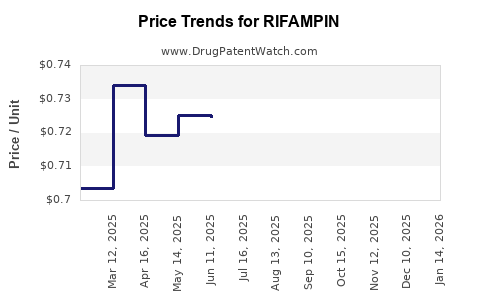
- Price: tends to drift down or remain flat; occasional upticks from supply constraints.
- Mix: shifts between standalone rifampin and FDC products, affecting reported category revenue depending on how customers structure procurement.
Key Takeaways
- Rifampin’s market is structurally generic and tender-driven; financial trajectory is dominated by TB procurement volume and price compression rather than patent-led value capture.
- In the US and other major markets, rifampin’s Orange Book footprint reflects broad generic availability with limited active exclusivity influence on category-level dynamics.
- The main commercial variability comes from supply continuity, tender award timing, and shifts between rifampin standalone and rifampin-containing combination procurement.
- IP and litigation risk is usually product-specific for rifampin-containing combinations or niche formulation claims, not a broad barrier around rifampin itself.
- Planning should treat rifampin as a volume-and-contract instrument with operational margin sensitivity to COGS, regulatory throughput, and supply reliability.
FAQs
1) Why does rifampin category revenue sometimes change without changes in TB incidence?
Tender award cycles, contract renewals, country-specific formulary shifts between standalone rifampin and FDC procurement, and supplier availability can move realized revenue even when underlying incidence is stable.
2) What business lever matters most for rifampin generics: patent position or manufacturing capacity?
For standalone rifampin, manufacturing capacity, batch release reliability, and cost of goods typically dominate; patent leverage is more relevant for specific rifampin-containing combination products.
3) How do fixed-dose combinations change the commercial reporting of rifampin?
When buyers procure an FDC, rifampin demand is embedded in the combo product channel; this can reduce standalone rifampin unit sales while preserving total rifampin consumption.
4) What supply disruptions most affect rifampin earnings?
API shortages, quality system batch rejections, and manufacturing downtime can temporarily concentrate supply among fewer qualified suppliers, shifting pricing and share.
5) Is there a realistic biosimilar competitive threat to rifampin?
No. Rifampin is not a biologic; biosimilar frameworks do not apply.
References (APA)
- FDA. (n.d.). Approved Drug Products with Therapeutic Equivalence Evaluations (Orange Book). U.S. Food and Drug Administration. https://www.accessdata.fda.gov/scripts/cder/daf/
- World Health Organization. (2023). Global tuberculosis report 2023. https://www.who.int/teams/global-tuberculosis-programme/tb-reports
- World Health Organization. (2024). Global tuberculosis report 2024 (if available). https://www.who.int/teams/global-tuberculosis-programme/tb-reports