Share This Page
Drug Sales Trends for vitamin a
✉ Email this page to a colleague
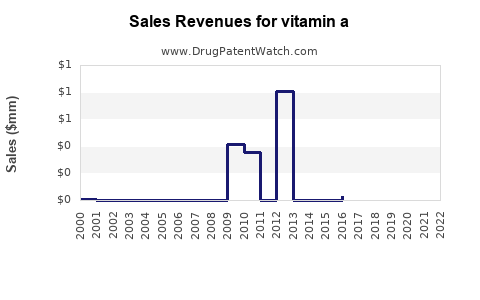
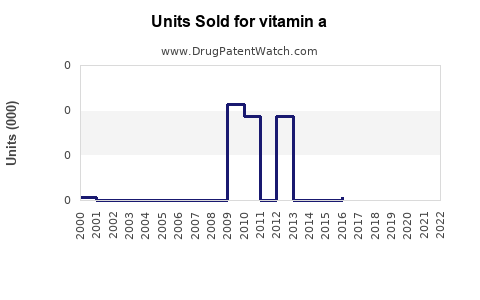
Annual Sales Revenues and Units Sold for vitamin a
| Drug Name | Revenues (USD) | Units | Year |
|---|---|---|---|
| VITAMIN A | ⤷ Start Trial | ⤷ Start Trial | 2022 |
| VITAMIN A | ⤷ Start Trial | ⤷ Start Trial | 2021 |
| VITAMIN A | ⤷ Start Trial | ⤷ Start Trial | 2020 |
| >Drug Name | >Revenues (USD) | >Units | >Year |
Market analysis and sales projections for Vitamin A
Vitamin A is a fat-soluble vitamin critical for vision, immune function, and cellular growth. The market for vitamin A supplements and derived pharmaceuticals is driven by consumer health trends, aging populations, and medical applications such as deficiency treatment and skin health.
Market Overview
The global Vitamin A market reached approximately USD 2.6 billion in 2022. It is projected to grow at a compound annual growth rate (CAGR) of 6% from 2023 to 2030, driven by increased awareness of vitamin deficiencies and expanding applications in both nutraceuticals and pharmaceuticals.
Key Market Segments
- Nutraceuticals and Dietary Supplements: Accounts for ~55% of the market. Consumers with health-conscious behaviors and aging demographics fuel demand.
- Pharmaceuticals: Approximately 25% of the market. Used in deficiency treatments, ocular health, and some dermatological conditions.
- Fortification and Food Products: The remaining 20%. Vitamin A is added to processed foods and infant foods, especially in developing regions.
Regional Market Dynamics
| Region | Market Share (2022) | Growth Rate (2023-2030) | Drivers |
|---|---|---|---|
| North America | 35% | 5-6% | Aging populations, high supplement consumption |
| Europe | 25% | 5-7% | Preventive health, dietary awareness |
| Asia-Pacific | 25% | 6-8% | Large population, increasing nutrition programs, rising income levels |
| Latin America & Caribbean | 8% | 6-7% | Growing health awareness, urbanization |
| Middle East & Africa | 7% | 7-9% | Increasing nutritional deficiencies, fortified food markets |
Competitive Landscape
Major companies include DSM, BASF, Koninklijke DSM N.V., and Chr. Hansen. These firms focus on high-purity beta-carotene and retinol production, investing in sustainable sourcing and supply chain enhancement. The market also sees private label brands and regional players expanding.
Sales Projections (2023-2030)
| Year | Estimated Market Size (USD billion) | Key Factors Influencing Growth |
|---|---|---|
| 2023 | 2.8 | Post-pandemic health awareness, new formulations |
| 2025 | 3.5 | Expansion in emerging markets, product innovation |
| 2027 | 4.4 | Increased fortification efforts, aging populations |
| 2030 | 5.2 | Broader application scope, tech advancements in production |
Drivers of Growth
- Aging Population: Elderly consumers seek vitamin A products for vision and immune support.
- Preventive Healthcare: Consumers increasingly choose supplements as part of wellness routines.
- Developing Countries: Public health initiatives address vitamin deficiency, boosting fortification programs.
- Formulation Innovation: Liposomal and encapsulated forms improve bioavailability and shelf life.
Challenges
- Regulatory Hurdles: Variability in regulations across regions affects formulations and marketing.
- Supply Chain Issues: Sourcing of natural retinol and beta-carotene faced disruptions due to environmental or geopolitical factors.
- Market Saturation: Mature markets experience slow growth, requiring innovation in delivery formats.
Strategic Opportunities
- Development of plant-based, organic, and non-GMO formulations.
- Expansion into emerging markets with fortified foods.
- Innovation in delivery systems to enhance absorption and stability.
Key Takeaways
- The global Vitamin A market is projected to grow at a CAGR of 6% through 2030.
- Nutraceuticals and dietary supplements dominate sales, with increasing demand in Asia-Pacific.
- Growth is driven by aging populations, preventive health trends, and government fortification programs.
- Market players face regulatory and supply chain challenges, but opportunities exist in product innovation and emerging markets.
FAQs
-
What are the main applications ofVitamin A in pharmaceuticals?
Deficiency treatment, ocular health supplements, dermatological formulations. -
How does the demand for natural vs. synthetic Vitamin A compare?
Natural sources like beta-carotene are preferred in organic and clean-label products, but synthetic Vitamin A is more cost-effective and widely used in fortification. -
What regulatory differences impact market growth across regions?
Europe and North America have strict regulations on supplement claims and maximum allowable doses. Emerging markets may have less stringent oversight, facilitating market entry but posing quality control challenges. -
What innovations are shaping the future of Vitamin A products?
Liposomal encapsulation, plant-based sourcing, and biofortified foods optimize absorption and appeal to health-conscious consumers. -
What are the primary challenges facing Vitamin A suppliers?
Supply chain disruptions, regulatory compliance costs, and market saturation in developed economies.
References
- MarketWatch. "Vitamin A Market Size, Share & Trends." 2023.
- Research and Markets. "Global Vitamin A Market Forecast to 2030." 2022.
- Grand View Research. "Nutraceuticals Market Analysis." 2023.
- FAO. "Global Nutrition Outlook." 2021.
- EU Regulations on Food Supplements, 2022.
More… ↓
