Share This Page
Drug Sales Trends for travoprost
✉ Email this page to a colleague
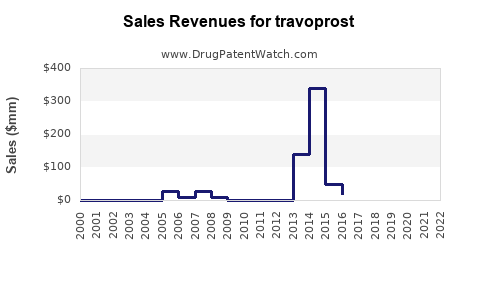
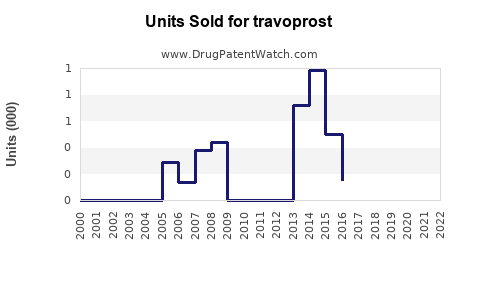
Annual Sales Revenues and Units Sold for travoprost
| Drug Name | Revenues (USD) | Units | Year |
|---|---|---|---|
| TRAVOPROST | ⤷ Start Trial | ⤷ Start Trial | 2022 |
| TRAVOPROST | ⤷ Start Trial | ⤷ Start Trial | 2021 |
| TRAVOPROST | ⤷ Start Trial | ⤷ Start Trial | 2020 |
| TRAVOPROST | ⤷ Start Trial | ⤷ Start Trial | 2019 |
| TRAVOPROST | ⤷ Start Trial | ⤷ Start Trial | 2018 |
| >Drug Name | >Revenues (USD) | >Units | >Year |
Travoprost Market Analysis, Sales Forecast, Patent Position, and Generic Competition
Travoprost is a mature prostaglandin analogue used to lower intraocular pressure in patients with open-angle glaucoma or ocular hypertension. The commercial market has shifted from Alcon’s Travatan and Travatan Z brands to generic travoprost ophthalmic solution. Revenue growth is limited by generic pricing, therapeutic substitution and competition from latanoprost, bimatoprost, tafluprost and fixed-combination glaucoma products.
The global travoprost market is estimated at approximately $180 million to $300 million in 2024 manufacturer revenue, including branded and generic products. A base-case model projects market revenue of $165 million to $275 million by 2029, with unit demand increasing modestly while average selling prices decline. Branded Travatan revenue is likely to remain a small portion of the total market.
What is travoprost and how large is its addressable market?
Travoprost is a synthetic prostaglandin F2-alpha analogue administered as an ophthalmic solution. It lowers intraocular pressure by increasing uveoscleral outflow. The usual concentration is 0.004%, administered once daily.
The principal indications are:
- Open-angle glaucoma
- Ocular hypertension
- Intraocular-pressure reduction as monotherapy or adjunctive therapy
Travoprost competes in a large but mature glaucoma market. Global glaucoma prevalence was estimated at approximately 76 million people in 2020 and is projected to exceed 110 million by 2040, according to the International Agency for the Prevention of Blindness and peer-reviewed epidemiological research.[1][2] Disease prevalence supports long-term demand, but not necessarily revenue growth for travoprost because generic substitution places sustained pressure on prices.
Global market segmentation
| Segment | 2024 estimated revenue | 2029 base-case estimate | Principal growth driver |
|---|---|---|---|
| Generic travoprost | $125 million-$220 million | $125 million-$220 million | Patient volume and broader access |
| Travatan and Travatan Z | $35 million-$60 million | $20 million-$35 million | Brand loyalty and selected markets |
| Combination or institutional supply attributable to travoprost | $20 million-$40 million | $20 million-$30 million | Hospital and public procurement |
| Total travoprost market | $180 million-$300 million | $165 million-$275 million | Stable demand offset by price erosion |
These figures are an analytical market model rather than reported manufacturer sales. Public companies generally do not disclose current travoprost revenue separately after generic entry.
What are the current sales drivers for travoprost?
Travoprost has four commercial advantages: once-daily dosing, established efficacy, broad physician familiarity and availability through generic suppliers. Its weaknesses are generic price competition, preservative-related tolerability concerns for conventional formulations and strong substitution by latanoprost.
Demand drivers
The main demand drivers are:
- Growth in the elderly population, which has a higher prevalence of glaucoma.
- Expansion of diagnosis and treatment in emerging markets.
- Continued use of prostaglandin analogues as first-line pharmacotherapy.
- Increased generic access in the United States and Europe.
- Use in patients who respond inadequately or develop intolerance to another prostaglandin analogue.
The product is not dependent on a narrow specialty-prescriber base. Ophthalmologists, optometrists and general medical providers can prescribe it, which supports volume. The main limitation is that a large share of newly diagnosed patients receive latanoprost because it is typically cheaper and widely available.
Revenue drivers and constraints
Travoprost revenue is more sensitive to price than to prescription growth. Generic ophthalmic products compete through:
- Wholesale acquisition price
- Pharmacy substitution
- Contracting with health systems
- Bottle size and package economics
- Preservative-free or low-preservative positioning
- Supply reliability
In the United States, generic products can capture substantial prescription volume while generating relatively little revenue per bottle. The branded product may retain share in patients with prior clinical response, insurance coverage or preference for the Travatan Z formulation.
What are the sales projections for travoprost from 2025 to 2029?
The following forecast uses a global manufacturer-revenue framework. It assumes stable patient demand, low-single-digit prescription growth, annual generic price erosion and continued brand contraction.
| Year | Low case | Base case | High case | Main assumption |
|---|---|---|---|---|
| 2024 | $180 million | $235 million | $300 million | Baseline estimate |
| 2025 | $172 million | $229 million | $300 million | Price decline offsets volume growth |
| 2026 | $165 million | $223 million | $300 million | Generic competition expands |
| 2027 | $159 million | $218 million | $299 million | Stable treated population |
| 2028 | $154 million | $214 million | $298 million | Lower prices, modest unit growth |
| 2029 | $150 million | $210 million | $300 million | Mature, largely generic market |
The base case implies a compound annual revenue decline of approximately 2% from 2024 to 2029. Unit volume could rise by 2% to 4% annually, but the resulting growth would be offset by lower generic pricing.
Branded sales outlook
A reasonable base-case estimate for Travatan and Travatan Z combined is $35 million to $60 million in 2024 global revenue. By 2029, branded revenue could decline to $20 million to $35 million unless Alcon obtains meaningful reimbursement advantages or expands preservative-free positioning.
The commercial value of the molecule is therefore concentrated in generic volume, not in premium branded pricing.
When did travoprost lose market exclusivity?
Travoprost lost practical market exclusivity in the United States after FDA approval of generic travoprost ophthalmic solution. The product’s principal composition and product-related patent protection did not prevent later generic entry.
Travatan was approved by the FDA in 2001. Travatan Z, the sofZia-preserved formulation, was approved in 2006.[3][4] Generic travoprost products subsequently entered the U.S. market, and multiple suppliers now compete in the 0.004% ophthalmic solution category.
The relevant commercial conclusion is that travoprost is a post-exclusivity product. Future revenue is not protected by the original brand’s regulatory exclusivity.
What is the FDA and Orange Book status of travoprost?
The FDA-approved reference products are Travatan and Travatan Z, both associated with Alcon. Travatan contains travoprost ophthalmic solution 0.004%. Travatan Z uses the sofZia ionic-buffered preservative system rather than benzalkonium chloride.[3][4]
The FDA Orange Book identifies approved drug products and relevant patent or exclusivity information. For a mature product such as travoprost, the key commercial issue is the availability of therapeutically equivalent generic products rather than remaining new-drug exclusivity.[5]
FDA regulatory profile
| Regulatory element | Travoprost status |
|---|---|
| Active ingredient | Travoprost |
| Dosage form | Ophthalmic solution |
| Common strength | 0.004% |
| Reference brands | Travatan; Travatan Z |
| Administration | Once daily |
| Regulatory pathway for generics | Abbreviated New Drug Application |
| Biosimilar pathway | Not applicable |
| Primary post-exclusivity risk | Generic substitution and price compression |
Which companies compete in the travoprost market?
Competition varies by country and changes as suppliers enter or exit. The principal commercial groups include Alcon as the originator-brand company and generic manufacturers such as Viatris, Teva, Apotex, Lupin and other regional ophthalmic-product suppliers, subject to market-specific approvals and supply status.
The most important competitive products are not limited to travoprost.
| Product | Company examples | Competitive position |
|---|---|---|
| Latanoprost | Pfizer, Viatris and other generics | Broadest generic competition and frequent first-line use |
| Bimatoprost | AbbVie/Allergan and generics | Strong efficacy profile; branded Lumigan remains relevant in selected markets |
| Tafluprost | Santen and generics in some markets | Preservative-free differentiation |
| Travoprost | Alcon and generic suppliers | Established once-daily option |
| Netarsudil | Aerie/Alcon | Different mechanism; used in selected refractory cases |
| Fixed combinations | Multiple manufacturers | Reduce administration burden and improve adherence |
Latanoprost is the main price competitor. Bimatoprost competes on intraocular-pressure reduction and brand familiarity. Tafluprost competes through preservative-free formulations and tolerability claims. Fixed combinations can reduce the number of bottles used by patients receiving multiple therapies.
What formulations are protected or commercially differentiated?
The strongest remaining commercial differentiation is formulation-based rather than molecule-based.
Travatan Z uses the sofZia preservative system, which was developed to address ocular-surface tolerability associated with benzalkonium chloride. Conventional travoprost products may use benzalkonium chloride or another preservative, depending on the manufacturer and jurisdiction.
Formulation differentiation may support premium pricing in:
- Patients with ocular-surface disease
- Patients using multiple preserved eye drops
- Patients with intolerance to benzalkonium chloride
- Patients receiving chronic long-term therapy
- Physicians who prefer a particular bottle or delivery system
The formulation advantage does not eliminate generic risk. A generic manufacturer can compete with a comparable formulation, seek approval for an equivalent product or gain share through lower pricing.
Are there method-of-use patents or biosimilar risks for travoprost?
Travoprost is a small molecule, so biosimilar risk does not apply. The relevant threats are generic ANDA filings, therapeutic substitution, formulation competition and potential patent litigation.
Method-of-use patents have limited commercial value because travoprost’s core indications are established and widely known. Any surviving method claims would need to address a specific patient population, dosing schedule, combination or clinical use. Such claims may be difficult to enforce against routine prescriptions unless the generic label directly encourages the patented use.
The principal intellectual-property barriers are:
- Composition-of-matter patents, which are no longer commercially blocking.
- Formulation patents, particularly preservative or stability systems.
- Device or container patents.
- Manufacturing know-how involving sterility, particle control and stability.
- Trademark protection for Travatan and Travatan Z.
What patent litigation and Paragraph IV risks affect travoprost?
Generic entry into a mature topical ophthalmic market can involve Paragraph IV certifications, patent challenges and abbreviated regulatory litigation. For travoprost, the most important litigation period was associated with generic entry and formulation-related patent claims rather than a continuing blockbuster-level patent dispute.
A Paragraph IV certification alleges that a listed patent is invalid, unenforceable or not infringed. A patent-holder suit can trigger a 30-month stay of FDA approval under the Hatch-Waxman framework, subject to statutory conditions.[6]
Current commercial risk is less about a new generic challenge to the original molecule and more about:
- Supplier consolidation
- Manufacturing interruptions
- New preservative-free entrants
- State substitution rules
- Reimbursement exclusions
- Litigation over formulation or labeling claims
How strong is the travoprost patent estate?
The original travoprost patent estate is commercially weak because generic products are already available. Remaining formulation and delivery patents may have value in narrow markets, but they are unlikely to restore molecule-level exclusivity.
| Patent-estate category | Current commercial strength | Revenue impact |
|---|---|---|
| Original active-ingredient protection | Low | Does not block generic supply |
| Core ophthalmic solution claims | Low to moderate | Depends on claim scope and jurisdiction |
| Preservative-system claims | Moderate in selected products | Can support niche differentiation |
| Container or delivery claims | Low to moderate | Limited unless tied to a clinically meaningful advantage |
| Manufacturing know-how | Moderate operational value | Can affect supply quality and cost |
| Trademark rights | Moderate for brand retention | Supports physician and patient recognition |
The principal barrier to entry is now regulatory and operational rather than patent-based. Sterile manufacturing, ophthalmic quality standards, stability and reliable supply can still limit the number of viable competitors.
What licensing deals affect travoprost?
Travoprost was developed and commercialized through legacy ophthalmic pharmaceutical transactions involving Pharmacia, Pfizer and Alcon. Alcon became the principal commercial owner of the Travatan franchise after its acquisition and separation history from Novartis.[7][8]
No current licensing arrangement is likely to materially change the global travoprost market outlook. The product is mature, genericized and relatively small compared with newer ophthalmic assets. Licensing value is more likely to arise from regional distribution, preservative-free formulations or portfolio bundling than from rights to the basic molecule.
What generic launch scenarios exist for travoprost?
Base case
Generic suppliers maintain broad availability. Prescription volume grows slowly, while average selling prices fall by 2% to 5% annually. Travatan retains a small premium segment.
Downside case
Additional generic suppliers enter, payers exclude the brand and low-cost suppliers gain share. Market revenue falls toward $150 million by 2029.
Upside case
Glaucoma diagnosis expands in emerging markets, preservative-free demand increases and supply disruptions affect competing products. Market revenue remains near $300 million, although the majority still accrues to generic manufacturers.
Key Takeaways
- Travoprost is a mature, post-exclusivity glaucoma drug with established global demand.
- Estimated 2024 market revenue is $180 million to $300 million.
- Base-case 2029 revenue is approximately $210 million, reflecting modest volume growth and generic price erosion.
- Travatan and Travatan Z likely account for a declining minority of total revenue.
- Latanoprost is the strongest price competitor; bimatoprost, tafluprost and fixed combinations create additional substitution pressure.
- Biosimilar risk is irrelevant because travoprost is a small molecule.
- Remaining formulation and manufacturing IP can support niche differentiation but is unlikely to restore broad exclusivity.
- Commercial upside depends on geographic expansion, preservative-free positioning and reliable sterile supply rather than on new patent protection.
FAQs
Is travoprost still a profitable drug?
Yes, but profitability is concentrated in efficient generic manufacturing and selected branded or preservative-free segments. The molecule no longer supports the revenue profile of a protected branded drug.
Is Travatan Z better positioned than generic travoprost?
Travatan Z may retain an advantage for patients concerned about ocular-surface tolerability because it uses the sofZia preservative system. That advantage depends on local generic formulation, reimbursement and physician preference.
Does travoprost have higher sales than latanoprost?
Generally, no. Latanoprost has broader generic adoption and stronger first-line positioning in many markets. Travoprost remains a meaningful alternative but usually has lower market share.
Can a company obtain new exclusivity for a travoprost formulation?
Potentially, if a formulation or delivery system satisfies patentability and regulatory requirements. Any resulting exclusivity would likely be narrow and product-specific rather than equivalent to active-ingredient exclusivity.
What is the main investment risk in the travoprost market?
The primary risk is further generic price erosion combined with therapeutic substitution. Supply interruptions, payer restrictions and declining brand loyalty are more material than biosimilar or molecule-level patent risk.
References
- International Agency for the Prevention of Blindness. (2023). The global eye health and vision care agenda. https://www.iapb.org
- Tham, Y. Y., Li, X., Wong, T. Y., Quigley, H. A., Aung, T., & Cheng, C. Y. (2014). Global prevalence of glaucoma and projections of glaucoma burden through 2040. Ophthalmology, 121(11), 2081-2090. https://doi.org/10.1016/j.ophtha.2014.05.013
- U.S. Food and Drug Administration. (2001). Travatan: Prescribing information and approval materials. Drugs@FDA. https://www.accessdata.fda.gov/scripts/cder/daf/
- U.S. Food and Drug Administration. (2006). Travatan Z: Prescribing information and approval materials. Drugs@FDA. https://www.accessdata.fda.gov/scripts/cder/daf/
- U.S. Food and Drug Administration. (2024). Approved drug products with therapeutic equivalence evaluations: Orange Book. https://www.fda.gov/drugs/drug-approvals-and-databases/approved-drug-products-therapeutic-equivalence-evaluations-orange-book
- U.S. Congress. (1984). Drug Price Competition and Patent Term Restoration Act of 1984, Pub. L. No. 98-417.
- Alcon, Inc. (2024). Annual report. https://www.alcon.com/investors
- Novartis AG. (2019). Annual report. https://www.novartis.com/investors/financial-data/annual-report
More… ↓
