Share This Page
Drug Sales Trends for quetiapine fumarate
✉ Email this page to a colleague
Payment Methods and Pharmacy Types for quetiapine fumarate (2022)
Revenues by Pharmacy Type
Units Sold by Pharmacy Type
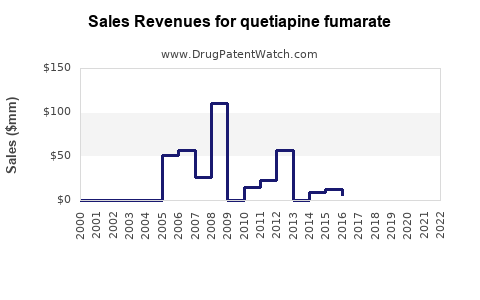
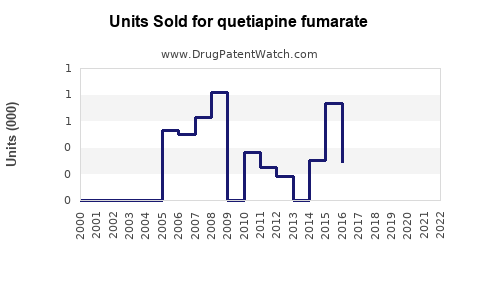
Annual Sales Revenues and Units Sold for quetiapine fumarate
| Drug Name | Revenues (USD) | Units | Year |
|---|---|---|---|
| QUETIAPINE FUMARATE | ⤷ Start Trial | ⤷ Start Trial | 2022 |
| QUETIAPINE FUMARATE | ⤷ Start Trial | ⤷ Start Trial | 2021 |
| QUETIAPINE FUMARATE | ⤷ Start Trial | ⤷ Start Trial | 2020 |
| QUETIAPINE FUMARATE | ⤷ Start Trial | ⤷ Start Trial | 2019 |
| >Drug Name | >Revenues (USD) | >Units | >Year |
Quetiapine Fumarate Market Analysis and Sales Projections
Quetiapine fumarate is a mature, genericized atypical antipsychotic with broad use in schizophrenia, bipolar disorder, and adjunctive treatment of major depressive disorder. The commercial market is large in volume but low in price. Global sales are likely concentrated in generic immediate-release tablets, extended-release tablets, hospital channels, and branded or authorized-generic products in selected markets.
A reasonable base-case estimate places global quetiapine fumarate sales at approximately $1.8 billion to $2.4 billion in 2024, including branded and generic products. The market is projected to reach approximately $2.0 billion to $2.8 billion by 2030, representing low-single-digit annual growth driven by prescription volume, population aging, bipolar-disorder treatment, and continued use in major depressive disorder. These are modeled market estimates, not consolidated manufacturer-reported sales, because generic quetiapine revenue is fragmented across multiple companies and countries.
What is quetiapine fumarate used for?
Quetiapine fumarate is the fumarate salt of quetiapine, an atypical antipsychotic marketed originally as Seroquel and Seroquel XR by AstraZeneca.
The FDA-approved uses include:
| Product | FDA-approved indications |
|---|---|
| Quetiapine immediate release | Schizophrenia; acute manic episodes associated with bipolar I disorder; depressive episodes associated with bipolar disorder |
| Quetiapine extended release | Schizophrenia; bipolar depression; acute mania associated with bipolar I disorder; maintenance treatment of bipolar I disorder as adjunctive therapy; adjunctive treatment of major depressive disorder |
| Generic tablets | Approved indications generally correspond to the reference product and approved abbreviated new drug application labeling |
Quetiapine is also widely used off label for insomnia, anxiety, behavioral symptoms, and other conditions. Off-label use can increase prescription volume, but it also creates safety, reimbursement, and regulatory risks because the strongest commercial protection remains tied to approved indications.
The FDA labeling identifies metabolic changes, somnolence, orthostatic hypotension, tardive dyskinesia, neuroleptic malignant syndrome, and increased mortality risk in elderly patients with dementia-related psychosis among the principal safety considerations.[1][2]
How large is the quetiapine fumarate market?
No single public database captures global revenue for all quetiapine fumarate manufacturers. Generic sales are reported differently by country, product form, and channel. Market sizing therefore requires a bottom-up estimate based on prescription volume, average net price, product mix, and geographic penetration.
Estimated 2024 market by region
| Region | Estimated 2024 sales | Market characteristics |
|---|---|---|
| North America | $650 million-$850 million | High prescription volume; low generic pricing; significant extended-release use |
| Europe | $400 million-$550 million | Strong generic penetration; centralized and reference pricing |
| Asia-Pacific | $500 million-$700 million | Volume growth in China, India, Southeast Asia, and Australia |
| Latin America | $150 million-$225 million | Private-market and institutional demand; uneven generic competition |
| Middle East and Africa | $75 million-$125 million | Smaller base; public procurement and availability drive sales |
| Global total | $1.8 billion-$2.4 billion | Mature, high-volume, low-to-moderate value market |
The United States remains commercially important because of the scale of psychiatric prescribing and the availability of multiple strengths and dosage forms. Unit prices are substantially lower than during the branded Seroquel period, but the market retains value through extended-release products, supply contracts, specialty wholesalers, and high prescription volume.
What are the sales projections for quetiapine fumarate through 2030?
The base case assumes modest prescription growth, continued generic price erosion, stable use in schizophrenia and bipolar disorder, and limited expansion of branded products.
| Year | Bear case | Base case | Bull case |
|---|---|---|---|
| 2024 | $1.8B | $2.1B | $2.4B |
| 2025 | $1.8B | $2.1B | $2.5B |
| 2026 | $1.8B | $2.2B | $2.5B |
| 2027 | $1.9B | $2.2B | $2.6B |
| 2028 | $1.9B | $2.3B | $2.7B |
| 2029 | $1.9B | $2.4B | $2.8B |
| 2030 | $2.0B | $2.4B | $2.9B |
| 2024-2030 CAGR | 1.8% | 2.3% | 3.2% |
The forecast is volume-led. Price increases are unlikely to be the main growth driver because quetiapine has been generic for years in major markets. The bull case depends on continued growth in diagnosed mood disorders, higher treatment duration, and supply disruptions affecting competing generic manufacturers. The bear case assumes greater payer pressure, increased switching to alternative atypical antipsychotics, and further tender-driven price declines.
When did quetiapine lose exclusivity?
Quetiapine lost meaningful U.S. small-molecule exclusivity in stages rather than on one date.
| Milestone | Approximate timing | Commercial effect |
|---|---|---|
| Original Seroquel patent protection | Early 2010s | Generic immediate-release entry became possible |
| U.S. immediate-release generic competition | 2011 onward | Rapid erosion of branded Seroquel revenue |
| Seroquel XR generic competition | Mid-to-late 2010s | Extended-release pricing and share declined |
| Current market | 2024 onward | Predominantly generic and authorized-generic |
AstraZeneca reported substantial Seroquel revenue before generic erosion. Seroquel was one of the company’s largest products, with annual sales exceeding $4 billion before broad generic substitution reduced branded revenue.[3] The loss of exclusivity shifted the commercial opportunity from originator pricing to manufacturing scale, supply reliability, formulation differentiation, and tender access.
What products and formulations are protected or commercially differentiated?
Quetiapine is sold mainly in two oral dosage forms.
Immediate-release tablets
Immediate-release tablets are available in multiple strengths, commonly including 25 mg, 50 mg, 100 mg, 200 mg, 300 mg, and 400 mg, subject to market-specific approvals. They are used for schizophrenia and bipolar disorder and are the most commoditized portion of the market.
Competition is based primarily on:
- Cost of active pharmaceutical ingredient
- Tablet manufacturing capacity
- Regulatory approvals across strengths
- Wholesaler and pharmacy distribution
- Supply continuity
- Tender pricing
Extended-release tablets
Extended-release quetiapine, originally marketed as Seroquel XR, provides once-daily dosing and has historically supported higher net prices than immediate-release tablets. Generic extended-release products compete through formulation performance, bioequivalence, manufacturing controls, and availability across strengths.
Extended-release products retain commercial value because:
- They can reduce dosing frequency.
- They have distinct prescription and substitution dynamics.
- Manufacturing complexity is higher than for conventional immediate-release tablets.
- Fewer reliable suppliers may remain in some markets.
The main intellectual-property risk for new entrants is less likely to involve the basic quetiapine molecule and more likely to involve release profiles, manufacturing processes, crystallinity, impurities, tablet composition, and bioequivalence strategy.
What is the Orange Book status of quetiapine fumarate?
The FDA Orange Book lists approved quetiapine products and associated patents or exclusivity information for reference-listed products where applicable.[4] The original Seroquel and Seroquel XR patent estates no longer provide broad commercial exclusivity against ordinary generic entry in the United States.
The practical Orange Book position is:
- Immediate-release quetiapine has extensive generic competition.
- Extended-release quetiapine has generic competition.
- Remaining listed patents, where applicable, are more likely to affect specific formulations or claims than the entire molecule.
- Approved generic products may rely on Paragraph III certifications, Paragraph IV certifications, or other certification pathways depending on the patents listed at the time of filing.
- Orange Book listings should be reviewed by product strength and dosage form because patent coverage may not be uniform.
For investors and licensing teams, the relevant question is not whether quetiapine has patents in the abstract. It is whether a listed patent covers the specific strength, release profile, formulation, or method of use targeted by a proposed product.
Which companies compete in quetiapine fumarate?
Competition is fragmented and varies by country. Major or historically significant suppliers include:
- Teva Pharmaceuticals
- Sandoz
- Viatris
- Dr. Reddy’s Laboratories
- Lupin
- Zydus Lifesciences
- Sun Pharmaceutical Industries
- Torrent Pharmaceuticals
- Accord Healthcare
- Apotex
- Hikma Pharmaceuticals
- Cipla
- Aurobindo Pharma
- Alembic Pharmaceuticals
- Endo and related generic businesses in selected periods
The commercial leaders differ by market. In the United States, pharmacy benefit manager formularies and wholesaler contracts can shift share quickly. In Europe, national reimbursement tenders and reference pricing are more important. In India and other emerging markets, branded-generic promotion remains more relevant than in the United States.
Which companies are challenging quetiapine patents?
Quetiapine has been the subject of historic generic patent challenges associated with the loss of Seroquel and Seroquel XR exclusivity. Generic applicants typically pursued abbreviated new drug applications and challenged listed patents through Paragraph IV certifications where patents were considered blocking.
The most commercially important challenges occurred before and during the introduction of generic immediate-release and extended-release products. Because the core product is now mature and broadly genericized, current competitive risk is more likely to arise from:
- New formulation patents
- Abuse-deterrent or modified-release concepts
- Combination products
- Manufacturing patents
- Jurisdiction-specific secondary patents
- Regulatory exclusivity for a new indication or delivery system
Publicly visible litigation should be evaluated case by case. The existence of historic litigation does not imply that a current quetiapine product has enforceable blocking rights.
What patent litigation and settlement issues affect quetiapine?
The major litigation phase involved AstraZeneca’s efforts to protect Seroquel and Seroquel XR from generic competition. Claims generally centered on formulation, extended release, patent validity, infringement, and generic entry timing.
A generic settlement can affect:
- Authorized-generic launch timing
- First-filer commercial rights
- Potential launch dates
- Patent-term economics
- Supply arrangements
- Geographic commercialization rights
For a current commercial assessment, historic Seroquel settlements have limited value unless they contain continuing restrictions, supply commitments, or rights relevant to a particular jurisdiction. Generic entry has already occurred broadly, so litigation risk is concentrated in follow-on products rather than standard quetiapine tablets.
How strong is the quetiapine patent estate?
The broad molecule-level patent estate is weak from a commercial-exclusivity perspective because quetiapine has been genericized for more than a decade in major markets.
| Patent category | Current strength |
|---|---|
| Core active ingredient | Low |
| Immediate-release tablet | Low |
| Extended-release formulation | Low to moderate, depending on claim scope and jurisdiction |
| Manufacturing process | Moderate in narrow circumstances |
| New indication | Potentially moderate, but vulnerable to label and use restrictions |
| Combination product | Potentially moderate to strong if clinically differentiated |
| Novel delivery system | Potentially strong if supported by robust clinical and patent claims |
The strongest remaining barriers are technical and regulatory rather than molecule-level patent barriers. A company seeking to commercialize a differentiated quetiapine product would need a defensible formulation, reliable bioequivalence data, manufacturing controls, and a reimbursement argument.
What generic launch risks exist for quetiapine fumarate?
Generic launch risk is moderate for conventional tablets and higher for extended-release formulations.
Immediate-release launch risks
- Intense price competition
- Low barriers to substitution
- Numerous approved suppliers
- API price volatility
- Inventory write-downs after tender losses
- FDA inspection or warning-letter exposure
- Pharmacy substitution and formulary displacement
Extended-release launch risks
- More difficult bioequivalence development
- Greater batch-failure risk
- Limited manufacturing sites
- Formulation-related patent claims
- Higher product liability sensitivity
- Need for consistent release performance
- Greater dependence on stable commercial contracts
Supply interruptions can create short-lived pricing opportunities, but these are difficult to underwrite as durable revenue. Generic profitability depends on cost position, manufacturing utilization, and the number of qualified competitors.
What is the biosimilar risk for quetiapine?
There is no biosimilar pathway risk because quetiapine fumarate is a chemically synthesized small-molecule drug, not a biologic. The relevant competitive threat is generic substitution, not biosimilar interchangeability.
Generic competition is more direct than biosimilar competition because approved abbreviated new drug applications can be therapeutically substitutable when FDA requirements are met. This limits pricing power for both immediate-release and extended-release products.
How does quetiapine compare with competing antipsychotics?
| Drug | Commercial status | Main competitive position |
|---|---|---|
| Quetiapine | Mature generic | Broad indication set; sedation and metabolic liabilities |
| Risperidone | Mature generic | Low-cost oral and long-acting injectable competition |
| Olanzapine | Mature generic | Strong efficacy; metabolic safety concerns |
| Aripiprazole | Generic, with long-acting products | Lower sedation profile; long-acting injection opportunity |
| Lurasidone | Generic in many markets | Bipolar depression positioning; historically differentiated food requirement |
| Cariprazine | Branded in major markets | Newer product with bipolar and schizophrenia positioning |
| Lumateperone | Branded in major markets | Differentiated mechanism and tolerability positioning |
| Brexpiprazole | Branded and partnered markets | Schizophrenia and adjunctive depression positioning |
Quetiapine’s advantages are broad labeling, physician familiarity, multiple strengths, and low generic cost. Its disadvantages include sedation, weight gain, metabolic effects, and competition from newer agents with differentiated tolerability or long-acting delivery.
What licensing and partnering opportunities exist?
Licensing value is limited for standard quetiapine tablets because the product is widely available. More credible opportunities include:
- Regional rights for extended-release quetiapine
- Authorized-generic supply agreements
- Novel fixed-dose combinations
- Long-acting or depot delivery systems
- Pediatric or geriatric formulations
- Abuse-deterrent formulations
- Manufacturing technology that reduces cost or improves release consistency
- Distribution rights in markets with limited generic penetration
A licensing transaction should be evaluated on net price, manufacturing cost, regulatory status, minimum purchase commitments, exclusivity duration, and substitution rules. Rights to ordinary immediate-release tablets generally have low strategic value unless paired with a low-cost API and a strong regional distribution network.
What are the key revenue drivers through 2030?
The principal revenue drivers are:
- Growth in diagnosed bipolar disorder and major depressive disorder.
- Continued use in schizophrenia maintenance therapy.
- Expansion of generic access in emerging markets.
- Stable prescription duration among chronic users.
- Supply consolidation among generic manufacturers.
- Commercial uptake of extended-release products.
- Potential reformulation into differentiated delivery systems.
The principal downside risks are:
- Further generic price erosion
- Generic manufacturer consolidation
- Reduced off-label prescribing
- Increased scrutiny of sedating antipsychotic use
- Safety-driven treatment switching
- Payer preference for lower-cost alternatives
- Manufacturing disruptions or regulatory actions
Key Takeaways
- Quetiapine fumarate is a mature, high-volume generic antipsychotic market.
- Estimated global sales were approximately $1.8 billion to $2.4 billion in 2024.
- Base-case global sales are projected to reach about $2.4 billion by 2030.
- Growth is expected to come from volume, emerging markets, and extended-release products rather than price expansion.
- Core molecule and immediate-release patent protection are commercially weak.
- Extended-release formulations and manufacturing processes retain the strongest potential for defensible differentiation.
- Generic substitution, not biosimilar competition, is the central competitive risk.
- Standard quetiapine tablets have limited licensing value unless supported by cost leadership or regional distribution advantages.
- A differentiated delivery system or combination product could support higher margins than ordinary generic tablets.
FAQs
What was Seroquel’s peak annual revenue?
Seroquel generated more than $4 billion in annual sales before broad generic competition materially reduced AstraZeneca’s branded revenue.[3]
Is quetiapine fumarate still under patent?
The basic quetiapine molecule and conventional tablets are no longer protected by broad, commercially meaningful exclusivity in major markets. Narrow formulation or process patents may still affect specific products.
Is quetiapine fumarate a high-growth drug market?
No. It is a mature market with expected low-single-digit growth, primarily from prescription volume and geographic expansion.
Which quetiapine formulation has the greatest commercial value?
Extended-release quetiapine generally has greater commercial value than immediate-release tablets because formulation development and manufacturing are more complex and competition can be less commoditized.
Can quetiapine fumarate support a new branded product?
A new branded product would require meaningful differentiation, such as a novel delivery system, improved tolerability, combination therapy, or a clinically valuable new indication. Ordinary quetiapine tablets would have limited pricing power.
References
-
U.S. Food and Drug Administration. (2024). Seroquel (quetiapine fumarate) prescribing information. FDA.
-
U.S. Food and Drug Administration. (2024). Seroquel XR (quetiapine fumarate) extended-release tablets prescribing information. FDA.
-
AstraZeneca PLC. (2012). Annual report and form 20-F 2011. AstraZeneca.
-
U.S. Food and Drug Administration. (2024). Approved drug products with therapeutic equivalence evaluations: Orange Book. FDA.
More… ↓
