Drug Sales Trends for pseudoephedrine hydrochloride
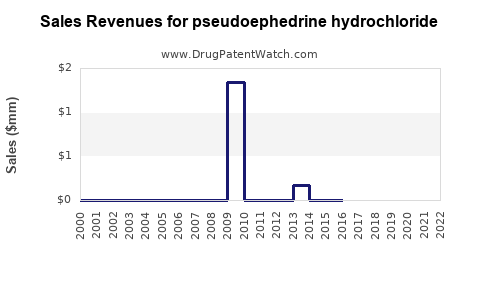

Annual Sales Revenues and Units Sold for pseudoephedrine hydrochloride
| Drug Name | Revenues (USD) | Units | Year |
|---|---|---|---|
| PSEUDOEPHEDRINE HYDROCHLORIDE | ⤷ Start Trial | ⤷ Start Trial | 2022 |
| PSEUDOEPHEDRINE HYDROCHLORIDE | ⤷ Start Trial | ⤷ Start Trial | 2021 |
| PSEUDOEPHEDRINE HYDROCHLORIDE | ⤷ Start Trial | ⤷ Start Trial | 2020 |
| >Drug Name | >Revenues (USD) | >Units | >Year |
Pseudoephedrine hydrochloride is a mature, largely generic oral decongestant with stable underlying demand, seasonal volume spikes, and limited patent protection. U.S. sales are constrained by purchase restrictions, methamphetamine-prevention controls, and competition from phenylephrine, intranasal products, antihistamine combinations, and non-drug remedies. The strongest near-term growth scenario is modest unit expansion from regulatory pressure against oral phenylephrine, while revenue growth depends mainly on price, product mix, and supply availability.
Pseudoephedrine Hydrochloride Market Analysis and Sales Projections
What is the market outlook for pseudoephedrine hydrochloride?
Pseudoephedrine hydrochloride has a defensive market position because it remains an established systemic nasal decongestant with a long history of consumer use. Its main commercial advantages are recognized efficacy, broad generic availability, and inclusion in combination cold products.
The U.S. market is structurally mature:
- Demand is seasonal and strongest during fall and winter respiratory illness periods.
- Most products are generic or private-label.
- Retail purchases are subject to identification, transaction logging, and quantity limits.
- Supply is exposed to precursor-control rules and pharmacy inventory policies.
- Brand pricing is higher than generic pricing, but brand products retain recognition and shelf value.
- The market is fragmented across tablets, extended-release tablets, liquid products, and combination cold remedies.
Public company filings generally do not report pseudoephedrine hydrochloride revenue as a separate line item. Sales are usually aggregated into broader consumer-health, cough-cold, respiratory, or pharmacy categories. A practical projection therefore requires an indexed forecast rather than a single verified global revenue figure.
Base-case market forecast
The following index uses 2024 market value as 100 and assumes no major change in U.S. federal quantity limits, no broad prescription conversion, and continued generic supply.
| Year | Bear case | Base case | Bull case |
|---|---|---|---|
| 2024 | 100 | 100 | 100 |
| 2025 | 98 | 103 | 108 |
| 2026 | 97 | 105 | 113 |
| 2027 | 96 | 107 | 118 |
| 2028 | 95 | 109 | 123 |
| 2029 | 94 | 111 | 128 |
| 2030 | 93 | 113 | 133 |
| 2024-2030 CAGR | -1.2% | 2.1% | 4.9% |
The base case assumes low-single-digit nominal growth, driven by inflation, premium extended-release products, and modest substitution away from oral phenylephrine. Unit demand is likely to be flatter than dollar sales because generic competition limits price expansion.
How large is the pseudoephedrine hydrochloride market?
The most commercially relevant market is the retail U.S. oral decongestant segment. Pseudoephedrine hydrochloride is sold through:
- Single-ingredient immediate-release tablets.
- Extended-release tablets, commonly marketed as 12-hour or 24-hour products.
- Combination products with acetaminophen, ibuprofen, antihistamines, cough suppressants, or expectorants.
- Liquid formulations, which have a smaller adult market but remain relevant in pediatric and family products.
- Pharmacy and private-label products sold under retailer brands.
The market’s revenue pool is larger than the single-ingredient pseudoephedrine segment because combination products capture a substantial share of cold and flu purchases. A sales analysis that counts only “pseudoephedrine hydrochloride” labeled products will understate the economic exposure of manufacturers that sell broader cold medicines.
Market segmentation
| Segment | Commercial position | Growth outlook |
|---|---|---|
| Immediate-release tablets | Highly generic, price competitive | Flat to slightly declining |
| Extended-release tablets | Higher price and convenience | Low-single-digit growth |
| Combination cold products | Larger basket value and brand visibility | Stable, seasonal growth |
| Liquid products | Smaller, family-oriented segment | Flat |
| Store brands | Strong price advantage | Gains share during inflation |
| Branded products | Retain recognition and premium pricing | Stable value, weaker unit growth |
What is driving pseudoephedrine hydrochloride sales?
Oral phenylephrine regulatory pressure
The FDA proposed removing oral phenylephrine from the over-the-counter monograph after concluding that available data did not support its effectiveness as an oral nasal decongestant at the permitted dosage. The proposal does not apply to pseudoephedrine hydrochloride, which creates a potential substitution opportunity for pseudoephedrine products (FDA, 2023).
If oral phenylephrine products are reformulated, relabeled, or removed, manufacturers may shift consumers toward:
- Pseudoephedrine hydrochloride.
- Intranasal oxymetazoline.
- Saline sprays.
- Combination products using alternative active ingredients.
The substitution effect will be limited by pseudoephedrine’s behind-the-counter status and by consumers’ preference for products that do not require pharmacy interaction.
Seasonal respiratory demand
Cold, influenza, and other respiratory illness cycles create substantial quarterly volatility. Pseudoephedrine sales typically rise during periods of elevated congestion-related self-care demand. Retailers and manufacturers must manage inventory around uncertain winter illness patterns, which can produce short-term stockouts or markdowns.
Consumer preference for extended-release products
Extended-release tablets support higher price points because they reduce dosing frequency. The format also gives manufacturers more room for brand differentiation than standard immediate-release tablets, although the active ingredient itself remains commoditized.
Retailer private-label expansion
Private-label products compete aggressively with branded Sudafed and other national brands. Pharmacy chains, mass retailers, grocery retailers, and online sellers can use store-brand pseudoephedrine to capture value-conscious consumers. This tends to increase unit availability while reducing average selling prices.
How does pseudoephedrine compare with phenylephrine?
Pseudoephedrine hydrochloride has a stronger regulatory and clinical position as an oral decongestant than oral phenylephrine under the FDA’s recent review framework. Phenylephrine has greater retail convenience because it is not subject to the same federal purchase controls.
| Factor | Pseudoephedrine hydrochloride | Oral phenylephrine |
|---|---|---|
| Oral decongestant status | Established OTC ingredient | FDA proposed removal from OTC monograph |
| Purchase controls | Behind-the-counter restrictions | Generally unrestricted OTC sale |
| Consumer access | Requires pharmacy or controlled-retail process | Open shelf |
| Efficacy position | More commercially defensible | Regulatory pressure after FDA review |
| Generic competition | Extensive | Extensive |
| Substitution potential | Beneficiary if phenylephrine exits | At risk of reformulation or withdrawal |
| Revenue outlook | Stable to modest growth | Downside risk |
Pseudoephedrine is likely to gain share in the oral decongestant category if phenylephrine loses monograph eligibility. That gain will not necessarily translate into equivalent manufacturer revenue because generic competition and store-brand substitution can compress pricing.
What is the FDA regulatory status of pseudoephedrine hydrochloride?
Pseudoephedrine hydrochloride is an established OTC active ingredient under the FDA’s nasal decongestant framework. The FDA’s OTC monograph system permits qualifying products to be marketed without a product-specific new drug application when they comply with applicable conditions, including active ingredient, dosage, labeling, and formulation requirements (FDA, 2024a).
Key regulatory conditions include:
- Compliance with the OTC monograph or an applicable approved application.
- Required warnings and directions.
- Dosage limits for adults and children.
- Restrictions applicable to combination products.
- Manufacturing compliance under current good manufacturing practice requirements.
- Controlled-precursor obligations under federal and state law.
Manufacturers introducing materially different formulations, delivery systems, or claims may face additional regulatory requirements.
What are the U.S. pseudoephedrine purchase limits?
Under the Combat Methamphetamine Epidemic Act, federal retail controls generally limit pseudoephedrine purchases to:
- 3.6 grams per purchaser per day.
- 9 grams per purchaser during a 30-day period for retail purchases.
- 7.5 grams during a 30-day period for mail-order purchases.
Retail sellers must maintain transaction records and verify purchaser identity. State laws can impose stricter controls, electronic tracking, or prescription requirements (DEA, 2024; U.S. Congress, 2005).
These rules reduce misuse risk but also create commercial friction. Consumers may select phenylephrine, intranasal products, or non-drug alternatives to avoid the purchase process.
What is the patent and exclusivity position for pseudoephedrine hydrochloride?
Pseudoephedrine hydrochloride has no meaningful composition-of-matter exclusivity. The active ingredient is long established, and generic manufacturers can produce standard immediate-release products without facing a molecule patent barrier.
Formulation patents
Potential intellectual-property protection is concentrated in:
- Extended-release matrices.
- Abuse-deterrent delivery systems.
- Combination products.
- Tablet architecture.
- Manufacturing processes.
- Packaging and dosing systems.
These rights generally protect a specific product architecture rather than pseudoephedrine hydrochloride itself. Their commercial impact depends on whether the protected formulation has meaningful market share and whether alternative formulations can be designed around the claims.
Orange Book status
Standard monograph-compliant OTC pseudoephedrine products are not dependent on a single branded NDA with broad Orange Book protection. An approved application may have product-specific listings, but the ordinary generic market is not controlled by one dominant patent estate.
The principal entry barriers are regulatory compliance, controlled-precursor procurement, quality systems, retailer acceptance, and reliable supply. Patent litigation is a secondary risk compared with ordinary generic competition.
Which companies compete in the pseudoephedrine hydrochloride market?
The competitive landscape includes national consumer-health brands, generic pharmaceutical manufacturers, contract manufacturers, pharmacy chains, and mass retailers.
Relevant commercial participants include:
- Kenvue, through the Sudafed brand in the U.S.
- Perrigo, through private-label and consumer-health products.
- Teva Pharmaceutical Industries.
- Major Pharmaceuticals and other generic suppliers.
- CVS Health and other pharmacy retailers.
- Walmart, Walgreens, and grocery retailers with store-brand offerings.
- Contract manufacturers supplying retailer and private-label products.
Brand ownership and manufacturing arrangements vary by country and product. Retailer-controlled brands can change suppliers without changing the consumer-facing label, which makes manufacturing share difficult to measure from public information.
What generic entry risks exist for pseudoephedrine hydrochloride?
Generic entry risk is high because the active ingredient is mature and multiple manufacturers can supply comparable dosage forms. The main risks are commercial rather than patent-based.
High-risk areas
- Immediate-release tablets.
- Standard-dose store-brand products.
- Common combination products.
- Products with limited formulation differentiation.
Moderate-risk areas
- 12-hour and 24-hour extended-release tablets.
- Products requiring specialized release testing.
- Products with retailer-specific packaging or supply agreements.
Higher-barrier areas
- Abuse-deterrent systems.
- Complex controlled-release technologies.
- Products supported by proprietary manufacturing know-how.
- Formulations with established retailer contracts and high service-level requirements.
A new entrant is more likely to compete through cost, supply reliability, private-label contracting, and manufacturing scale than through patent differentiation.
What manufacturing and supply-chain barriers affect sales?
Pseudoephedrine is a controlled precursor, so manufacturers and distributors face tighter compliance requirements than ordinary OTC ingredients. Procurement, storage, shipment, recordkeeping, and customer verification can affect working capital and supply continuity.
Commercial barriers include:
- Precursor-control licenses and registrations.
- Supplier qualification.
- Batch testing and stability data.
- Retailer authorization.
- Inventory controls.
- State-level electronic tracking requirements.
- Seasonal demand forecasting.
- Exposure to import and customs controls.
Supply disruptions can create temporary pricing power for manufacturers with inventory, but sustained price increases are difficult because retailers can shift volume among approved suppliers.
What is the likely generic launch scenario?
A typical new generic entrant would likely follow one of three strategies:
Low-cost immediate-release launch
This approach targets pharmacy chains, wholesalers, and private-label contracts. It has the lowest development burden but the highest price competition.
Extended-release launch
This approach supports a higher average selling price and stronger shelf differentiation. It requires more extensive formulation, stability, and release-profile work.
Combination-product launch
This approach increases basket value but creates more regulatory, labeling, and supply-chain complexity. It also exposes the manufacturer to competition from established branded cold remedies.
The most credible commercial launch path is a private-label or contract-manufacturing agreement rather than a new national consumer brand.
How strong is the commercial outlook through 2030?
The base-case outlook is stable with modest nominal growth. The market does not have the characteristics of a high-growth specialty pharmaceutical category. It has predictable recurring demand, but limited pricing power and high generic substitution.
Revenue projection by scenario
| Scenario | Primary assumptions | 2030 value versus 2024 |
|---|---|---|
| Bear | Oral phenylephrine remains available, weak respiratory seasons, increased private-label discounting | 93 |
| Base | Modest phenylephrine substitution, stable access rules, low-single-digit price growth | 113 |
| Bull | Broad phenylephrine withdrawal, strong respiratory demand, premium extended-release mix | 133 |
The bull case requires regulatory-driven category migration and favorable product mix. It does not imply equivalent growth in pseudoephedrine units because the market remains mature.
Key Takeaways
- Pseudoephedrine hydrochloride is a mature, generic-heavy OTC market with stable demand.
- U.S. revenue growth is more likely to come from price and mix than from unit expansion.
- FDA action against oral phenylephrine creates the strongest identifiable upside driver.
- Federal purchase restrictions limit convenience and cap some demand migration.
- Immediate-release products face severe commodity pricing pressure.
- Extended-release and combination products offer better revenue economics.
- Patent risk is limited for the active ingredient; formulation and manufacturing rights have narrower relevance.
- The base-case 2024-2030 revenue index is approximately 100 to 113, equivalent to about 2.1% annual growth.
- A new entrant is more likely to win through cost, supply reliability, and private-label contracts than through brand investment.
- Regulatory controls and precursor supply compliance are more important barriers than molecule-level patent exclusivity.
FAQs
Is pseudoephedrine hydrochloride still an OTC drug?
Yes. It remains available as an OTC decongestant in the United States, but products are generally sold behind the pharmacy counter or through controlled retail processes.
Does pseudoephedrine hydrochloride have a new drug patent?
The active ingredient is long established and does not have meaningful composition-of-matter exclusivity. Any relevant patent exposure is more likely to involve extended-release, abuse-deterrent, combination, or manufacturing technology.
Will FDA action against oral phenylephrine increase pseudoephedrine sales?
It could increase pseudoephedrine demand if phenylephrine products are removed or reformulated. The revenue benefit will be moderated by generic competition, store-brand substitution, and consumers switching to intranasal products.
Is Sudafed the only major pseudoephedrine brand?
No. Sudafed is a leading branded product, but generic manufacturers, pharmacy chains, mass retailers, and private-label suppliers account for substantial market activity.
What is the biggest risk to pseudoephedrine hydrochloride manufacturers?
The largest risks are generic price competition, purchase restrictions, controlled-precursor compliance, supply interruptions, and retailer substitution among approved suppliers.
References
-
Drug Enforcement Administration. (2024). Retail sales of pseudoephedrine, ephedrine, and phenylpropanolamine. U.S. Department of Justice.
-
U.S. Congress. (2005). Combat Methamphetamine Epidemic Act of 2005, Pub. L. No. 109-177, Title VII.
-
U.S. Food and Drug Administration. (2023). FDA proposes to remove oral phenylephrine from OTC monograph. U.S. Department of Health and Human Services.
-
U.S. Food and Drug Administration. (2024a). Over-the-counter monograph M012: Cold, cough, allergy, bronchodilator, and anti-asthmatic drug products. U.S. Department of Health and Human Services.
-
U.S. Food and Drug Administration. (2024b). Drug products marketed under the OTC monograph system. U.S. Department of Health and Human Services.
More… ↓
