You're using a free limited version of DrugPatentWatch: Upgrade for Complete Access

Last Updated: March 26, 2026

Drug Sales Trends for oxycodone


✉ Email this page to a colleague

« Back to Dashboard


Payment Methods and Pharmacy Types for oxycodone (2022)

Revenues by Pharmacy Type

Pharmacy Type Revenues
MAIL-ORDER $8,487,621
INSIDE ANOTHER STORE $111,464,000
[disabled in preview] $160,046,350
This preview shows a limited data set
Subscribe for full access, or try a Trial

Units Sold by Pharmacy Type

Pharmacy Type Units
MAIL-ORDER 589,764
INSIDE ANOTHER STORE 2,967,393
[disabled in preview] 5,445,713
This preview shows a limited data set
Subscribe for full access, or try a Trial

Revenues by Payment Method

Payment Method Revenues
MEDICAID $16,879,132
MEDICARE $72,628,887
[disabled in preview] $190,489,953
This preview shows a limited data set
Subscribe for full access, or try a Trial
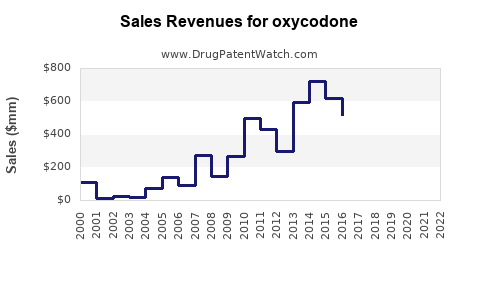
Drug Sales Revenue Trends for oxycodone
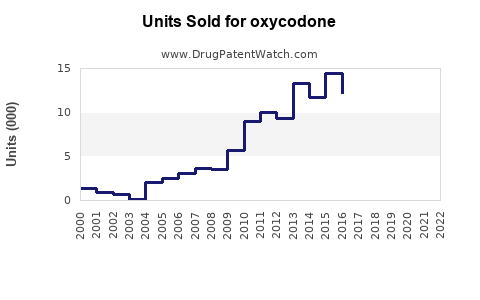
Drug Units Sold Trends for oxycodone

Market Analysis and Sales Projections for Oxycodone

Last updated: February 20, 2026

Oxycodone, a semi-synthetic opioid analgesic, is prescribed for moderate to severe pain. It is widely used for both acute and chronic pain management but faces regulatory and market pressures due to its potential for abuse and addiction. This document analyzes the market landscape and provides sales projections based on current trends, regulatory changes, and industry developments.

Market Overview

Current Market Size

The global opioid analgesics market was valued at approximately USD 26 billion in 2022. Oxycodone contributed a significant share, with an estimated global sales volume of 15 million prescriptions in 2022, equating to roughly USD 8 billion in revenue.

Key Market Players

  • Purdue Pharma (OxyContin)
  • Teva Pharmaceuticals
  • Endo International
  • Allergan (rebranded as AbbVie)
  • Mylan (now part of Viatris)
  • Pacira BioSciences (Exparel, alternative modality)

Geographic Distribution

Region Market Share Notes
North America 75% Major market, high prescribing rates, regulatory scrutiny increasing
Europe 15% Growing market, with some countries tightening prescription controls
Asia-Pacific 8% Emerging, but limited due to regulatory and cultural factors
Rest of the World 2% Minimal presence

Regulatory Environment

U.S. Food and Drug Administration (FDA) stricter controls since 2010, including scheduling changes, surveillance, and prescribing guidelines. The UK and European countries implement risk mitigation strategies, including Prescription Drug Monitoring Programs (PDMPs).

Market Drivers

  • Rising prevalence of chronic pain conditions.
  • Aging populations in developed countries.
  • Advances in pain management protocols favoring opioids under controlled circumstances.
  • Limited development of alternative pain management therapies.

Market Constraints

  • Increased regulation and prescribing restrictions.
  • Growing awareness of opioid abuse and dependence.
  • Competition from non-opioid analgesics and emerging modalities.
  • Legal liabilities and litigation related to opioid misuse.

Sales Projections (2023-2028)

Assumptions

  • Moderate growth rate of 3-5% annually in North America, driven by aging demographics and chronic pain prevalence.
  • European market growth at 2-3%, hindered by regulatory restraints.
  • Limited growth in Asia-Pacific, approximately 1-2%, due to cultural factors and regulatory barriers.
  • The impact of ongoing legal actions may influence sales trajectories, especially in North America.

2023-2028 Sales Forecast

Year Estimated Global Revenue (USD billion) Comments
2023 8.2 Slight growth, stabilization after pandemic disruption
2024 8.5 Continued increment, possibly influenced by new formulations
2025 8.8 Market maturity, with steady prescription rates
2026 9.2 Slight acceleration, driven by aging population
2027 9.6 Increased scrutiny may temper growth, offset by demand
2028 10.0 Market approaches USD 10 billion milestone

Factors Influencing Sales

  • Approval of reformulated or abuse-deterrent formulations could sustain sales.
  • Regulatory tightening or crackdowns can inhibit sales growth.
  • Litigation outcomes may influence prescribing practices and market size.
  • Adoption of alternative pain therapies could reduce opioid reliance.

Competitive Landscape

Company Estimated Market Share (2022) Key Products Notable Moves
Purdue Pharma 30% OxyContin Restructuring after bankruptcy, focus on abuse-deterrent formulations
Teva Pharmaceuticals 20% Generic oxycodone Expanding biosimilar offerings
Endo International 15% Morphine, oxycodone Focus on branded formulations with abuse-deterrent properties
Others 35% Various Increasing generic presence, price competition

Key Trends

  • Shift toward abuse-deterrent formulations to counteract misuse.
  • Growing genericization reduces revenue per prescription.
  • Increased medical oversight, possibly limiting prescription volumes.
  • Vertical integration and licensing of formulations for specific markets.

Key Challenges

  • Regulatory risk leading to formulation restrictions or scheduling reclassifications.
  • Legal liabilities from ongoing lawsuits, affecting market stability and company valuations.
  • Public and governmental push toward alternative pain management strategies.
  • Market saturation in developed countries, limiting growth potential.

Conclusions

Oxycodone remains a significant revenue generator within the opioid analgesics market. Market growth is expected to stabilize around 4% annually until 2028, primarily driven by aging populations and chronic pain prevalence. Regulatory and societal pressures will continue to shape sales, with reforms favoring abuse-deterrent formulations and alternative therapies.

Key Takeaways

  • The global oxycodone market was worth about USD 8 billion in 2022, with steady but restrained growth projections.
  • North America dominates sales due to high prescription rates, but faces increasing regulatory restrictions.
  • Advances in abuse-deterrent formulations are vital to market sustainability.
  • Legal and societal factors pose ongoing risks to sales stability.
  • Market maturation and generics may pressure unit prices and profit margins.

FAQs

Q1: How will regulatory changes impact oxycodone sales in the next five years?
A: Stricter regulations tend to reduce prescription volumes, limiting sales growth. The industry may counter with abuse-deterrent formulations, which can sustain or slightly increase revenue.

Q2: What role do abuse-deterrent formulations play in the market?
A: They serve as a compliance and safety measure, helping companies avoid legal liabilities and maintain market share in a more restrictive environment.

Q3: How significant is the generic market for oxycodone?
A: Generics account for over 50% of prescriptions, pressuring branded product revenues but expanding overall market reach.

Q4: Are alternative pain therapies a threat to oxycodone?
A: Yes. The development and approval of non-opioid analgesics and interventional procedures could reduce demand over time.

Q5: What are the main risks for investors in the oxycodone market?
A: Regulatory restrictions, legal liabilities from litigation, public health policies, and the emergence of effective non-opioid alternatives.


References

[1] Statista. (2023). Global opioid analgesics market size.
[2] IMS Health. (2022). Prescription trends and market share analysis.
[3] U.S. Food and Drug Administration. (2022). Regulations on opioid manufacturing and prescribing.
[4] MarketWatch. (2023). Opioid market forecast and industry analysis.
[5] Health Affairs. (2022). Impact of opioid prescribing regulations.

More… ↓

⤷  Start Trial

Make Better Decisions: Try a trial or see plans & pricing

Drugs may be covered by multiple patents or regulatory protections. All trademarks and applicant names are the property of their respective owners or licensors. Although great care is taken in the proper and correct provision of this service, thinkBiotech LLC does not accept any responsibility for possible consequences of errors or omissions in the provided data. The data presented herein is for information purposes only. There is no warranty that the data contained herein is error free. We do not provide individual investment advice. This service is not registered with any financial regulatory agency. The information we publish is educational only and based on our opinions plus our models. By using DrugPatentWatch you acknowledge that we do not provide personalized recommendations or advice. thinkBiotech performs no independent verification of facts as provided by public sources nor are attempts made to provide legal or investing advice. Any reliance on data provided herein is done solely at the discretion of the user. Users of this service are advised to seek professional advice and independent confirmation before considering acting on any of the provided information. thinkBiotech LLC reserves the right to amend, extend or withdraw any part or all of the offered service without notice.