Last updated: February 20, 2026
What Are the Market Sizes and Growth Drivers?
Metoprolol succinate, a beta-1 selective adrenergic blocker used primarily for hypertension, angina, and heart failure, is a leading therapy in cardio-protection. The global beta-blocker market was valued at approximately $8.2 billion in 2022 and is projected to grow at a compound annual growth rate (CAGR) of around 3.5% through 2028.
Major drivers include the rising prevalence of cardiovascular diseases (CVD), aging populations, and increased adoption of long-term pharmacotherapy. The World Health Organization reports an increase from 520 million CVD cases in 2017 to an expected 700 million by 2030 [1].
U.S. market dominance is driven by high hypertension treatment rates and extensive medication adherence. The U.S. accounted for nearly 40% of the global beta-blocker market in 2022, with sales approximating $3.2 billion.
What Is the Current Market Share and Competitive Landscape?
Metoprolol succinate is a product of GlaxoSmithKline (marketed as Toprol-XL/Metoprolol), with a significant share stemming from the brand-name segment. The generic segment has increased, driven by patent expirations, reducing prices and expanding accessibility.
Top 3 market players:
- GlaxoSmithKline (brand and generic)
- Novartis
- Teva Pharmaceuticals
Generic versions account for about 65% of sales globally, indicating price competition as a major factor for market dynamics.
What Are Sales Trends and Forecasts?
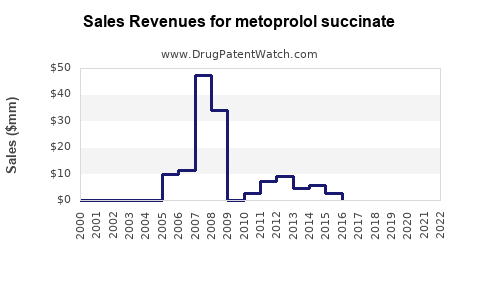
Global sales for metoprolol succinate reached approximately $2.5 billion in 2022. The compound annual growth is estimated at 3-4%, paralleling the generic beta-blocker market growth.
Regional projections:
| Region |
2022 Sales ($ millions) |
2026 Projected Sales ($ millions) |
CAGR |
| North America |
1,100 |
1,350 |
3.4% |
| Europe |
700 |
800 |
3.0% |
| Asia-Pacific |
400 |
580 |
10.6% |
| Rest of World |
300 |
440 |
10.9% |
The rapid growth in Asia-Pacific reflects increasing healthcare access, expanding insurance coverage, and rising cardiovascular disease prevalence.
What Are the Key Factors Impacting Future Sales?
- Patent Expirations: The U.S. patent for Toprol-XL expired in 2007; for Europe, it expired around 2008. Generics now dominate, reducing prices.
- Regulatory Approvals: New formulations, extended-release tablets, and combination therapies can influence sales.
- Pricing Strategies: Price reductions due to generic competition impact revenue per unit.
- Market Penetration: Growth in developing markets through subgroup expansion (e.g., hypertensive patients aged under 45) offers sales opportunities.
What Are the Risks and Opportunities?
Risks include the emergence of alternative therapies such as angiotensin receptor blockers (ARBs) or calcium channel blockers. Also, switching behaviors driven by insurance formulary changes can impact volume.
Opportunities arise from expanding indications—such as heart failure—and potential for fixed-dose combinations with other cardiovascular agents.
Summary of Sales Projection Methodology
Projections are based on:
- Historical sales data
- Market penetration rates
- Disease prevalence estimates
- Competitive landscape shifts
- Regulatory environment
Models incorporate conservative estimates of growth, adjusted for upcoming patent cliffs and generic competition.
Key Takeaways
- The global market for metoprolol succinate was approximately $2.5 billion in 2022, with steady growth expected through 2026.
- The U.S., Europe, and Asia-Pacific dominate, with significant growth prospects in emerging markets, especially Asia-Pacific.
- Generic competition reduces価格 but broadens access, supporting volume growth.
- Strategic factors include patent expirations, new formulation approvals, and shifting treatment guidelines.
FAQs
Q1: How will patent expirations affect metoprolol succinate sales?
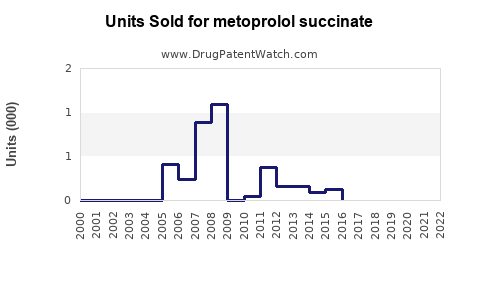
Patent expirations led to increased generic availability since 2008, decreasing prices but boosting volume. Continued generics expansion is expected to maintain sales growth, albeit at lower margins.
Q2: What are the primary therapeutic competitors to metoprolol succinate?
ARBs (e.g., losartan, valsartan), calcium channel blockers (e.g., amlodipine), and other beta-blockers (e.g., carvedilol) compete for similar indications.
Q3: Are there upcoming regulatory changes influencing sales?
Regulatory approvals for new formulations, extended-release versions, or combination therapies can expand indications or improve compliance, positively impacting sales.
Q4: What market segments are most promising for growth?
Developing markets in Asia-Pacific and expansion into heart failure treatment represent significant growth potential.
Q5: How does pricing influence growth prospects?
Price reductions due to generic competition limit revenue per unit but increase overall volume, supporting sales volume growth.
References
[1] World Health Organization. (2021). Cardiovascular diseases. https://www.who.int/news-room/fact-sheets/detail/cardiovascular-diseases