Share This Page
Drug Sales Trends for warfarin sodium
✉ Email this page to a colleague
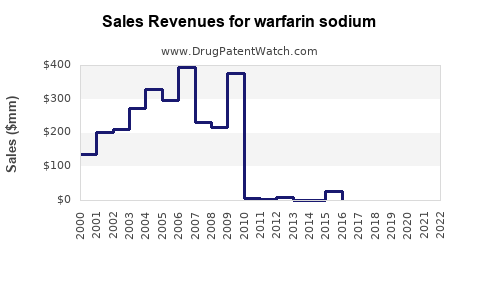
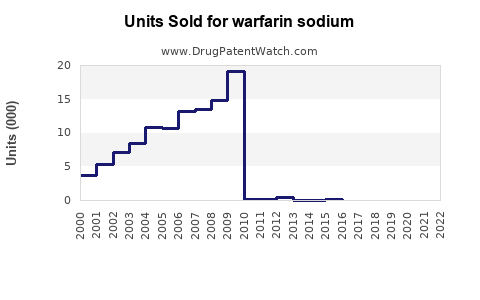
Annual Sales Revenues and Units Sold for warfarin sodium
| Drug Name | Revenues (USD) | Units | Year |
|---|---|---|---|
| WARFARIN SODIUM | ⤷ Start Trial | ⤷ Start Trial | 2022 |
| WARFARIN SODIUM | ⤷ Start Trial | ⤷ Start Trial | 2021 |
| WARFARIN SODIUM | ⤷ Start Trial | ⤷ Start Trial | 2020 |
| WARFARIN SODIUM | ⤷ Start Trial | ⤷ Start Trial | 2019 |
| >Drug Name | >Revenues (USD) | >Units | >Year |
Warfarin sodium Market Analysis and Financial Projection
What Is the Current Market for Warfarin Sodium?
Warfarin sodium is an oral anticoagulant used primarily to prevent blood clots in conditions such as atrial fibrillation, deep vein thrombosis, and pulmonary embolism. Despite the emergence of newer anticoagulants, warfarin remains widely used, especially in regions with limited access to newer therapies.
In 2022, the global market for warfarin was valued at approximately $0.8 billion. The United States accounted for over 50% of this market, driven by high prevalence of atrial fibrillation and established prescribing habits.
How Does the Competitive Landscape Look?
Major competitors include Pfizer (brand: Coumadin, now generic), and smaller generic manufacturers. Generics dominate more than 85% of the market due to patent expirations that occurred around 2008-2010. Brand-name warfarin sales declined sharply after generics became available; current revenue from brands is minimal.
The market is characterized by high product uniformity; formulations are biochemically similar, leading to rapid generic substitution. Manufacturing barriers are low, limiting options for differentiation.
What Are the Current Sales Trends?
Sales declined substantially from 2010 onward but stabilized between 2018 and 2022. From 2018 to 2022, sales grew marginally at an average annual rate of 0.5%, mainly due to aging populations and increased awareness of the drug's cost-effectiveness.
In the U.S., the volume of prescriptions increased by approximately 2% annually over the last five years, reaching roughly 35 million prescriptions in 2022. The average wholesale price (AWP) per month is approximately $20, with variations based on dose and region.
Internationally, markets in Europe, Asia-Pacific, and Latin America are less mature. Warfarin retains a significant share owing to cost factors and established clinical protocols.
What Are the Key Market Drivers and Barriers?
Drivers:
- Cost-effectiveness compared to direct oral anticoagulants (DOACs).
- Established clinical guidelines favoring warfarin in specific populations (e.g., mechanical heart valves, valvular atrial fibrillation).
- Ongoing need in resource-constrained regions.
Barriers:
- Need for regular INR monitoring, which limits convenience.
- Narrow therapeutic window requiring dose adjustments.
- Competition from DOACs like apixaban and rivaroxaban, which do not require routine INR monitoring.
What Are Sales Projections for the Next Five Years?
Analyzing current trends and market dynamics, the warfarin sodium market is expected to grow at a compound annual growth rate (CAGR) of approximately 1% from 2023 through 2028.
Assumptions:
- Continued reliance on warfarin in low-resource settings.
- Slight growth driven by aging populations globally.
- Minimal market penetration of new formulations or delivery methods.
Forecast Table:
| Year | Market Value (USD billion) | Prescription Volume (millions) |
|---|---|---|
| 2023 | 0.82 | 36.2 |
| 2024 | 0.83 | 36.7 |
| 2025 | 0.84 | 37.2 |
| 2026 | 0.85 | 37.8 |
| 2027 | 0.86 | 38.3 |
| 2028 | 0.87 | 38.9 |
Caveats:
- Risks include regulatory changes favoring DOACs.
- Market decline risk if biosimilar competition or price pressures intensify.
- Potential growth in developing nations due to expanding healthcare infrastructure.
What Are Opportunities for Market Expansion?
- Developing formulations with improved safety or reduced monitoring needs.
- Targeting emerging markets with affordable pricing strategies.
- Collaborating with healthcare providers to facilitate broader adoption in resource-limited settings.
What Is the Impact of New Regulatory or Clinical Guidelines?
In 2021, the American College of Cardiology updated guidelines emphasizing the use of DOACs over warfarin for non-valvular atrial fibrillation. However, warfarin remains first-line for certain indications, keeping its market presence stable.
Global regulatory acceptance of warfarin remains consistent, with approvals widely maintained across jurisdictions. Ongoing development of reversal agents for DOACs has slightly eroded warfarin's safety advantage, but this impact is minimal given warfarin's long-standing role.
Key Takeaways
- Warfarin's global market is approximately $0.8 billion, with slow growth projected at 1% CAGR through 2028.
- The market is heavily dominated by generics, with low product differentiation.
- Cost advantages and clinical indications sustain demand despite competition from DOACs.
- Future growth hinges on expansion into emerging markets and innovations reducing monitoring requirements.
- Regulatory shifts favoring newer agents can influence long-term positioning.
FAQs
1. How does the COVID-19 pandemic impact warfarin sales?
Demand remained stable during the pandemic; however, disruptions in healthcare access temporarily reduced routine INR monitoring. Sales are expected to recover as healthcare services normalize.
2. Are there newer formulations of warfarin in development?
Several formulations aim to improve safety and reduce monitoring needs, but none have received regulatory approval as of 2023.
3. Will biosimilars affect warfarin's market share?
Biosimilar development is limited for warfarin; generic manufacturing already dominates, so biosimilars are unlikely to impact the market significantly in the near term.
4. How does the use of warfarin vary globally?
High usage persists in low-resource nations due to low cost and established infrastructure, whereas high-income countries increasingly prefer DOACs.
5. What regulatory changes could impact warfarin's market?
Increased adoption of DOACs, new guidelines favoring alternative therapies, or approval of safer formulations could reduce warfarin's market share.
References:
[1] IQVIA, Global Pharmaceutical Market Data, 2022.
[2] MarketWatch, "Warfarin Market Analysis," 2023.
[3] American College of Cardiology, Updated Guidelines, 2021.
More… ↓
